

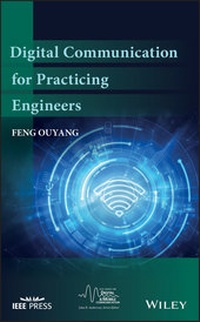
Digital Communication for Practicing Engineers
Description

This book presents the most relevant concepts and technologies of today's communication systems and presents them in a concise and intuitive manner. It covers advanced topics such as Orthogonal Frequency-Division Multiplexing (OFDM) and Multiple-Input Multiple-Output (MIMO) Technology, which are enabling technologies for modern communication systems such as WiFi (including the latest enhancements) and LTE-Advanced.
Following a brief introduction to the field, Digital Communication for Practicing Engineers immerses readers in the theories and technologies that engineers deal with. It starts off with Shannon Theorem and Information Theory, before moving on to basic modules of a communication system, including modulation, statistical detection, channel coding, synchronization, and equalization. The next part of the book discusses advanced topics such as OFDM and MIMO, and introduces several emerging technologies in the context of 5G cellular system radio interface. The book closes by outlining several current research areas in digital communications. In addition, this text:
* Breaks down the subject into self-contained lectures, which can be read individually or as a whole
* Focuses on the pros and cons of widely used techniques, while providing references for detailed mathematical analysis
* Follows the current technology trends, including advanced topics such as OFDM and MIMO
* Touches on content this is not usually contained in textbooks such as cyclo-stationary symbol timing recovery, adaptive self-interference canceler, and Tomlinson-Harashima precoder
* Includes many illustrations, homework problems, and examples
Digital Communication for Practicing Engineers is an ideal guide for graduate students and professionals in digital communication looking to understand, work with, and adapt to the current and future technology.
More details
Other editions
Additional editions
Person
FENG OUYANG, PHD, is a senior member of professional staff for Wireless Technology Analysis at the Johns Hopkins University Applied Physics Laboratory and an adjunct faculty member at the John Hopkins University Whiting School of Engineering. He was previously a technical manager at Conexant Systems and a staff member at Bell Labs. He has served as TPC member and session chair for IEEE MILCOM and IEEE Globecom. He earned his Ph.D. in Applied and Engineering Physics from Cornell University.
Content
Chapter 1 Introduction 1
1.1 Why this Book? 1
1.2 How to Use this Book 2
1.3 Scope 2
1.4 Roadmap 4
1.5 Other Notes 5
Acknowledgments 7
References 8
Chapter 2 Shannon Theorem and Information Theory 9
2.1 Introduction 9
2.2 Reliable Transmission with Noisy Channel 10
2.3 Entropy and Uncertainty 10
2.4 Entropy and Bit Length 14
2.5 Information Measured as Reduction of Uncertainty 18
2.6 Shannon Theorem 21
2.7 Additive White Gaussian Noise (AWGN) Channel 25
2.8 Frequency-Selective Channel and Water Filling 32
2.9 Summary 34
2.10 Appendix: Derivation of Entropy as a Measure of Uncertainty 34
2.11 Appendix: Compression Coding 38
References 43
Homework 43
Chapter 3 Single Carrier Modulation and Nyquist Sampling Theory 45
3.1 Introduction 45
3.2 Symbol Mapping 47
3.3 Nyquist-Shannon Sampling Theory 58
3.4 Pulse Shaping and Nyquist Criterion 69
3.5 Implementation of Pulse Shaping Filter: Up-Sampling 74
3.6 Baseband and Passband 76
3.7 Summary 85
3.8 Appendix: Fourier Transform 87
3.9 Appendix: Function Localization in Frequency and Time Domains 91
3.10 Appendix: Proof of the Nyquist Criterion 96
References 98
Homework 99
Chapter 4 Statistical Detection and Error Probability 101
4.1 Introduction 101
4.2 Wide-Sense Stationary (WSS) Process 102
4.3 AWGN Channel 108
4.4 Detection Problem and Maximum Likelihood Detection 115
4.5 Map and ML Detection with AWGN Channel 119
4.6 Matched Filter (MF) 122
4.7 Error Probability of Uncoded Modulations Under AWGN Model 137
4.8 Summary 146
4.9 Appendix: PSD of Modulated Signals 148
4.10 Appendix: Baseband Noise 151
4.11 Appendix: Representing Signals and Noises with Vectors 154
References 159
Homework 160
Chapter 5 Channel Coding 163
5.1 Introduction 163
5.2 Channel Coding or Forward Error Correction (FEC) 164
5.3 Block Code 169
5.4 Convolutional Code 182
5.5 Coding for Bandwidth-Limited Channels and Trellis-Coded Modulation (TCM) 203
5.6 Combined Codes 211
5.7 Turbo Code 213
5.8 Low-Density Parity-Check (LDPC) Code 225
5.9 Summary 231
5.10 Appendix: Upper Bound of Shaping Gain 233
5.11 Appendix: Probability Update at Parity Node 234
References 235
Homework 238
Chapter 6 Channel Characteristics 241
6.1 Introduction 241
6.2 Channel Gain and Channel Classification 243
6.3 Constant Flat Channels 246
6.4 Flat Fading Channel 252
6.5 Time Dispersion and Frequency-Selective Fading 262
6.6 Channel Formulation in Frequency and Time Domains 265
6.7 Channel Modeling Methods 270
6.8 Link Budget Computation 273
6.9 Summary 282
6.10 Appendix: Channel Gain in Passband and Baseband 284
References 286
Homework 288
Chapter 7 Synchronization 291
7.1 Introduction 291
7.2 Synchronization Overview 293
7.3 Timing Control and Correction 299
7.4 Timing Error Estimate 311
7.5 Initial Acquisition 325
7.6 Summary 328
References 329
Homework 330
Chapter 8 Adaptive Filter 333
8.1 Introduction 333
8.2 Adaptive Filter Overview 335
8.3 Optimal Solution 337
8.4 Iterative Solution: Speediest Descent (SD) 339
8.5 Sample-by-Sample Adaptation: Least Mean Squares (LMS) Algorithm 343
8.6 Block-Based Adaptation: Least Squares (LS) Algorithm 347
8.7 Block-Based Iteration: Recursive Least Squares (RLS) Algorithm 350
8.8 Case Study: Full-Duplex Radio and Self-Interference Cancellation 355
8.9 Summary 359
References 360
Homework 360
Chapter 9 Channel Equalization 363
9.1 Introduction 363
9.2 Channel Dispersion Formulation 365
9.3 Maximum Likelihood Sequence Estimation (MLSE) 370
9.4 Linear Equalizer (LE) 371
9.5 Decision Feedback Equalizer (DFE) 387
9.6 Tomlinson-Harashima Precoding (THP) 411
9.7 Fractionally Spaced Equalizers 419
9.8 Summary 420
9.9 Appendix: Z-Transform and Related Results 422
9.10 Appendix: Optimization of Functions with Complex Variables 431
9.11 Appendix: Optimal Solution of Zero Forcing Linear Equalizer 434
9.12 Appendix: Gain of an MMSE Equalizer 439
9.13 Appendix: Detailed Derivation of Finite-Length DFE 440
References 449
Homework 451
Chapter 10 Orthogonal Frequency Division Multiplexing (OFDM) 453
10.1 Introduction 453
10.2 OFDM Formulation 455
10.3 Time Domain Equalization 475
10.4 OFDM Advantages and Enhancements 477
10.5 Receiver Training and Adaptation 480
10.6 Implementation Issues 491
10.7 Orthogonal Frequency Division Multiple Access (OFDMA) 495
10.8 Filter Bank Multicarrier (FBMC) Modulation 497
10.9 Summary 499
References 500
Homework 504
Chapter 11 Multiple-Input Multiple-Output (MIMO) Technology 505
11.1 Introduction 505
11.2 MIMO Overview 506
11.3 A Simple Case of Mimo: Multibeam Transmission 507
11.4 Spatial Multiplexing: Bell Laboratories Layered Space-Time (BLAST) 518
11.5 Spatial Diversity: Space-Time Coding 525
11.6 Theoretical Treatments of MIMO Techniques 530
11.7 Other Forms of MIMO 543
11.8 Areas of Further Exploration 545
11.9 MIMO Applications 549
11.10 Summary 555
11.11 Appendix: Successive Cancellation (SC) Formulation 556
11.12 Appendix: Derivation of MIMO Channel Capacity for Fixed Channel 564
References 567
Homework 571
Chapter 12 5G Cellular System Radio Interface Technology 573
12.1 Introduction 573
12.2 Cellular Systems 573
12.3 The 5G System 578
12.4 Highlights of 3GPP Proposal 579
12.5 5G Physical Layer Technologies 583
12.6 Summary 606
References 607
Homework 614
Chapter 13 Closing Remarks and Further Exploration 615
13.1 Introduction 615
13.2 Analog Circuitry 615
13.3 Software-Defined Radio (SDR) 616
13.4 Cognitive Radio (CR) and Dynamic Spectrum Access (DSA) 617
13.5 Ultrawide Band (UWB) 620
13.6 Relaying and Cooperative Communications 620
13.7 Code Division Multiple Access (CDMA) 621
13.8 Interference Management 622
13.9 Other Modulation Schemes 623
13.10 Optical Communications 623
13.11 Green Communications 624
13.12 Applications of Artificial Intelligence (AI) 625
13.13 Application of Game Theory 625
13.14 Security 625
13.15 Network Coding 626
13.16 Summary 628
References 628
Index 637
CHAPTER 1
INTRODUCTION
1.1 WHY THIS BOOK?
This book is intended for practicing engineers in the digital communication field. It can be used as a textbook for master's level courses (e.g., for part-time professional education programs) or self-study. As such, the book has some unique characteristics comparing a typical textbook on the same subject.
A typical textbook strives to provide comprehensive and pedagogically sophisticated coverage of the concepts and theories. Such treatment makes it easier for the students to grasp key knowledge points. However, practicing engineers already have good general engineering knowledge and powerful self-learning skills. They need information sources that can be digested quickly. This book selects concepts and technologies that are most relevant to today's communication systems and presents them concisely and intuitively.
Instead of becoming well-versed in the entire field of digital communications, practicing engineers are more interested in getting knowledge on the specific subfields of their work. This book is organized as self-contained chapters. One can choose to read one or several relevant chapters, instead of the entire book.
Practicing engineers are more interested in applying existing techniques to their particular problems, rather than inventing new techniques. This book focuses on the pros and cons of broadly used techniques, rather than detailed mathematical analyses that may lead to discoveries. For example, on adaptive filtering, this book discusses in detail the tradeoff between performance and complexity of various methods and the tradeoff between convergence speed and final accuracy based on parameter choices.
Advanced topics such as orthogonal frequency division multiplexing (OFDM) and multiple-input multiple-output (MIMO), which are enabling technologies for modern communication systems such as WiFi and LTE-Advanced, are covered in more detail than usual (Chapters 10 and 11). This book also briefly describes other emerging technologies, some of which are adopted in the 5G cellular standards. These contents help practicing engineers follow the current technology trend.
This book also covers some contents that are usually out of scope for textbooks, such as cyclostationary symbol timing recovery (Chapter 7), adaptive self-interference canceller (Chapter 8), and Tomlinson-Harashima precoder (Chapter 9). These techniques are used in many popular communications systems and are therefore useful to practicing engineers.
In addition to practicing engineers, regular students of digital communications can benefit from this book's unique perspective and treatment, by using it as a primary or supplementary textbook.
1.2 HOW TO USE THIS BOOK
A textbook typically strikes a balance between details and suspense. Omitting some details in derivation and leaving some open questions help to keep the readers engaged and inspired. On the other hand, narrative gaps increase the difficulty in understanding. Since its targeted readers are likely to be self-studying without professors or peers available to answer questions, this book biases to providing more details and leaving fewer gaps. Some of the homework problems provide leads for further exploration and contemplation.
Another balance is between conceptual discourses and mathematical details. Since the book is designed for self-study, it is important to provide detailed derivations to important conclusions. On the other hand, these derivations may distract the readers from the thread of concept development. To address this concern, we mark the important mathematical results with solid-line frames. The readers may focus on the text and framed equations in the first pass. Detailed derivations contained in other equations can be revisited once the conceptual landscape is understood.
This book is based on the author's experience of teaching "Advanced Digital Communication Systems" at the master's level. In general, the material in each chapter is suitable for one 3-hour lecture. The exceptions are Chapters 5 and 9, which are suitable for two lectures each. Overall, this book is suitable for a master's level course of one semester, while some homework problems can be used as class projects.
1.3 SCOPE
1.3.1 The Physical Layer Transceiver
The prevailing Open Systems Interconnection (OSI) model divides a system into seven layers [1]. This book focuses on layer 1, known as the physical layer, or the PHY layer.
The PHY layer functions as a "bit pipe" of the system. A PHY transmitter takes bits from the upper layers and sends them through the physical medium (copper wire, fiber optics, electromagnetic waves, etc.) to the receiver. A PHY receiver recovers the bits and passes them to the upper layers. A transceiver is a combination of a transmitter and a receiver. The PHY layer is about point-to-point or point-to-multipoint (in the case of broadcast) connections, as opposed to a multi-hop network, which is the concern of the upper layers. The PHY layer transports bits from a transmitter to a receiver with a controlled error probability. The upper layers may perform other functionalities (such as retransmission) to achieve virtually error-free communication.
Figure 1.1 shows the general physical layer architecture of a transmitter/receiver pair. The "Bit Source" block at the transmitter side and the "Bit Output" block at the receiver side are interfaces to the upper layers. At the transmitter side, channel coding is applied to the data bits (Chapter 5) to enhance protection against random errors. Modulation is then performed to convert the bits into signals (i.e., time-varying voltages) (Chapter 3). The signal is then conditioned in various steps and transmitted through the physical medium, known as the channel (Chapters 3 and 4). At the receiver side, the signal is conditioned and demodulated to recover the encoded bits (Chapters 4, 8, and 9). Channel decoding is then performed to recover the data bits (Chapter 5), which is then passed to the upper layer. Chapters 10 and 11 cover more advanced modulation and demodulation techniques.
Figure 1.1 Physical layer architecture.
1.3.2 Prerequisites
This book is for master's level study. It assumes the readers have some training in electrical engineering and beginning digital communications [2]. For example, the readers should have basic knowledge about filters, shift registers, antennas, etc.
As to mathematics, the readers should have knowledge on statistics (Gaussian distribution and the Bayes' theorem), calculus, basic differential equations, linear algebra (especially eigenanalysis and singular value decomposition), and Fourier transform. Some mathematics topics are included in the appendices of the relevant chapters. Notably, Chapter 3 includes the formulation of the Fourier transform, which is also used in other chapters. These appendices intend to clarify conventions and notations, rather than teaching the knowledge from scratch. On the other hand, the required mathematics concepts and properties are very limited in this book. Readers can fill potential knowledge gaps by consulting other textbooks or online tutorials.
1.3.3 Topics Not Covered
This book focuses on advanced and practical topics in digital communications. Some topics such as analog modulation techniques and noncoherent detections are usually covered in the prerequisite courses [2] and are not repeated in this book. While covering basic concepts and techniques of digital communications, the book focuses on the mainstream commercial applications such as mobile cellular systems and wireless local area network (WLAN). Special applications such as underwater communications, satellite communications, military communications, and optical communications are not covered in this book.
This book is on point-to-point communications, that is, a single transmitter-receiver pair. The issue of access, that is, multiple users sharing a medium in coordinated or uncoordinated ways, is only briefly addressed in Chapters 10-13. Since the scope is limited to the PHY-layer, protocols and networking issues are not discussed.
Some of the uncovered topics are briefly discussed in Chapter 13.
1.4 ROADMAP
The book can be roughly divided into four parts.
The first part covers the basic techniques. It starts with Chapter 2, which introduces the foundation of modern digital communication theories: the Shannon theorem. In addition to guiding the development of channel coding, the Shannon theorem also provides some valuable insights into the practical case of white noise channels. Chapter 3 covers several techniques involved in the modulation process, which converts bits to symbols. These techniques include modulation, pulse shaping, and up-converting. They are based on various interesting mathematical concepts discussed in the chapter. Chapter 4 discusses the reverse process, that is, converting received symbols to bits. The chapter focuses on optimal demodulation theories and analyses of error probability. A detailed study of the additive white...
