

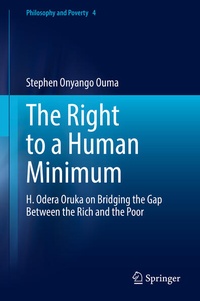
The Right to a Human Minimum
Description

This book provides a profound exploration of the concept of a "human minimum" as articulated by the renowned African philosopher H. Odera Oruka. It delves into the pressing issue of global inequality and examines how basic rights such as access to food, shelter, education, and healthcare are fundamental to human dignity and should be accessible to all, regardless of socioeconomic status. In a world where the gap between the rich and the poor continues to widen, Oruka's philosophical framework is a blueprint for addressing this divide. Through a critical analysis of Oruka's work, this book presents the philosophy of a "human minimum" and describes why basic rights are essential to ensuring justice, equity, and sustainable development. It contextualizes these ideas within contemporary challenges, including poverty, unemployment, and the global disparities exacerbated by economic systems that favor wealth accumulation by the few.
This exploration pushes beyond abstract theory, offering practical insights into policy solutions and societal structures that can uphold the dignity of every individual. It argues that achieving this requires not only ethical responsibility but systemic change in political and economic structures. By rethinking development, governance, and social justice through the lens of Oruka's philosophy, the book presents a compelling case for policies and actions that guarantee the human minimum for all. This book is of interest to scholars of philosophy, social justice advocates, policymakers, and anyone committed to addressing global inequality. It provides a roadmap for how societies can move toward a more equitable future.
More details
Other editions
Additional editions
Person
Stephen Onyango Ouma is a Kenyan philosopher and author. He currently serves as the Editor-in-Chief and Publications Manager at the Consolata Institute of Philosophy (CIP), where he also lectures. In addition, he holds lecturing positions at Tangaza University, Maasai Mara University, and Marist International University College. His scholarly work is rooted in the philosophical interpretation of diverse cultural phenomena across Africa and beyond, with a primary specialization in African Studies and philosophy.
Content
Chapter 1. Oruka's Concept Of The Right To A Human Minimum.- Chapter 2. Oruka's Biographical Background And His Concept Of Sagacity In Practical Philosophy.- Chapter 3. Human Minimum And The Spirit Of Ubuntu.- Chapter 4. Human Minimum And Inequality.- Chapter 5. H. Odera Oruka On Moral Reasoning.
