

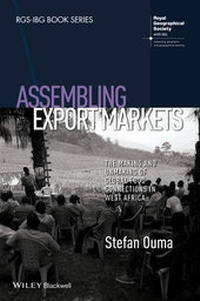
Assembling Export Markets
Description

Reviews / Votes
USA: Annals of the American Association of Geographers Economic Geography Review of International Political Economy Socio-Economic Review ROW: African Affairs Transactions of the Institute of British Geographers Cambridge Journal for Regions, Economy and Society Development and Change Environment and Planning A Economy and Society Global Networks Globalizations Progress in Human Geography Journal of Agrarian Change Journal of Modern African Studies Science and Technology Studies 'In transparently clear prose, Stefan Ouma has written awonderfully rich empirical account of how global markets fortropical fruit are made both materially and institutionally at theintersection of very particular local sites. The book is anotherterrific example of the usefulness of the theory of economicperformativity that German economic geographers have increasinglyhoned and made their own.' -- Trevor Barnes, Department of Geography, University ofBritish Columbia 'In this provocative book, Ouma challenges theconventional wisdom of both market enthusiasts and critics. Throughinsights from across the social sciences, he shows how both marketinstitutions and the persons who perform them always emerge fromparticular messy historical circumstances, creating differentformats and distributions of power in different locations.Ouma's 'on the ground' study offers a new andimportant approach to understanding markets.' -- Lawrence Busch, Department of Sociology, Michigan StateUniversityMore details
Other editions
Additional editions
Person
Content
Series Editors' Preface viii
Preface ix
Technical Remarks xi
List of Figures xii
List of Tables xiii
Abbreviations xiv
1 Introduction: Struggling with "World Market Integration" 1
Rethinking Global Connections 6
Grounding Commodity Chains: Geographies of Marketization 9
Matters of Concern 14
The Practical Means of Marketization 15
Marketization as Proliferation 16
Of Frontier Regions and Borderlands 16
How This Book Unfolds 17
2 Querying Marketization 21
Studying Markets as Practical Accomplishments 23
Markets as Sociotechnical Agencements 25
"Problems" of Market?]Making 29
Exchanging Goods the "Right" Way 31
Qualified Objectifications 32
Detachment/Calculation 35
Singularizations 36
Knowing and Doing Markets 37
From Market Knowledge to Knowing Markets 38
Power in/through Markets 39
Formatting Market Encounters 42
The Order(ing) of Markets 44
Conclusion 49
3 Remaking "the Economy": Taking Ghanaian Horticulture to Global Markets 53
Models of Organizing "the Economy": From Macro to Micro 56
A Tale of Two Frontiers 59
Markets for Development: Organic Mangoes in Northern Ghana 60
Fresh from Farm: JIT Pineapple Markets 66
Sites of Attention 71
Conclusion 74
4 Critical Ethnographies of Marketization 77
Researching Markets in the Making 79
Outside/Inside "the Market" 81
"Reconstructing" Market Practices 85
Technicalities? 86
Knowledge Production: Heuristics and Limitations 88
After "the Field": Veni, Vidi, Vici? 90
Conclusion 92
5 The Birth of Global Agrifood Market Connections 94
Nothing Was Packaged for (High?]value) Export 97
Market Enrollment, Not Integration 98
The Messy Economics of Outgrowing 107
Market?]making as Boundary Work 108
Outflanking Nature? 113
The Terms of "World Market" Enrollment 115
Good(s) Connect(ions) 119
Having the "Right" Product 121
Performing the Audit Economy 122
Relational Properties of Competition 123
Ongoing Struggles for Retail Worth 124
The Orderings of JIT 125
Conclusion 126
6 Enacting Global Connections: The Making of World Market Agencies 131
Qualculating the Mango Tree 133
Indeterminate Framings of Worth 133
Struggling for the Agricola Oeconomicus 137
Responsibilizing/Autonomizing Farmers 140
Standardizing Market STAs 141
Standards and the Stubborn Social 147
Value/Power 149
Conclusion 151
7 Markets, Materiality, and (Anti?])Political Encounters 153
The Hidden Conditions of Global Markets 155
Powerful Valorimeters 157
Pricing, Returns, and Visible hands 159
Power Relations as Relations of Accounting 162
Accounting: Frontstage 165
Accounting: Backstage 166
Conclusion 171
8 Market Crises: When Things Fall Apart, or Won't Come Together 174
A Model in Crisis 177
MD2 Takes Over the Market, or How Goods Become Delegitimated 178
Trading Down in Times of Crisis 183
Currency and Capital Volatilities 183
When the Supply Base Disenrolls ... 184
Reassembling the Market Social? 187
Recalcitrant "Nature" and the Crisis of the Developmental Market 189
(Mis?])calculating "Nature" and other Surprises: Mango Trees as Precarious Commodities 191
Crisis Accounts 193
Regrouping 196
The Corporate Calculus of the Crisis 197
Fixing Yields: Contested Pathways of Qualification 198
Conclusion 201
9 Conclusion 205
Beyond Inclusion 209
"Market Modernity," Alternatives, Critique 212
Beyond Agrifood: Profanizing Marketization 213
References 215
Index 232
Chapter One
Introduction: Struggling with "World Market Integration"
It has become a familiar scene in Densu Valley, Aborobe district, southern Ghana: Trucks piled with fresh pineapples struggle through the rough rural terrain, making their way to the nearby processing facility of a multinational agribusiness company. Upon arrival, the fruits are sliced and packed, and flown "fresh from farm" and "just-in-time" to retailers in Europe, where an affluent and quality-conscious urban clientele would buy the little 200?g packages of pineapple chunks, making the farmers distant participants in the convenience food revolution.
For some time now, Densu Valley has been one of the new sites of the global agrifood economy. In the past, many farmers in the valley - until the 1950s a major cocoa-growing area, when all the plants were destroyed by disease - had mainly been involved in food crop production or had left to seek their fortunes in Ghana's sprawling cities, but it was in the late 1980s that a much more lucrative window of business opportunity opened. With European consumers hungry for fresh pineapples, some farmers and pioneer exporters ventured into pineapple production, which subsequently took off on a broad scale from the early 1990s onwards. However, "the market" was frequently deceitful, shaped by mistrust and uncertainty, with both exporters and farmers often being cheated by one another or by buyers in distant Europe, in a trade that was mainly organized around volatile spot-market relations. With the arrival of the exporter-processor Ton:go Fruits1 (TF) in the late 1990s, times seemed to change for a few chosen ones. Through its operations, some farmers were integrated into more tightly regulated, dynamic, and demanding supply chains via more solid contractual arrangements. Under close supervision of the company's agronomists and through its financial support, the farmers were introduced to the world of European retailers, with its demands for food safety, quality, freshness, supply chain management. Many farmers fared well with the just-in-time model. Their new riches materialized through the opening of shops and the construction of houses in the area, symbolizing the relative fortunes that a new class of "big-time farmers" (as they are known locally) had acquired through the blessings of international trade.
Depending on one's theoretical inclination, the integration of Densu Valley farmers into agrobusiness supply chains may be seen through very different prisms. In their seminal work Living under Contract, Little and Watts (1994) conceived of the "world market integration" of farmers in the Global South through specific contractual relations with (often large) agribusiness companies as an industrial appropriation of selected rural activities, expressive of a new global regime of capital accumulation based on "global fresh" and the penetration of new agrarian frontiers (see also Friedmann 1993). In the same book, Watts (1994) reflected extensively and with impressive historical detail upon the social implications of contract farming in the rural South,2 arguing that through such a mode of market integration "[n]ominally independent growers retain the illusion of autonomy but have become in practice what Lenin called propertied proletarians, workers cultivating company crops on private allotments" (ibid.: 64). Watts' argument can be placed in a lineage with other political economy texts that have critically discussed how agribusiness operates and takes control over production in the Global South, and what role smallholder farmers (or "peasants") play in a globalized agrifood economy (Feder 1976; Bernstein 2010).
Agrarian political economy's critical stance towards "world market integration" and global capitalism more generally can be contrasted to the position of neoclassical economics and the policy descriptions derived from it. From the viewpoint of the World Bank economists who in the 1980s and 1990s urged the Ghanaian government to liberalize markets, attract foreign direct investments (FDI), and embrace export promotion strategies, the case of TF and its farmers might have been considered as nothing less than a success story. From the 1980s onward, the World Bank singled out the promotion of non-traditional exports (NTEs) as a new panacea for development, as prices for traditional commodities such as cocoa, coffee, and sugar were declining. As part of a new paradigm advocating "private-sector development with an emphasis on export-led growth, monetary and fiscal reform, and government deregulation in agricultural production and marketing" (Little & Dolan 2000: 63), countries like Ghana were promised a rosy future, given their comparative advantage with regard to land, labor, climate and proximity to European markets. As the World Bank (1993: 40) noted back then, "[a]ccelerated growth is predicated on a rapid integration of the Ghanaian economy into world markets, and Ghana has a comparative advantage in horticulture and (potentially) fruit and vegetable processing industries."
Indeed, TF invested in Ghana owing to the country's comparative advantages and a range of tax incentives the structurally adjusted Ghanaian state provided to foreign investors under a free zone model promoted by the World Bank - which some may consider ostensible proof that export promotion policies can attract precious FDI. The case also seems to provide striking evidence that the diversification of Ghana's economy, which since colonial times had relied upon the export of cocoa, minerals, and timber, is feasible. TF moved beyond the mere export of crude fruits by adding local value through processing, generating employment and transferring skills and knowledge to workers and suppliers alike. In this regard, the company also seems to have helped evade the trap of crude (low-value) exports, the yoke under which most export-oriented economies across sub-Saharan Africa had found themselves since colonial times.
Despite their different theoretical inclination and treatment of the consequences of "world market integration", the agrarian political economy and neoclassical take on markets do share a striking commonality. Implicitly, they both render the global market an "organismic totality" (Gibson-Graham 2006 [1996]: 98). Through scholarly abstraction, an essential, absolute economic entity with a self-evident quality is created.3 In these narratives, "the market" to varying degrees either features as a grand destructive or grand empowering force (and thus either as an object of critique or glorification), but it is rarely made an object of discussion in itself. While many critical political economy approaches often treat markets, and capitalism more generally, as abstract machines whose "dominance is guaranteed by a logic of profitability, a telos of expansion, an imperative of accumulation, a structure of ownership and control, or some other quality of feature [.]" (Gibson-Graham 2006 [1996]: 15), neoclassical economics in its various disguises does so by naturalizing and dehistoricizing them (see also Barnes 2005). By abstracting markets, these readings often unintentionally join tracks by black-boxing how markets (and "capital" more generally) come into being practically. Far from natural, smooth, or straightforward, this is often a contested, interrupted, and precarious process.
Many hundred miles north of Densu Valley, we encounter another frontier of the global agrifood economy. Since the late 1990s, a company, hereafter referred to as Organic Fruits Ltd. (OFL), has tried to create a market for organic mangoes in northern Ghana, a region where farmers had neither grown trees for export, nor trees under contract before. Where subsistence farming based on a slash and burn system is still the dominant mode of production, where rural land is largely held as a communal property, and daily life is deeply entangled with customary and religious values and forms of authority, market-making becomes a complex project. Ghana's north has always been marked by high incidences of poverty and food insecurity, having fared less well during Ghana's economic recovery that took shape in the 1980s. Having been structurally "underdeveloped" since colonial times, it has largely served as a labor reservoir for the cocoa, mining and urban economies in the country's south. A Ghanaian geographer attuned to critical political economy once described it as "a marginal, peripheral and 'distant' rural space in the context of capital accumulation" (Songsore 1989; cited in Kasanga 1995: 221). Choosing a different wording, even more liberal economists subscribe to such a diagnosis, arguing that the "high incidence of poverty in northern Ghana is [.] attributed to exclusion from trade" (Al-Hassan & Diao 2007: 5).
In both discourses on the developmental condition of northern Ghana, categories such as "marginal," "peripheral," "distant," and "excluded" are usually based on the idea that the market has a boundary, which, according to Mitchell (2007: 246-247), "is thought to separate the market from the large areas of material activity and...
