

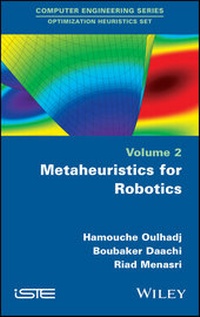
Metaheuristics for Robotics
Description

Through concrete examples and case studies particularly related to robotics this book outlines the essentials of what is needed to reformulate control laws into concrete optimization data.
The resolution approaches implemented as well as the results obtained are described in detail, in order to give, as much as possible, an idea of metaheuristics and their performance within the context of their application to robotics.
More details
Other editions
Additional editions
Persons
Boubaker Daachi is a Full Professor in Computer Science at the University of Paris 8, France. He is an Engineer in Computer Science and has a PhD in Robotics. His main research interests are in brain computer interfaces, biometrics, neurofeedback and robotics.
Riad Menasri is a Development Engineer at Assystem Technologies, France. Holding a Master's degree in Advanced Systems and Robotics and a PhD in Robotics, his main research interests are in optimization and trajectory planning for robotics applications.
Content
Introduction xiii
Chapter 1. Optimization: Theoretical Foundations and Methods 1
1.1. The formalization of an optimization problem 1
1.2. Constrained optimization methods 5
1.2.1. The method of Lagrange multipliers 9
1.2.2. Method of the quadratic penalization 11
1.2.3. Methods of interior penalties 12
1.2.4. Methods of exterior penalties 13
1.2.5. Augmented Lagrangian method 14
1.3. Classification of optimization methods 15
1.3.1. Deterministic methods 16
1.3.2. Stochastic methods 18
1.4. Conclusion 21
1.5. Bibliography 22
Chapter 2. Metaheuristics for Robotics 27
2.1. Introduction 27
2.2. Metaheuristics for trajectory planning problems 28
2.2.1. Path planning 29
2.2.2. Trajectory generation 43
2.3. Metaheuristics for automatic control problems 45
2.4. Conclusion 50
2.5. Bibliography 50
Chapter 3. Metaheuristics for Constrained and Unconstrained Trajectory Planning 53
3.1. Introduction 53
3.2. Obstacle avoidance 54
3.3. Bilevel optimization problem 58
3.4. Formulation of the trajectory planning problem 59
3.4.1. Objective functions 60
3.4.2. Constraints 62
3.5. Resolution with a bigenetic algorithm 63
3.6. Simulation with the model of the Neuromate robot 66
3.6.1. Geometric model of the Neuromate robot 67
3.6.2. Kinematic model of the Neuromate robot 71
3.6.3. Simulation results 72
3.7. Conclusion 83
3.8. Bibliography 83
Chapter 4. Metaheuristics for Trajectory Generation by Polynomial Interpolation 87
4.1. Introduction 87
4.2. Description of the problem addressed 88
4.3. Formalization 91
4.3.1. Criteria 91
4.3.2. Constraints 92
4.4. Resolution 94
4.4.1. Augmented Lagrangian 95
4.4.2. Genetic operators 97
4.4.3. Solution coding 99
4.5. Simulation results 100
4.6. Conclusion 116
4.7. Bibliography 118
Chapter 5. Particle Swarm Optimization for Exoskeleton Control 121
5.1. Introduction 121
5.2. The system and the problem under consideration 123
5.2.1. Representation and model of the system under consideration 123
5.2.2. The problem under consideration 125
5.3. Proposed control algorithm 126
5.3.1. The standard PSO algorithm 126
5.3.2. Proposed control approach 128
5.4. Experimental results 135
5.5. Conclusion 142
5.6. Bibliography 143
Conclusion 147
Index 153
Introduction
This work is part of a collection of books, published by ISTE and Wiley, devoted to metaheuristics and their applications. Known for being specific and particular algorithms, what practical interest do metaheuristics have to make them increasingly attractive to engineers, researchers and scientists from various areas interested in different fields of application? There are two important arguments that provide us with obvious answers: on the one hand, the scope of application of metaheuristics is constantly gaining momentum, without apparently being concerned with any limitations; on the other hand, these resolution methods possess a high level of abstraction, which makes them adaptable to a wide range of engineering problems. Furthermore, a small number of necessary adjustments that do not change the nature of algorithms are usually sufficient to solve new optimization problems without any particular links existing between them.
Moreover, metaheuristics belong to a particular class of algorithms, not always easy to configure and reserved for difficult optimization problems for which there are no accurate methods to solve them more efficiently. These problems are renowned for being complex and among them we can find problems whose mathematical models are not derivable; problems whose research space is too extended to exhaustively enumerate all feasible solutions, such as problems of a combinatorial nature or involving continuous decision variables; as well as any problem making use of highly noisy, erroneous or even incomplete data, which prove unsuitable for mathematical modeling. For all these categories of problems, we generally adopt approximated solutions belonging to the field of admissible solutions, which are capable of reaching a goal without violating constraints that might be a priori imposed.
In practice, there may be several existing solutions to an optimization problem, of which only one of these solutions is generally optimal. All others are suboptimal solutions, but are still eligible, so-called acceptable, solutions because they guarantee the completion of an objective without violating associated constraints. However, the notion of optimizing acceptability may appear to be overly abstract: how can the level of solution operability be identified when the level of appreciation of that solution may vary not only from one user to another, but also with the margin of error tolerated by each type of application? Clearly, there is no absolute answer to this question, because it is ultimately each individual who decides how to define the level of acceptability for a solution, based on individual needs and the quality of the results sought for the application to be addressed.
Are metaheuristics deterministic or stochastic algorithms? Providing a clear answer to this question is also not an easy task. In effect, while it is clear that metaheuristics are not deterministic algorithms, they are also not completely stochastic algorithms. In fact, they can be categorized halfway between these two families of algorithms, because solving an optimization problem by means of a metaheuristic systematically relies on a more or less random sampling process of the solution space. When the algorithm is started, chance plays an important role in the process of finding solutions. Then, as the iterations progress, this randomness is progressively attenuated as we approach the final phase of the algorithm. Therefore, a metaheuristic will behave as a stochastic algorithm during initial iterations, and will asymptotically tend towards a greedy and deterministic algorithm during the last iterations. As we might expect, the accuracy of a metaheuristic lies in the right balance to be found between exploration phases, in which chance plays an important role, and the phases of intensification of solutions, also called phases of exploitation, in which randomness is reduced in order to focus only on potentially promising solutions. At the moment, there is no automatic parameterization method for these two search phases, whose respective weights generally depend on the type of application under study, the type of computational effort to be sustained and the type of results sought after.
Today, metaheuristics have become almost unavoidable in numerous areas of engineering due to the difficulties that have to be overcome to properly solve common optimization problems. These difficulties generally lie in the complex nature of the systems under study: the number of constraints and decision variables to be taken into account can be very high, computational times can be very long and non-differentiable objective functions can be highly multimodal or even too complex to be mathematically formalized with accuracy. The field of robotics is by nature a very broad field of application. In fact, these very relevant algorithms can be found in many applications of robotics:
- - trajectory planning for mobile robots;
- - robust control of portable robots for motion assistance;
- - cooperation tasks between robots;
- - vision in robotics.
In this book, we will focus more specifically on using metaheuristics for solving trajectory planning problems for redundant manipulative arms, as well as automatic control problems involving collaborative robots for assistance. These studies are conducted with a view to eventually exploiting the results within a clinical framework, within the context of surgical or physical assistance in order to compensate for efforts or to increase motor capabilities in performing a task.
With regard to trajectory planning, the difficulties raised are related to the redundant nature of the robot being used (the manipulative arm with several degrees of freedom), the nature of the environment in which the robot evolves (the environment cluttered with obstacles, uncertainties about the environment, etc.) and of course the complexity of the task at hand (the level of accuracy required, the time allowed to perform this task, the amount of motor power needed in order to minimize consumed energy and avoid sudden movements which could deteriorate the mechanical structure of the robot). All of these parameters can induce an excessively high number of decision variables and constraints to be taken into account.
For the control of collaborative robots (force-feedback robots designed for physical assistance in carrying out a task), the complexity of the problem resides in the almost infinite number of combinatory solutions to be tested before finding the proper values of control parameters. These must provide the desired optimal effort, within a reasonable time frame, without anachronistic movements that could endanger the person under assistance or present a risk of resonance that could deteriorate the mechanical structure of the robot. Since the automatic control system is designed to operate in an uncertain and dynamic environment, the task becomes more complex due to the servo control that operates in real time, in order to take into account external disturbances and the permanent evolution of input data (setpoints) over time.
We underline that the optimization issues studied in this book have been the subject of research carried out in collaboration between university laboratories and hospitals. Despite the practical and experimental aspect of this work, the methods developed are generic overall and can be generalized to other areas of application without requiring significant changes in the structure of the algorithms. Given this last point, these methods might be of particular interest to a very wide audience including students of robotics, algorithmics, applied mathematics and operational research, as well as engineers or teachers/researchers whose work deals with difficult optimization problems.
This book is organized into five chapters.
Chapter 1 is a general study which reviews the mathematical foundations needed for modeling optimization problem in order to solve them using numerical methods. A list of basic methods can be found therein, including comments and a great deal of information about their characteristics and properties. This chapter is essential for understanding the approaches developed in the following chapters to solve more complex medical problems.
Chapter 2 focuses on the application of metaheuristics in optimization problems related to robotics. Particular emphasis is placed on issues related to the fields of trajectory planning and automatic control. The challenges encountered, the difficulties that have to be overcome and the pertinence of metaheuristics for their solution in an approximate but sufficiently effective manner are described with the utmost concern for clarity. Most common general algorithms within these two areas of application are also presented in detail.
Chapter 3 is dedicated to the specific problem of trajectory planning for redundant manipulative arms. A resolution method based on a bigenetic algorithm (two genetic algorithms running in parallel) is presented in this chapter. Inspired by two-tier optimization problems, this method distinguishes two planning spaces: the Cartesian space, in order to control and guide the movements of the effector (terminal organ of the manipulative arm) in the work environment, and the joint space, in order to operate the different segments of the motorized arm. The coordination of the movements of the robot within these two spaces is ensured by the collaboration of the two genetic algorithms. Each of these two algorithms uses its own decision variables and optimizes its own objective function by exploring its limited...
