

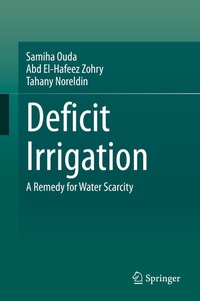
Deficit Irrigation
Description

This book focuses on proving that deficit irrigation could play an important role in increasing food production in times of water scarcity. Although the application of deficit irrigation can involve loss in crop productivity, it still secures water to be use in cultivating more lands and producing more food.
The following questions are discussed and the authors offer solutions to these problems:
Will the production, on a national level, resulting from these new added areas compensate yield losses attained by application of deficit irrigation?
Is it possible to use deficit irrigation practice to reduce the applied irrigation water to certain crops that have a surplus in their production, and direct this saved water to cultivate new areas with crops have low self-sufficiency ratios?
Under climate change in 2030, would deficit irrigation practice have the same role it plays under the current conditions?
This book will appeal to students and researchers involved with water scarcity and food security.
More details
Other editions
Additional editions
Persons
Professor Samiha Ouda had her BSc. from Cairo University in 1982 (Agricultural Economy Department), Egypt and her MSc from Ain Shams University in 1993 (Agronomy Department), Egypt. She had her PhD in 1998 from Iowa State University, USA (Crop Physiology and management). She had her professor appointment in 2009. Prof. Ouda have been working in the Agricultural Research Center in Water Requirements and Field Irrigation Research Department; Soils Water and Environment Institute; in Egypt for 28 years. She won three prizes: two of them local and the third one from International Commission on Irrigation and Drainage (ICID-CIID) in 2015. She published 88 research papers, 40 book chapters and 4 books on irrigation water management, modeling, crop simulation, agroclimatology, climate change impacts on crops and its water requirements. She supervised 4 Master and PhD theses on simulation models and climate change.
Professor Abd El-Hafeez Zohry have been working in the Agricultural Research Center for 28 years in Crops Intensification Research Department; Field Crops Research Institute; Agricultural Research Center in Egypt. He had his BSc from El-Minia University in Egypt in 1987 (General Agriculture Department) and his MSc from Al-Azhar University in 1990 in Egypt (Agronomy Department). He had his PhD in 1994 from Al-Azhar University (Crop Physiology and Production). He had his professor appointment in 2006. He published 39 research papers, 27 book chapters, 2 books and 4 extension bulletins on intensive cropping, and crop rotations. He supervised one MSc and one PhDs theses on intensive cropping. He won water innovation prize from International Commission on Irrigation and Drainage (ICID-CIID) in 2015.
Dr. Tahany Noreldin obtained her BSc, MSc. and PhD from College of Agriculture, Cairo University, Egypt (Agronomy Department) in 1998, 2005 and 2010, respectively. She have been working in Water Requirements and Field Irrigation Research Department; Soils Water and Environment Institute; Agricultural Research Center in Egypt for 7 years. She had her associated professor appointment in 2018. She published her MSc and PhD theses in two books. She contributed in authoring 2 books, 5 book chapters and 34 research papers on irrigation water management, modeling, crop simulation, agroclimatology, and climate change.
Content
Chapter 1: Water scarcity leads to food insecurity.- Chapter 2: Deficit irrigation and water conservation.- Chapter 3: Egypt faces water deficiency, and food insufficiency.- Chapter 4: Field crops and deficit irrigation in Egypt.- Chapter 5: Vegetable crops and deficit irrigation in Egypt.- Chapter 6: Wheat insufficiency and deficit irrigation.- Chapter 7: Climate change assessment in Egypt: A review.- Chapter 8: Climate change and wheat self-sufficiency.
