

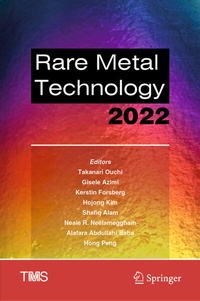
Rare Metal Technology 2022
1st Edition
Published on 2. February 2022
XVII, 353 pages
978-3-030-92662-5 (ISBN)
Description

This collection presents papers from a symposium on extraction of rare metals from primary and secondary materials and residues as well as rare extraction processing techniques used in metal production. Authors cover the extraction of less common or minor metals including elements such as antimony, bismuth, barium, beryllium, boron, calcium, chromium, gallium, germanium, hafnium, indium, manganese, molybdenum, platinum group metals, rare earth metals, rhenium, scandium, selenium, sodium, strontium, tantalum, tellurium, and tungsten. Contributions also discuss rare metals of low-tonnage sales compared to high-tonnage metals (iron, copper, nickel, lead, tin, zinc, or light metals such as aluminum, magnesium, or titanium and electronic metalloid silicon). Authors also cover biometallurgy, hydrometallurgy, and electrometallurgy while novel high-temperature processes such as microwave heating, solar-thermal reaction synthesis, and cold crucible synthesis of rare metals are addressed. Also included in this collection is the design of extraction equipment used in these processes from suppliers as well as laboratory and pilot plant studies.
More details
Series
Language
English
Place of publication
Cham
Switzerland
Publishing group
Springer International Publishing
Product notice
Reflowable
Illustrations
XVII, 353 p. 163 illus., 118 illus. in color.
File size
13,62 MB
ISBN-13
978-3-030-92662-5 (9783030926625)
DOI
10.1007/978-3-030-92662-5
Schweitzer Classification
Other editions
Additional editions
Takanari Ouchi | Gisele Azimi | Kerstin Forsberg
Rare Metal Technology 2022
Book
02/2022
Springer
€246.09
Shipment within 7-9 days
Persons
Takanari Ouchi, The University of Tokyo; Gisele Azimi, University of Toronto; Kerstin M. Forsberg, KTH Royal Institute of Technology; Hojong Kim, Pennsylvania State University; Shafiq Alam, University of Saskatchewan; Neale Neelameggham, IND LLC; Alafara Abdullahi Baba, University of Ilorin; Hong Peng, University of Queensland.
Content
- Intro
- Preface
- Contents
- About the Editors
- Part I Processes for Rare Earth Elements
- 1 Rare-Earth and Critical Material Recovery from Peralkaline Volcanic Ores: Minerals Processing, Hydrometallurgy, and Solvent Extraction Separation
- 2 Extraction of Cerium, Lanthanum, and Neodymium from Alluvial Gold Mining Waste from the Bagre-Nechí Mining District in Colombia
- 3 Rare-Earth Element Adsorption to Gypsum in Hydrometallurgical Processes
- 4 Low-Cost Distillation Technology for Rare-Earth Recycling
- 5 Extraction and Recovery of Rare-Earth Elements and Critical Materials from Coal Waste Using Low Cost Processing Methods: Acid Generation Using Acidithiobacillus Ferrooxidans Mediated Bio-Oxidation of Pyrite
- 6 Extraction of Rare Earth Metals from Coal Ash Using Mild Lixiviants in a Single Step Process
- 7 Separation of Scandium by Phosphinic Acid Extractant from Sulfuric Acid Solution
- Part II Solvent Extraction for Rare Metals
- 8 Physicochemistry in Service of Process Design: Case of Uranium Recovery by Liquid-Liquid Extraction
- 9 Solvent Extraction Separation of Tungsten and Vanadium from Simulated Leaching Solution of Spent SCR Catalyst
- 10 Extraction Behaviors of Vanadium(V) with Unacidified and Acidified N1923 from a Real Leachate of Vanadium-Titanomagnetite
- 11 Novel Environmentally Friendly Leaching Process for Vanadium and Tungsten Recovery from Spent SCR Catalyst
- 12 Effect of Antisolvent Type and Concentration on Morphology and Crystal Size of (NH4)³ScF6 Obtained by Antisolvent Crystallization
- 13 Purification of a Low-Grade Molybdenite Ore for Industrial Steel Production
- 14 Hydrometallurgical Extraction of Rhenium from Mo-Bearing Leach Liquor of Molybdenite Flue-Dusts
- 15 Extraction for Neodymium from NdFeB Magnet Using Supercritical Carbon Dioxide and Organophosphorus Ligands
- Part III New Extractant and Biometallurgical Processing
- 16 Development of New Extractants for Platinum Group Metal Ions in Hydrochloric Acid Solutions
- 17 Development of Antagonistic Solvent Extraction Systems for Selective Separation of Copper, Cobalt, and Nickel in Ammoniacal Solution
- 18 Study on Pre-removal Antimony from Antimony-Gold Concentrate Using Slurry Electrolysis
- 19 Bionanomining: A Revised Insight into Processing of South Africa's Complex Gold Ores
- 20 Research Progress in Biohydrometallurgy of Rare Metals and Heavy Nonferrous Metals with an Emphasis on China
- Part IV Process Development and Optimization for Rare Metals
- 21 A Highly Selective Metal-Organic Complex Collector for Efficient Mineral Flotation
- 22 Tellurium Recovery-Development of a Novel Hydrometallurgical Process
- 23 CO²-Optimized Recovery of Special Metals from Precipitation Residue by Selective Chlorination
- 24 Comprehensive Processing of Mica Concentrate from Yaroslavsky GRK for Lithium Carbonate, Potassium Sulfate, Aluminum Sulfate, Rubidium, and Cesium
- 25 Selective Sulfidation for Rare Earth Element Separation
- 26 Upgrading of Riruwai Cassiterite (Tin Ore) from Doguwa Local Government, North West Nigeria, Using Gravity Beneficiation Technique
- 27 Method for Producing High-Purity LiOH·H²O Using Ba(OH)²
- Part V Electrochemical Processing and High Temperature Processing
- 28 Direct Synthesis of Intermetallic Compounds Through Thermo-Reduction and Electrochemical Deposition
- 29 Development of Molten Salt Electrolysis of MgO Using a Metal Cathode and Vacuum Distillation to Produce Ultra-High Purity Mg Metal
- 30 Electrochemical Cell Design for Emf Measurements of Liquid Nd-Bi Alloys via Coulombic Titration in LiCl-KCl-NdCl³ Electrolyte
- 31 Two-Phase Rare-Earth Alloys as Reference Electrodes in Molten Chlorides for Reliable Electrochemical Measurements
- 32 Fundamental Study of a Novel Electrolytic Process Using a Cu Cathode in MgF²-LiF-KCl Molten Salt for Producing Mg Metal from MgO
- 33 Electrochemical Reduction of Iron Oxides in Aqueous NaOH Electrolyte Including Iron Residue from Nickel and Zinc Electrowinning Processes
- Author Index
- Subject Index
