

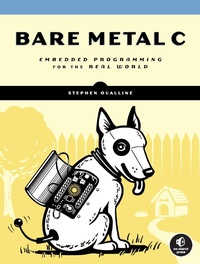
Bare Metal C
Embedded Programming for the Real World
Published on 19. July 2022
304 pages
978-1-7185-0163-8 (ISBN)
Description

Bare Metal C teaches you to program embedded systems with the C programming language. You'll learn how embedded programs interact with bare hardware directly, go behind the scenes with the compiler and linker, and learn C features that are important for programming regular computers.
Bare Metal C will teach you how to program embedded devices with the C programming language. For embedded system programmers who want precise and complete control over the system they are using, this book pulls back the curtain on what the compiler is doing for you so that you can see all the details of what's happening with your program.
The first part of the book teaches C basics with the aid of a low-cost, widely available bare metal system (the Nucleo Arm evaluation system), which gives you all the tools needed to perform basic embedded programming. As you progress through the book you'll learn how to integrate serial input/output (I/O) and interrupts into your programs. You'll also learn what the C compiler and linker do behind the scenes, so that you'll be better able to write more efficient programs that maximize limited memory. Finally, you'll learn how to use more complex, memory hungry C features like dynamic memory, file I/O, and floating-point numbers.
Topic coverage includes:
• The basic program creation process
• Simple GPIO programming (blink an LED)
• Writing serial device drivers
• The C linker and preprocessor
• Decision and control statements
• Numbers, arrays, pointers, strings, and complex data types
• Local variables and procedures
• Dynamic memory
• File and raw I/O
• Floating-point numbers
• Modular programming
Bare Metal C will teach you how to program embedded devices with the C programming language. For embedded system programmers who want precise and complete control over the system they are using, this book pulls back the curtain on what the compiler is doing for you so that you can see all the details of what's happening with your program.
The first part of the book teaches C basics with the aid of a low-cost, widely available bare metal system (the Nucleo Arm evaluation system), which gives you all the tools needed to perform basic embedded programming. As you progress through the book you'll learn how to integrate serial input/output (I/O) and interrupts into your programs. You'll also learn what the C compiler and linker do behind the scenes, so that you'll be better able to write more efficient programs that maximize limited memory. Finally, you'll learn how to use more complex, memory hungry C features like dynamic memory, file I/O, and floating-point numbers.
Topic coverage includes:
• The basic program creation process
• Simple GPIO programming (blink an LED)
• Writing serial device drivers
• The C linker and preprocessor
• Decision and control statements
• Numbers, arrays, pointers, strings, and complex data types
• Local variables and procedures
• Dynamic memory
• File and raw I/O
• Floating-point numbers
• Modular programming
More details
Other editions
Additional editions
Book
08/2022
No Starch Press
€59.50
Shipment within 3-4 weeks
Person
Steve Oualline wrote his first program when he was 11. It was for an
embedded system. He has been programming and designing
methodologies for reliable programming ever since. He has a Master of Science from USC and has written many books for both No Starch Press and O'Reilly.
embedded system. He has been programming and designing
methodologies for reliable programming ever since. He has a Master of Science from USC and has written many books for both No Starch Press and O'Reilly.
