

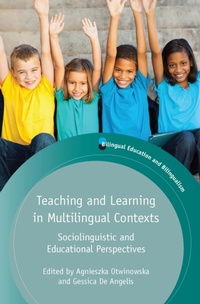
Teaching and Learning in Multilingual Contexts
Sociolinguistic and Educational Perspectives
Published on 6. January 2014
272 pages
978-1-78309-127-0 (ISBN)
Description

It is clearly illogical to search for one good, universal solution for multilingual education when educational contexts differ so widely due to demographic and social factors. The situation is further complicated by the motivations of learners and teachers, and by attitudes towards multilingualism and 'otherness'. The studies in this volume seek to investigate not only whether certain solutions and practices are 'good', but also when and for whom they make sense. The book covers a wide range of Western multilingual contexts, and uncovers common themes and practices, shared aims and preoccupations, and often similar solutions, within seemingly diverse contexts. In addition to chapters based on empirical data, this book offers theoretical contributions in the shape of a discussion of the appropriateness of L1-Ln terminology when discussing complex multilingual realities, and looks at how the age factor works in classroom settings.
Reviews / Votes
Given the growing number of multilinguals around the world (Hornberger, 2009), the insights and results contributed by the authors shape Teaching and Learning in Multilingual Contexts into a useful resource for a variety of audiences including language educators, sociolinguists, language policy planners, and others conducting research in the field of language pedagogy and multilingualism. -- Rachel Kraut, Rice University, USA; Heather Smyser, Defense Language Institute, USA; Zachary Brooks, University of Arizona, USA * Journal of Language, Identity & Education, 15:3, 194-197 * The articles collected in this book not only provide a sampling of the phenomenon of multilingualism in a fascinating variety of its manifestations, but in addition offer a wealth of thoughtful and well-motivated discussion of the implications of this diversity in theoretical and practical terms. -- David Singleton, University of Pannonia, Hungary and Fellow Emeritus, Trinity College, Dublin, Ireland This book is a very timely and important contribution to the rapidly growing field of multilingualism and multilingual education by putting an emphasis on novel perspectives of multilingual phenomena in education. The editors have managed to present a unique collection of papers focusing on different sociolinguistic settings of Canada and Europe (Austria, Croatia, Germany, Italy, Poland, Spain, Switzerland) which will stimulate multidimensional discussions in the academic community. -- Ulrike Jessner, University of Innsbruck, Austria, Current President of the International Association of Multilingualism On the whole, the editors and authors achieved their goal of developing a deeper understanding of what is involved in teaching and learning in multilingual contexts. The insights and results contributed by the authors shape "Teaching and Learning in Multilingual Contexts" into a useful resource for a variety of audiences including language educators, sociolinguists, language policy planners, and others conducting research in the field of language pedagogy and multilingualism. -- Rachel Kraut, Heather Smyser, and Zachary Brooks, The University of Arizona, USA in Journal of Language, Identity and EducationMore details
Series
Language
English
Place of publication
Bristol
United Kingdom
Publishing group
Channel View Publications Ltd
Target group
Professional and scholarly
ISBN-13
978-1-78309-127-0 (9781783091270)
Copyright in bibliographic data and cover images is held by Nielsen Book Services Limited or by the publishers or by their respective licensors: all rights reserved.
Schweitzer Classification
Other editions
Additional editions
Agnieszka Otwinowska | Gessica De Angelis
Teaching and Learning in Multilingual Contexts
Sociolinguistic and Educational Perspectives
Book
01/2014
Multilingual Matters
€48.40
Shipment within 10-20 days
Persons
Agnieszka Otwinowska is Assistant Professor at the Institute of English Studies, University of Warsaw, Poland. Her research interests include crosslinguistic influences, bilingual and multilingual language acquisition in children and adults, language teaching, bilingual education and CLIL. She is the co-editor of Teaching and Learning in Multilingual Contexts (with Gessica De Angelis, Multilingual Matters, 2014).
Gessica De Angelis works at the Centre for Language and Communication Studies, Trinity College, Dublin, Ireland. Her research focuses on multilingualism, language education, and second/third language acquisition. Her publications include New Trends in Crosslinguistic Influence and Multilingualism Research (2011, co-edited with J-M. Dewaele) and Third or Additional Language Acquisition (2007).
Gessica De Angelis works at the Centre for Language and Communication Studies, Trinity College, Dublin, Ireland. Her research focuses on multilingualism, language education, and second/third language acquisition. Her publications include New Trends in Crosslinguistic Influence and Multilingualism Research (2011, co-edited with J-M. Dewaele) and Third or Additional Language Acquisition (2007).
Content
Agnieszka Otwinowska and Gessica De Angelis: Introduction: Towards Education for Multilingualism
Part I: Multilingualism in Education: Conceptual Issues and Sociolinguistic Perspectives
1. Bjoern Hammarberg: Problems in Defining the Concepts of L1, L2 and L3
2. Hanna Komorowska: Analyzing Linguistic Landscapes. A Diachronic Study of Multilingualism in Poland
3. Julie S. Byrd Clark and Sylvie A. Lamoureux: Rethinking Multilingualism: Complex Identities, Representations, and Practices of Multilingual Student Teachers moving through Plurilingual Times in University French Language Teacher Education Programs
4. Laura Portoles Falomir: Analysing Prospective Teachers? Attitudes towards three Languages in two Different Sociolinguistic and Educational Settings
5. Katarzyna Cybulska and Visnja Kabalin Borenic: EFL Teacher Trainees and European Goals of Multilingualism and Plurilingualism. A Survey of Attitudes in Poland and Croatia
6. Tatjana Leichsering: Rethinking Urban Schools - a Sociolinguistic Analysis of Multilingual Environments in Frankfurt/m, Germany. Principles of Ascription, Categorization, Discourse and Language Proficiency
Part II: Students and Teachers in the Multilingual Classroom
7. Laura Sanchez: The Roles of Age on the Development of Written Competence in L4 English. Evidence from a Spanish/German CLIL Context.
8. Sandra Lucietto: The Role of External Consultancy in Supporting Multilingual CLIL teams and in Shaping School Pedagogical Culture. The case of S. Giacomo di Laives/St. Jakob Leifers (Italy)
9. Claudine Brohy, Philippe A. Genoud and Jean-Luc Gurtner: Discourse on Multilingualism, Language Competence, Use and Attitudes in German-English Bilingual Vocational Schools in Switzerland
10. Irena Horvatic Cajko: Developing Metalinguistic Awareness in L3 German Classrooms
11. Marta Csire and Johanna Laakso: L3, L1 or L0? Heritage Language-Students as Third-Language Learners
12. Agnieszka Otwinowska and Gessica De Angelis: Epilogue: Education for Multilingualism: From Political Discourse to Classroom Applications
Part I: Multilingualism in Education: Conceptual Issues and Sociolinguistic Perspectives
1. Bjoern Hammarberg: Problems in Defining the Concepts of L1, L2 and L3
2. Hanna Komorowska: Analyzing Linguistic Landscapes. A Diachronic Study of Multilingualism in Poland
3. Julie S. Byrd Clark and Sylvie A. Lamoureux: Rethinking Multilingualism: Complex Identities, Representations, and Practices of Multilingual Student Teachers moving through Plurilingual Times in University French Language Teacher Education Programs
4. Laura Portoles Falomir: Analysing Prospective Teachers? Attitudes towards three Languages in two Different Sociolinguistic and Educational Settings
5. Katarzyna Cybulska and Visnja Kabalin Borenic: EFL Teacher Trainees and European Goals of Multilingualism and Plurilingualism. A Survey of Attitudes in Poland and Croatia
6. Tatjana Leichsering: Rethinking Urban Schools - a Sociolinguistic Analysis of Multilingual Environments in Frankfurt/m, Germany. Principles of Ascription, Categorization, Discourse and Language Proficiency
Part II: Students and Teachers in the Multilingual Classroom
7. Laura Sanchez: The Roles of Age on the Development of Written Competence in L4 English. Evidence from a Spanish/German CLIL Context.
8. Sandra Lucietto: The Role of External Consultancy in Supporting Multilingual CLIL teams and in Shaping School Pedagogical Culture. The case of S. Giacomo di Laives/St. Jakob Leifers (Italy)
9. Claudine Brohy, Philippe A. Genoud and Jean-Luc Gurtner: Discourse on Multilingualism, Language Competence, Use and Attitudes in German-English Bilingual Vocational Schools in Switzerland
10. Irena Horvatic Cajko: Developing Metalinguistic Awareness in L3 German Classrooms
11. Marta Csire and Johanna Laakso: L3, L1 or L0? Heritage Language-Students as Third-Language Learners
12. Agnieszka Otwinowska and Gessica De Angelis: Epilogue: Education for Multilingualism: From Political Discourse to Classroom Applications
