

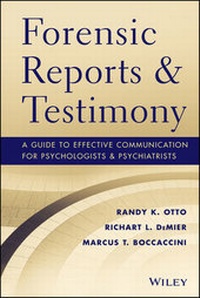
Forensic Reports and Testimony
A Guide to Effective Communication for Psychologists and Psychiatrists
Published on 21. August 2014
400 pages
978-1-118-41904-5 (ISBN)
Description

Forensic Reports & Testimony: A Guide to EffectiveCommunication for Psychologists and Psychiatrists provides aroadmap for the mental health professional who wants to provideconsistently accurate, defensible, and useful reports and testimonyto the legal system. Authors Randy K. Otto, Richart L. DeMier, andMarcus Boccaccini, recognized experts in the field, cover allaspects of the process, including preparing affidavits and reports,preparing for depositions, and testifying.
Every written or spoken communication for the courts must beclear and precise, and distinguish between facts, inferences, andopinions. This book uniquely:
*Shows the critical differences between forensicpsychological reports and the clinical reports psychologists andpsychiatrists are accustomed to writing
*Includes and explains important maxims of forensic reportwriting, including separating facts from inferences, focusing onoffering expert opinions, explaining why you think what you think,and connecting the dots between facts and conclusions
*Provides numerous examples of experts' testimony,affidavits, reports-with commentary and critiques
Expert forensic work deserves to be presented in a clear,precise, and understandable way so that it is useful to attorneys,judges, and juries. Forensic Reports & Testimonyprovides the guidelines and models forensic psychologists andforensic psychiatrists need to make that happen.
Every written or spoken communication for the courts must beclear and precise, and distinguish between facts, inferences, andopinions. This book uniquely:
*Shows the critical differences between forensicpsychological reports and the clinical reports psychologists andpsychiatrists are accustomed to writing
*Includes and explains important maxims of forensic reportwriting, including separating facts from inferences, focusing onoffering expert opinions, explaining why you think what you think,and connecting the dots between facts and conclusions
*Provides numerous examples of experts' testimony,affidavits, reports-with commentary and critiques
Expert forensic work deserves to be presented in a clear,precise, and understandable way so that it is useful to attorneys,judges, and juries. Forensic Reports & Testimonyprovides the guidelines and models forensic psychologists andforensic psychiatrists need to make that happen.
More details
Other editions
Additional editions
Randy K. Otto | Richart DeMier | Marcus Boccaccini
Forensic Reports and Testimony
A Guide to Effective Communication for Psychologists and Psychiatrists
Book
10/2014
Wiley
€73.50
Shipment within 15-20 days
Persons
RANDY K. OTTO, PHD, ABPP, AssociateProfessor, Department of Mental Health Law & Policy at theUniversity of South is board certified in forensic psychology andclinical psychology by the American Board of ProfessionalPsychology. He has served as President of the American Board ofProfessional Psychology, the American Psychology-Law Society, theAmerican Board of Forensic Psychology, and the American Academy ofForensic Psychology.
RICHART L. DEMIER, PHD,ABPP, is board certified in forensic psychology by the AmericanBoard of Professional Psychology. He is retired from the U.S.Medical Center for Federal Prisoners, where he conducted forensicevaluations and served as Director of Clinical Training for thefacility's internship and postdoctoral fellowship programs.He is currently the Director of Clinical Training at the School ofProfessional Psychology at Forest Institute, in Springfield,Missouri.
MARCUS T. BOCCACCINI, PHD, Professor,Department of Psychology and Philosophy at Sam Houston StateUniversity in Huntsville, Texas has published more than 75 articlesrelating to the intersection of psychology and the legal system.His research focuses on agreement among expert witnesses and fieldresearch in forensic psychology.
RICHART L. DEMIER, PHD,ABPP, is board certified in forensic psychology by the AmericanBoard of Professional Psychology. He is retired from the U.S.Medical Center for Federal Prisoners, where he conducted forensicevaluations and served as Director of Clinical Training for thefacility's internship and postdoctoral fellowship programs.He is currently the Director of Clinical Training at the School ofProfessional Psychology at Forest Institute, in Springfield,Missouri.
MARCUS T. BOCCACCINI, PHD, Professor,Department of Psychology and Philosophy at Sam Houston StateUniversity in Huntsville, Texas has published more than 75 articlesrelating to the intersection of psychology and the legal system.His research focuses on agreement among expert witnesses and fieldresearch in forensic psychology.
Content
Foreword
Thomas Grisso, Ph.D. vii
Preface xi
About the authors xv
Chapter 1 Introduction 1
Chapter 2 Functions of Forensic Reports 9
Chapter 3 Content of Forensic Reports 17
Chapter 4 Principles of Forensic Reports 34
Chapter 5 Structure of Forensic Reports 54
Chapter 6 Interrogatories, Affidavits, Declarations, Demonstrative Exhibits, and Demonstrative Aids 91
Chapter 7 Conceptual Issues Regarding Testimony 97
Chapter 8 Testifying at Depositions 118
Chapter 9 Testifying in Admissibility Hearings 129
Chapter 10 Pretrial Preparation 137
Chapter 11 Direct Examination 151
Chapter 12 Cross-Examination 171
Appendix A Sample Reports 223
Appendix B Sample Affidavits and Declaration 315
References 341
Author Index 355
Subject Index 361
Thomas Grisso, Ph.D. vii
Preface xi
About the authors xv
Chapter 1 Introduction 1
Chapter 2 Functions of Forensic Reports 9
Chapter 3 Content of Forensic Reports 17
Chapter 4 Principles of Forensic Reports 34
Chapter 5 Structure of Forensic Reports 54
Chapter 6 Interrogatories, Affidavits, Declarations, Demonstrative Exhibits, and Demonstrative Aids 91
Chapter 7 Conceptual Issues Regarding Testimony 97
Chapter 8 Testifying at Depositions 118
Chapter 9 Testifying in Admissibility Hearings 129
Chapter 10 Pretrial Preparation 137
Chapter 11 Direct Examination 151
Chapter 12 Cross-Examination 171
Appendix A Sample Reports 223
Appendix B Sample Affidavits and Declaration 315
References 341
Author Index 355
Subject Index 361
