

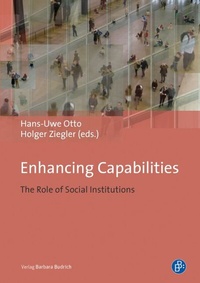
Enhancing Capabilities
The Role of Social Institutions
1st Edition
Published on 30. January 2013
235 pages
978-3-8474-0339-5 (ISBN)
Description

The volume suggests a capability perspective for evaluating welfare and educational policies. Capabilities are conceptualized as people's freedom to choose and conduct a life they have reason to value. The contributions of this volume analyze what social institutions - in particular in the field of education and welfare - may provide in order to enhance capabilities in particular for most vulnerable people.
More details
Language
English
Place of publication
Leverkusen-Opladen
Germany
Target group
College/higher education
Professional and scholarly
academics and professionals in education, social development, welfare and labor market policy, poverty research and social work
File size
3,72 MB
ISBN-13
978-3-8474-0339-5 (9783847403395)
Schweitzer Classification
Other editions
Additional editions
Book
01/2013
1st Edition
Verlag Barbara Budrich
€29.90
No shipping information available
Persons
Content
- Intro
- Enhancing Capabilities
- Content
- Introduction: Enhancing Capabilities - The Role of Social Institutions
- Part I - Welfare
- Connecting 'Human' and 'Social' Discourses: The Human Development, Human Security, and Social Quality Approaches
- Introduction
- The Human Development and Human Security Discourses
- The Social Quality Approach: Historical Background and Current State of Theory
- Conclusions and Suggestions for Future Work
- References
- Implications for a Capability-based Social Policy - A European Perspective
- 1. Components of the CA
- 2. A normative task
- 3. Social policy from a capabilities perspective
- 4. Some conclusions
- References
- The Local Dimension in Labour Market Policies: Promoting Autonomy or Enforcing Compliance?
- 1. The emergence of new patterns of public action and its significance
- 2. An alternative analytical and normative framework: capability for voice
- 3. Implementing Active Labour Market Policies: the Swiss unemployment insurance
- 4. Conclusion
- References
- Enabling local actors in labour market policy in Germany - lessons from a case study on the reintegration of disadvantaged youth
- 1. Central steering in labour market policy and the governance-based constraints on local actors
- 2. The capability approach's perspective on institutions as social conversion factors
- 3. The project "Neukölln-Aktiv" - an example of good practice in the sense of the capability approach
- 4. Institutional capabilities and the accountability of local actors
- 5. Summary and conclusions
- References
- Governmental Poverty and Wealth Reporting based on the Capability Approach
- 1. The Official German Poverty and Wealth Reporting System
- 2. The UK Equalities and Human Rights Commission Measurement Framework
- 3. CA-based reporting on poverty and wealth: a preliminary evaluation
- 4. Conclusion
- References
- Part II - Education
- Subjectivity, Education and Capabilities - Education ('Bildung') as an essential Dimension of Welfare Politics which are aimed at enhancing Capabilities
- Preliminary remark
- 1. Education and the welfare state
- 2. Functionings and capabilities as social conditions for processes of Bildung, Bildung as a key dimension of developing and enhancing capabilities
- 3. The CA and its implicit theory of Bildung
- 4. Non-pedagogical conditions of Bildung
- 5. Conclusions
- References
- Constrained opportunities and principles of justice in action: The role of school actors in helping technical students finding a work experience
- 1. The difficulties to find a job experience
- 2. Private and public resources: the role of the parental network and the role of public actors
- 3. Practical egalitarianism. The balance between individual and collective responsibilities
- 4. Conclusion
- References
- Hidden Privatisation and its Impacts on Public Education
- Introduction
- What is hidden privatization? Terminology and practice
- Forms of endogenous privatization: schools as enterprises
- Forms of exogenous privatisation: private sector ineducation
- Global patterns of privatisation
- Impacts of privatisation
- Conclusion
- References
- Nussbaum's Capabilities, Gender Justice and Educational Transformations
- Illustrating gender in/justice and education
- Education capabilities
- Being free to choose to do and to be
- Nussbaum: a theory of education
- Some reservations
- Conclusion
- References
- Part III - Social Services
- Associations, Communities and Nations: The Solidarities and Services Sustaining Human Capabilities
- Social Care, Capabilities and Solidarity
- Why is the UK Different?
- Criticisms of these Developments
- Conclusions
- References
- Creative capabilities and community capacity
- The Capabilities Approach
- Capabilities and creativity
- Community as a source of social power
- Philadelphia's Cultural Assets and Capabilities
- Social stress and public health
- Ethnic and racial harassment
- Immigrants' Capability Challenge
- Conclusion
- References
- On the normative Foundation of Social Welfare - Capabilities as a Yardstick for Critical Social Work
- Introduction
- Critical Social Work as an Explicitly Normative Enterprise
- Normativity and Power
- Normativity and Social Work
- Traditions of Critical Social Work
- What equality?
- Yardsticks of Criticism - Possibilities for Flourishing and the Question of the Good Life
- Critical Social Work and the Capabilities Approach
- References
- Contributors
- Index
