

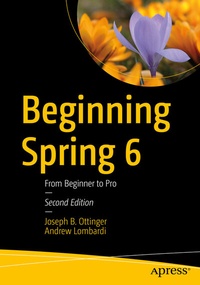
Beginning Spring 6
Description

This book will teach you how to use the Spring Framework to build Java-based applications, web applications, and microservices. Aimed at beginners, it has been revised and expanded to reflect the latest features and best practices for Spring 6.
Authors Joseph Ottinger and Andrew Lombardi will get you started using Spring Framework 6 and its ecosystem, walking you through all the best practices in modern application development. You'll see how Spring has drastically and positively affected the way applications are designed and programmed in Java, and how to build apps with the Spring mindset. Along the way, you will learn many aspects of the Spring ecosystem with easy-to-understand applications designed to teach you not only the technology, but also the practices that benefit the most from Spring. Starting with the basics, you'll learn gradually, including topics such as the configuration and declaration of beans, the application lifecycle, how todeploy a Spring application into a Java EE application, Spring Reactive, Spring Web, Spring Boot, and Spring Cloud.
After completing this book, you'll be prepared to develop your own scalable, modular Spring-based applications.
What You Will Learn
- Discover the most common use cases encountered in the real world
- Learn the proper way of testing with the Spring framework
- Create reliable, modular software
- Build skills that will translate well across all languages and environments
- Integrate and use data access and persistence frameworks such as Hibernate, JPA, and MongoDB
- Get started with the most common, most-used Spring features
Who This Book Is For
Those who are new to Spring or for those who have experience with Spring but want to learn what's new in Spring 6. This book assumes you have some prior coding experience inJava, but many core concepts in Java are discussed as they're encountered.More details
Other editions
Additional editions
Persons
Joseph B. Ottinger is a distributed systems architect with experience in many cloud platforms. He was the editor-in-chief of both Java Developer Journal and TheServerSide.com, and has also contributed to many, many publications, open source projects, and commercial projects over the years, using many different languages (but primarily Java, Python, and JavaScript). He's also a previously published author online (with too many publications to note individually) and in print, through Apress.
Andrew Lombardi is a veteran entrepreneur and software developer. His parents taught him to code while barely able to read on an Apple ][ he still wishes he had. He invented the Internet (suck it Al Gore) while drinking straight coffee and staring off into space. He's been running the consulting firm Mystic Coders for 24 years, authored a kick-ass book on Spring for Apress and WebSocket for O'Reilly, coding, speaking internationally andoffering technical guidance to companies as large as Walmart and companies with problems as interesting as helicopter simulation and social media. He firmly believes that the best thing he's done so far is being a great dad.
