

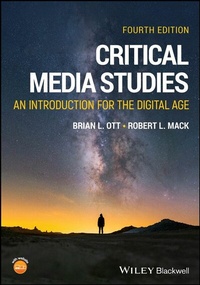
Critical Media Studies
Description

Master the critical tools for understanding media in today's fast-evolving digital landscape
Critical Media Studies: An Introduction for the Digital Age provides students with a powerful framework for analyzing the impact of media on knowledge, attitudes, and behaviors. In a world increasingly shaped by digital technologies and personalized information feeds, this leading textbook supplies the theoretical tools and knowledge to understand how media influence individuals and society.
With an interdisciplinary approach, Brian L. Ott and Robert L. Mack explore media's role as a powerful socializing force, addressing the key areas of media technologies, industries, messages, and audiences. Each section delves into distinct critical perspectives, such as Marxist, feminist, and queer analysis, alongside exclusive chapters on pragmatic and erotic approaches.
The fourth edition includes significant updates, including a detailed examination of the ecological impact of digital media and unique engagement with Byung-Chul Han's philosophy. Throughout this edition, revised chapters incorporate contemporary examples, cutting-edge pedagogical features, timely discussion of global trends, and much more.
Ideal for both undergraduate and graduate students, Critical Media Studies is perfect for courses in Media Studies, Communication, and Digital Media programs. Whether in introductory or advanced classes, students will find the text invaluable for fostering critical thinking, media literacy, and informed citizenship. Covering both introductory and advanced topics, it is also a valuable reference for scholars, media professionals, and those in communication-related fields.
More details
Other editions
Additional editions
Persons
BRIAN L. OTT is Distinguished Professor of Media and Communication at Missouri State University. He has been studying the interplay between rhetoric and media for more than 25 years, during which time he has authored more than 100 books, essays, and op-eds addressing the evolving nature of communication in the digital era. His insights have been featured in major publications such as The New York Times and The Washington Post.
ROBERT L. MACK is Associate Teaching Professor and Honors Faculty Fellow at Barrett, the Honors College at Arizona State University. In addition to teaching the college's signature seminar, The Human Event, he also specializes in media studies, rhetoric, and psychoanalysis. His research has been published in respected journals including Journal of the Fantastic in the Arts and The Journal of Religion and Communication.
Content
About the Authors vii
Preface ix
About the Companion Website xi
1 Introducing Critical Media Studies 1
Part I Media Technologies: An Ecological Perspective 29
2 Ecological Analysis 31
Part II Media Industries: Marxist, Organizational, and Pragmatic Perspectives 61
3 Marxist Analysis 63
4 Organizational Analysis 101
5 Pragmatic Analysis 131
Part III Media Messages: Rhetorical, Cultural, Psychoanalytic, Feminist, and Queer Perspectives 159
6 Rhetorical Analysis 161
7 Cultural Analysis 189
8 Psychoanalytic Analysis 219
9 Feminist Analysis 251
10 Queer Analysis 277
Part IV Media Audiences: Reception, Sociological, and Erotic Perspectives 307
11 Reception Analysis 309
12 Sociological Analysis 333
13 Erotic Analysis 357
14 Conclusion: The Partial Pachyderm 385
Appendix: Sample Student Essays 399
Glossary 431
Index 441
