

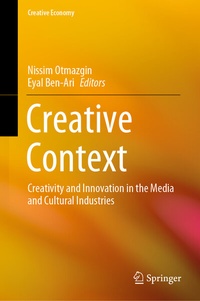
Creative Context
Description

The purpose of this volume is to broaden scholars' analytical perspective by placing the creative industries in frameworks that compare and contrast them with other kinds of entities, organizations, and social forms that mix creativity and production. In other words, this volume aims to set out an emerging agenda for the study of creativity in the cultural and media industries. Although this work focuses on the media and cultural industries, they are investigated in the context of other groups and organizations connecting forms of creativity with an explicit emphasis on turning ideas into concrete practices and products.
The originality of this book lies in (1) presenting a comparative and interdisciplinary perspective that develops a new framework and analytical concepts to understand the notion of creativity in the media and cultural industries, and (2) providing a series of fresh empirically based studies of the process of creativity in fields such as advertising, fashion, animation, and pop culture. This comparative move is taken in order to generate new insights about the particular features of the creative industries and new questions for future analysis.More details
Other editions
Additional editions
Persons
Eyal Ben-Ari is senior fellow of the Center for Society, Security and Peace at Kinneret College on the Sea of Galilee. He has carried out research in Israel, Japan, Singapore and Hong Kong. His main areas of research are the sociology of the armed forces, early childhood education, and popular culture in Asia. Among his recent books are Japanese Encounters (2018), (with Zev Lehrer, Uzi Ben-Shalom and Ariel Vainer) Rethinking the Sociology of Warfare (2010), (with Nissim Otmazgin) The State and Popular Culture in East Asia (2012), and (with Jessica Glicken Turnley and Kobi Michael) (2017) Social Science and Special Operations Forces . He has published articles spanning a variety of disciplines including the American Ethnologist , Cultural Anthropology , The Sociological Review , The Sociological Quarterly , Special Operations Journal , and the Journal of Strategic Studies .
Content
Preface.- Chapter 1 Creativity and Innovation in the Media and Cultural Industries: Setting an Agenda for Social and Human Sciences.- Chapter 2 Creative Activity under Attention Scarcity.- Chapter 3. "Outsourcing Taste: Are Algorithms Doing all the Work?.- Chapter 4 Embodied Social Dimensions in the Creative Process: Improvisation, Ethics and Gender in Choreography Classes in Israeli High-school Dance Programs.- Chapter 5 Creative Masses: Creative Exploitation and Corporate Success in Japan's Media Industries.- Chapter 6 Dilemma: Professional Identity Work among Tokyo-based Designers.- Chapter 7 Creativity at the Margins: the 'Golden Age' of Japanese Cinema (1945-1965).- Chapter 8 Several Things that We Know about Creativity: History, Biography and Affordances in Entrepreneurship.- Chapter 9 Rethinking Copyrights: The Impact of Copying on Cultural Creativity and Diversity.- Chapter 10 Tradition or Innovation? Creativity and Internationalisation in Kyoto's craft industries.
