

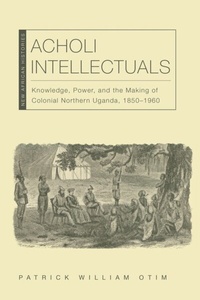
Acholi Intellectuals
Knowledge, Power, and the Making of Colonial Northern Uganda, 1850-1960
1st Edition
Published on 13. February 2024
277 pages
978-0-8214-4237-1 (ISBN)
Available for download
Description

Acholi Intellectuals draws on the writings of homespun historians, interviews with elderly men and women who remember the last days of colonial rule, and government and missionary archives to illuminate the intellectual and political history of the colonial transition in northern Uganda. The book focuses on Acholiland, a place that has been chronically understudied in comparison to Uganda's rich, fertile, and well-documented south. Southerners there-following the depictions of colonial officials and missionaries-have often regarded northerners as uncultured people lacking ideas. Acholi Intellectuals challenges this prejudice, bringing into view a whole category of men (and a few women) who mediated between indigenous and colonial knowledge systems and inaugurated a new kind of politics.
Patrick William Otim studies a category of people-known as healers, messengers, war leaders, poet-musicians, and diplomats-who possessed prestige and power in an older Acholi political logic and who, in the dawning days of colonial government, came to occupy positions of power in the British administration. Otim argues that these Acholi intellectuals were not simply creatures of British colonial self-interest; neither was their power invented by the coercive logic of indirect rule. He asserts instead that people who held moral and social power in the older system were able to transform that strength, under colonial administration, into a new form of political legitimacy.
Patrick William Otim studies a category of people-known as healers, messengers, war leaders, poet-musicians, and diplomats-who possessed prestige and power in an older Acholi political logic and who, in the dawning days of colonial government, came to occupy positions of power in the British administration. Otim argues that these Acholi intellectuals were not simply creatures of British colonial self-interest; neither was their power invented by the coercive logic of indirect rule. He asserts instead that people who held moral and social power in the older system were able to transform that strength, under colonial administration, into a new form of political legitimacy.
Reviews / Votes
A landmark study in African intellectual history. Patrick William Otim's Acholi Intellectuals puts the acquisition and deployment of erudition and skill at the center of the contradictions and ironies shaping this region's political-cultural history. In accessible prose and well-chosen detail, Otim demonstrates that complex networks of elder men and women cultivated skill and ambition among a small number of exceptional Africans who reinvented power in a fractious nineteenth century, a short colonial century of administration and bureaucracy, and a later twentieth century of nationalist frictions. - David Schoenbrun, Northwestern University Engagingly and intimately written, Acholi Intellectuals reveals how Acholi cultivated talent across a broad sweep of nineteenth and twentieth century East African history, and how historical actors both seized the opportunities and navigated the perils that successive political regimes offered. Focused on the lives of healers, war leaders, and royal messengers-who became clerks, translators, converts, writers, and elders-Patrick William Otim has written a masterful study that sets a new standard for the study of exemplary individuals in African history. - Daniel Magaziner, Yale University Patrick William Otim has written a fascinating, innovative, and meticulously documented account of Acholi history. He shows that intellectuals who played major roles before conquest worked to create an Acholi-inflected version of colonial society. We were mistaken to imagine that the most important post-conquest transformations revolved around chiefs. Instead, people who were already influential in the realm of symbolism and knowledge reimagined and recreated their own society. - Steven Feierman, University of Pennsylvania Patrick William Otim's definitive history of Acholi intellectuals analyzes their embodied knowledge, revealing their centrality in Acholiland's colonial history. Deeply researched, Otim's clear, engaging, and imaginative analysis interweaves rich sources and historiographies, yielding fresh critical insights on Acholi intellectuals' intermediary roles within Acholiland's politics. - Michelle Moyd, Michigan State University With this book, Patrick William Otim becomes a leader in rethinking Uganda's intellectual history. Drawing deeply from ethnographic and Acholi archival sources, Otim moves us beyond the political terrain of chiefs into the inner worlds of war leaders, royal messengers, public healers, poets, musicians, and aspiring historians. This work also manages to push Ugandan history writing beyond its obsession with kingdoms toward a more inclusive vision of republican history writing. Scholars and students of Ugandan and African political thought owe Otim a tremendous debt of gratitude. - Jonathon L. Earle, Centre College Patrick William Otim's evidence...refutes the division of African history into precolonial, colonial, and postcolonial periods....Otim's work invites historians of Africa to think again about history we thought we knew. - Holly Elisabeth Hanson, Mount Holyoke College "An important project ... an impressive achievement." - Joel Cabrita, author of Text and Authority in the South African Nazaretha ChurchMore details
Series
Language
English
Place of publication
Athens
United States
Target group
Professional and scholarly
Illustrations
10 black-and-white illustrations
ISBN-13
978-0-8214-4237-1 (9780821442371)
Copyright in bibliographic data and cover images is held by Nielsen Book Services Limited or by the publishers or by their respective licensors: all rights reserved.
Schweitzer Classification
Other editions
Additional editions
Patrick William Otim
Acholi Intellectuals
Knowledge, Power, and the Making of Colonial Northern Uganda, 1850-1960
Book
02/2024
Ohio University Press
€53.41
Shipment within 10-20 days
Book
03/2007
Ohio University Press
€49.70
Article not available at the moment
Person
Patrick William Otim is an associate professor of history at Bates College and affiliated faculty at the Africana Program. He is a historian of East Africa with a particular interest in northern Uganda. His work has appeared in the Journal of Eastern African Studies, Critical African Studies, International Journal of African Historical Studies, Canadian Journal of African Studies, History in Africa, and Stichproben-Vienna Journal of African Studies, among other places.
Content
List of Illustrations ix
Acknowledgments xi
Introduction The Forgotten Acholi Intellectuals 1
Chapter 1 Acholiland, 1850-1911: An Overview 27
Chapter 2 Power and Authority: The Making of Acholi Intellectuals 48
Chapter 3 The Roles of Court Officials: Acholi Intellectuals and the Functioning of Their Chiefdoms 75
Chapter 4 The Introduction of Christianity: Acholi Intellectuals and the Spread of the New Religion 101
Chapter 5 The Demise of the Old Order: Acholi Intellectuals and the Spread of Colonial Rule 141
Chapter 6 The Intellectual Lives of the Transitional Acholi, 1920s-1960 173
Epilogue The Destruction of Acholi Intellectuals 204
Glossary of Selected Local Terms 215
Source Abbreviations 219
Notes 221
Bibliography 267
Index 279
Acknowledgments xi
Introduction The Forgotten Acholi Intellectuals 1
Chapter 1 Acholiland, 1850-1911: An Overview 27
Chapter 2 Power and Authority: The Making of Acholi Intellectuals 48
Chapter 3 The Roles of Court Officials: Acholi Intellectuals and the Functioning of Their Chiefdoms 75
Chapter 4 The Introduction of Christianity: Acholi Intellectuals and the Spread of the New Religion 101
Chapter 5 The Demise of the Old Order: Acholi Intellectuals and the Spread of Colonial Rule 141
Chapter 6 The Intellectual Lives of the Transitional Acholi, 1920s-1960 173
Epilogue The Destruction of Acholi Intellectuals 204
Glossary of Selected Local Terms 215
Source Abbreviations 219
Notes 221
Bibliography 267
Index 279

