

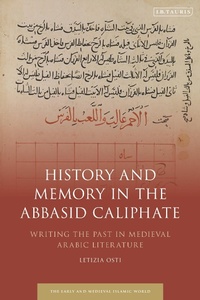
History and Memory in the Abbasid Caliphate
Writing the Past in Medieval Arabic Literature
1st Edition
Published on 19. May 2022
200 pages
978-1-83860-056-3 (ISBN)
Description

Abu Bakr al-Suli was an Abbasid polymath and table companion, as well as a legendary chess player. He was perhaps best known for his work on poetry and chancery, which would have a long-lasting influence on Arabic literature. His decades of service at the court of at least three caliphs give him a unique perspective as an historian of his own time, although he is often valued as an observer rather than an interpreter of events for posterity.
Letizia Osti here provides the first full-length English-language study devoted to al-Suli, illustrating how investigating the life, times and works of such a complex individual can serve as a fil rouge for tackling broader, contested concepts, such as biography, autobiography, court culture, and written culture. The result is an exploration of the ways in which the Abbasid court made sense of the past and, in general, of what 'historiography' means in a medieval Arabic context.
Letizia Osti here provides the first full-length English-language study devoted to al-Suli, illustrating how investigating the life, times and works of such a complex individual can serve as a fil rouge for tackling broader, contested concepts, such as biography, autobiography, court culture, and written culture. The result is an exploration of the ways in which the Abbasid court made sense of the past and, in general, of what 'historiography' means in a medieval Arabic context.
Reviews / Votes
[This book] is a tightly argued investigation of a court operative ... Readers who have followed Osti's previous studies on the Abbasids, the court, and writerly practices will find the book a satisfying read for its integration and focused discussion of crucial topics ranging from (auto)biography to finding aids in books. * American Historical Review * [Letizia Osti] has offered a convincing and balanced rehabilitation of al-Suli's reputation as a chronicler. * Journal of Islamic Studies * [Letizia Osti] has written a book that is both useful and a pleasure to read. Senior scholars and graduate students alike will find much here to inform their own research and reflection. * Bulletin of SOAS * Those interested in medieval Islamic history and historiography, especially students of the turbulent-albeit rich-fourth/tenth century, in addition to anyone studying al-Suli and his work, will find this book insightful and thought provoking. * Journal of the American Oriental Society * "History and Memory in the Abbasid Caliphate is an innovative contribution compelling the field to think differently about our historical sources. In rehabilitating al-Suli, Osti provides an important guide for how to approach other texts, presenting a rich and rewarding model for interpretation to which readers will want to return again and again." * John P. Turner, Colby College, USA * "Do the formats of early Arabic prose allow us to identify a writer's viewpoint? What is the role of poetry in Arabic historiography? In this detailed but succinct and accessible discussion of how we categorise and evaluate Arabic sources, Letizia Osti makes convincing use of concepts of autobiography and emplotment to explore al-Suli's textual strategies, and reappraises him radically as a historian of his own times." * Julia Bray, The Abdulaziz Saud AlBabtain Laudian Professor of Arabic, University of Oxford, UK * In this careful study Letizia Osti takes seriously the praise and criticism that her subject, Abu Bakr al-?uli (d. 335/947), has received through the ages, and comes down definitively in his defence. She argues convincingly that he was a thoughtful commentator on his life in the caliphal court and his time in history. Osti goes far beyond a "life-and-times" piece, however. She models how to work with the grain of the written material to craft something that is useful for scholars today... Letizia Osti has written a book that is both useful and a pleasure to read. Senior scholars and graduate students alike will find much here to inform their own research and reflection. * Bulletin of the School of Oriental and African Studies *More details
Series
Edition
1. Auflage
Language
English
Place of publication
London
United Kingdom
Publishing group
Bloomsbury Publishing PLC
Target group
College/higher education
ISBN-13
978-1-83860-056-3 (9781838600563)
Copyright in bibliographic data and cover images is held by Nielsen Book Services Limited or by the publishers or by their respective licensors: all rights reserved.
Schweitzer Classification
Other editions
Additional editions
Letizia Osti
History and Memory in the Abbasid Caliphate
Writing the Past in Medieval Arabic Literature
Book
12/2024
I.B. Tauris
€55.89
Shipment within 10-20 days
Letizia Osti
History and Memory in the Abbasid Caliphate
Writing the Past in Medieval Arabic Literature
Book
06/2022
I.B. Tauris
€133.70
Shipment within 3-4 weeks
Person
Letizia Osti is Associate Professor of Arabic Literature and Language at the University of Milan, Italy. She has been published in journals such as the Journal of Abbasid Studies, the Journal of Arabic and Islamic Studies and Middle Eastern Literatures is the co-author of Crisis and Continuity at the Abbasid Court (2013).
Content
Acknowledgements
Transliteration and Translation
Introduction
1. Life and Afterlife
2. In his own Words
3. In his own Time
4. In his own Books
5. Insight and Hindsight
Conclusion
Notes
Bibliography
Index
Transliteration and Translation
Introduction
1. Life and Afterlife
2. In his own Words
3. In his own Time
4. In his own Books
5. Insight and Hindsight
Conclusion
Notes
Bibliography
Index
