

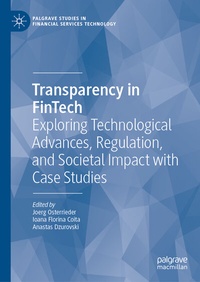
Transparency in FinTech
Description

This book investigates AI and FinTech from the angle of transparency. Assessing three specific parts, the books examines transparency as part of technological advances, regulation, and its societal impacts. While current developments offered by the Fifth Technological Revolution in terms of Artificial Intelligence and Machine Learning are revolutionizing FinTech and increasing the levels of transparency, there are arising issues such as taxation of platforms and regulation changes that must be examined. It discusses new tools and how they can be utilized for more transparent Fintech market segments through AI and ML. The book explores the impact of FinTech transparency, specifically on developing countries as compared to Europe, and will be of interest to scholars, researchers, and policymakers in financial technology and financial regulation.
More details
Other editions
Additional editions
Persons
Jörg Osterrieder is a Professor for Sustainable Finance at the BFH, Switzerland, and an Associate Professor for Finance and Artificial Intelligence at the University of Twente, Niederlande. He has been working for more than 15 years in the fields of financial statistics, quantitative finance, algorithmic trading and digitalization of the financial industry.
Ioana Florina Coita is a Lecturer of Machine Learning in Finance at University of Oradea Romania and University of Wroclaw in Poland. She also holds position in Finance at University of Economics in Bratislava Slovakia.
Anastas Dzurovski is Professor of Finance, Economics and Law at State University St. Kliment Ohridski in Bitola, North Macedonia. He also holds position at Faculty of Business Economics in Skopje.
Content
Chapter 1: Introduction.- Part I. Recent technological advances is selected Fintech Market segments.- Chapter 2: Integrating Health System Performance and Economic Stability: A Geospatial and AI-Driven Approach to Transparency in FinTech.- Chapter 3: Conceptual Framework for Assessing the Use of Artificial Intelligence in Wealth & Asset Management.- Chapter 4: Empowering Triple-Entry Accounting with Machine Learning and Blockchain: Unveiling Transparency Through Advanced Analytics.- Chapter 5: Fintech Regulations in Europe and in the USA. Balancing Innovation and Regulation: FinTech, Sandboxes, and EU Competition Law.- Part II. Regulatory perspective of technological advances' impact on Transparency in Fintech.- Chapter 6: Taxation of Crowdfunding Platforms.- Chapter 7: Playing by the rules: advances to prudential regulation and supervision of UK insurance startups and insurtech.- Part III. Societal perspective of Transparency in Fintech.- Chapter 8: Knowledge and use of Fintech Products by the young generations: a Zero inflated ordinal data model.- Chapter 9: Regional Fintech Report for Türkiye, Romania and Bulgaria.- Chapter 10: A Bibliometric Analysis of Transparency AI in Fintech with Emphasis on Gender Dynamics.- Part IV. Chapter 11: The Role of Transparency in Promoting Financial Inclusion.- Chapter 12: Transparency and Financial Governance.- Part V. The Future on Fintech Organizations and their Transparency.- Chapter 13: Conclusion.
