

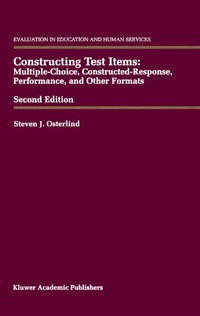
Constructing Test Items
Multiple-Choice, Constructed-Response, Performance and Other Formats
2nd Edition
Published on 17. December 2005
IX, 339 pages
978-0-306-47535-1 (ISBN)
Description

Constructing test items for standardized tests of achievement, ability, and aptitude is a task of enormous importance. The interpretability of a test's scores flows directly from the quality of its items and exercises. Concomitant with score interpretability is the notion that including only carefully crafted items on a test is the primary method by which the skilled test developer reduces unwanted error variance, or errors of measurement, and thereby increases a test score's reliability. The aim of this entire book is to increase the test constructor's awareness of this source of measurement error, and then to describe methods for identifying and minimizing it during item construction and later review.
Persons involved in assessment are keenly aware of the increased attention given to alternative formats for test items in recent years. Yet, in many writers' zeal to be `curriculum-relevant' or `authentic' or `realistic', the items are often developed seemingly without conscious thought to the interpretations that may be garnered from them. This book argues that the format for such alternative items and exercises also requires rigor in their construction and even offers some solutions, as one chapter is devoted to these alternative formats.
This book addresses major issues in constructing test items by focusing on four ideas. First, it describes the characteristics and functions of test items. A second feature of this book is the presentation of editorial guidelines for writing test items in all of the commonly used item formats, including constructed-response formats and performance tests.
A third aspect of this book is the presentation of methods for determining the quality of test items. Finally, this book presents a compendium of important issues about test items, including procedures for ordering items in a test, ethical and legal concerns over using copyrighted test items, item scoring schemes, computer-generateditems and more.
Persons involved in assessment are keenly aware of the increased attention given to alternative formats for test items in recent years. Yet, in many writers' zeal to be `curriculum-relevant' or `authentic' or `realistic', the items are often developed seemingly without conscious thought to the interpretations that may be garnered from them. This book argues that the format for such alternative items and exercises also requires rigor in their construction and even offers some solutions, as one chapter is devoted to these alternative formats.
This book addresses major issues in constructing test items by focusing on four ideas. First, it describes the characteristics and functions of test items. A second feature of this book is the presentation of editorial guidelines for writing test items in all of the commonly used item formats, including constructed-response formats and performance tests.
A third aspect of this book is the presentation of methods for determining the quality of test items. Finally, this book presents a compendium of important issues about test items, including procedures for ordering items in a test, ethical and legal concerns over using copyrighted test items, item scoring schemes, computer-generateditems and more.
More details
Other editions
Additional editions
Steven J. Osterlind
Constructing Test Items
Multiple-Choice, Constructed-Response, Performance and Other Formats
Book
10/2013
2nd Edition
Springer
€160.49
Shipment within 15-20 days
Steven J. Osterlind
Constructing Test Items
Multiple-Choice, Constructed-Response, Performance and Other Formats
Book
12/1997
2nd Edition
Kluwer Academic Publishers
€160.49
Shipment within 15-20 days
Content
What Is Constructing Test Items?.- Definition, Purpose, and Characteristics of Items.- Determining the Content for Items: Validity.- Starting to Write Items: Practical Considerations.- Style, Editorial, and Publication Guidelines for Items in the Multiple-choice Format.- Style, Editorial, and Publication Guidelines for Items in Constructed-response/Performance Formats.- Style, Editorial, and Publication Guidelines for Items in Other Common Formats.- Judging the Quality of Test Items: Item Analysis.- Ethical, Legal Considerations, and Final Remarks for Item Writers.
