

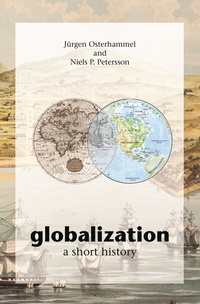
Globalization
A Short History
1st Edition
Published on 5. July 2021
200 pages
978-1-4008-2432-8 (ISBN)
Description

"Globalization" has become a popular buzzword for explaining today's world. The expression achieved terminological stardom in the 1990s and was soon embraced by the general public and integrated into numerous languages.
But is this much-discussed phenomenon really an invention of modern times? In this work, Jürgen Osterhammel and Niels Petersson make the case that globalization is not so new, after all. Arguing that the world did not turn "global" overnight, the book traces the emergence of globalization over the past seven or eight centuries. In fact, the authors write, the phenomenon can be traced back to early modern large-scale trading, for example, the silk trade between China and the Mediterranean region, the shipping routes between the Arabian Peninsula and India, and the more frequently traveled caravan routes of the Near East and North Africa--all conduits for people, goods, coins, artwork, and ideas.
Osterhammel and Petersson argue that the period from 1750 to 1880--an era characterized by the development of free trade and the long-distance impact of the industrial revolution--represented an important phase in the globalization phenomenon. Moreover, they demonstrate how globalization in the mid-twentieth century opened up the prospect of global destruction though nuclear war and ecological catastrophe. In the end, the authors write, today's globalization is part of a long-running transformation and has not ushered in a "global age" radically different from anything that came before.
This book will appeal to historians, economists, and anyone in the social sciences who is interested in the historical emergence of globalization.
But is this much-discussed phenomenon really an invention of modern times? In this work, Jürgen Osterhammel and Niels Petersson make the case that globalization is not so new, after all. Arguing that the world did not turn "global" overnight, the book traces the emergence of globalization over the past seven or eight centuries. In fact, the authors write, the phenomenon can be traced back to early modern large-scale trading, for example, the silk trade between China and the Mediterranean region, the shipping routes between the Arabian Peninsula and India, and the more frequently traveled caravan routes of the Near East and North Africa--all conduits for people, goods, coins, artwork, and ideas.
Osterhammel and Petersson argue that the period from 1750 to 1880--an era characterized by the development of free trade and the long-distance impact of the industrial revolution--represented an important phase in the globalization phenomenon. Moreover, they demonstrate how globalization in the mid-twentieth century opened up the prospect of global destruction though nuclear war and ecological catastrophe. In the end, the authors write, today's globalization is part of a long-running transformation and has not ushered in a "global age" radically different from anything that came before.
This book will appeal to historians, economists, and anyone in the social sciences who is interested in the historical emergence of globalization.
More details
Other editions
Additional editions
Book
08/2009
Princeton University Press
€31.50
Shipment within 10-20 days
Book
05/2005
Princeton University Press
€39.62
Article exhausted; check different version
Persons
Jürgen Osterhammel is Professor of Modern and Contemporary History at the University of Konstanz. He has published on modern Chinese history, imperialism, and the theory of history. Niels P. Petersson is Senior Lecturer in History at Sheffield Hallam University and has published on imperialism and economic history.
Content
- Cover Page
- Half-title Page
- Title Page
- Copyright Page
- Contents
- Preface
- I. "Globalization": Circumnavigating a Term
- A Diagnosis of the Present and a Term for a Historical Process
- The Core Concept and the Controversies
- II. The Dimensions of Globalization
- World System-Imperialism-Global History
- Networks and Interaction Spheres
- Historical Periods
- III. The Development and Establishment of Worldwide Connections Until 1750
- Long-distance Trade, Empires, Ecumenes
- Gunpowder Empires and Maritime Domains
- Holes in the Net
- IV. 1750-1880: Imperialism, Industrialization, and Free Trade
- Early World Politics and Atlantic Revolutions
- The Far-reaching Impact of the Industrial Revolution
- Empires and Nation-States
- The Emergence of a World Economy
- V. 1880-1945: Global Capitalism and Global Crises
- The Experience of Globality, Global Economy, and World Politics at the Turn of the Century
- Imperialism and World War
- 1918-1945: Global Crises and Conflicts
- The "American Century"
- VI. 1945 to the Mid-1970s: Globalization Split in Two
- Political Spaces: Power Blocs, Nation-States, and Transnational Movements
- The Institutions of the Global Economy
- Sociocultural Globalization?
- VII. Conclusion
- A New Millennium
- On the Road to a Global Age?
- Globalization: Putting the Concept into Perspective
- Notes
- Recommended Literature
- Index
