

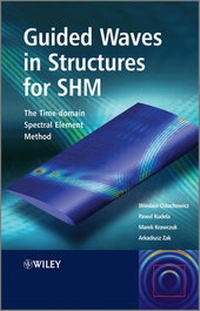
Guided Waves in Structures for SHM
Description

More details
Other editions
Additional editions
Persons
Wieslaw Ostachowicz, Pawel Kudela, Marek Krawczuk, Zak Arkadiusz, Polish Academy of Sciences, Poland
Wieslaw Ostachowicz is Professor and Head of the Department of Mechanics of Intelligent Structures in the Institute of Fluid Flow Machinery at the Polish Academy of Sciences. His research areas include structural health monitoring, vibration control and damage control, structural dynamics, smart materials and structures, composite structures and fracture mechanics. He is on the editorial boards of Composites Part B: Engineering, Strain, Mechanical Engineering Science, Smart Materials and Structures and Structural Health Monitoring. All three co-authors are are members of Professor Ostachowicz's research team within Institute of Fluid Flow Machinery at the Polish Academy of Sciences.
Pawel Kudela is a Ph.D. senior researcher at the Institute of Fluid Flow Machinery at the Polish Academy of Sciences.
Marek Krawczuk is Professor at the Institute of Fluid Flow Machinery at the Polish Academy of Sciences.
Arkadiusz Zak is an associate professor at the Institute of Fluid Machinery at the Polish Academy of Sciences.
Content
Preface ix
1 Introduction to the Theory of Elastic Waves 1
1.1 Elastic Waves 1
1.1.1 Longitudinal Waves (Compressional/Pressure/Primary/P Waves) 2
1.1.2 Shear Waves (Transverse/Secondary/S Waves) 2
1.1.3 Rayleigh Waves 3
1.1.4 Love Waves 4
1.1.5 Lamb Waves 4
1.2 Basic Definitions 5
1.3 Bulk Waves in Three-Dimensional Media 10
1.3.1 Isotropic Media 10
1.3.2 Christoffel Equations for Anisotropic Media 12
1.3.3 Potential Method 14
1.4 Plane Waves 15
1.4.1 Surface Waves 16
1.4.2 Derivation of Lamb Wave Equations 17
1.4.3 Numerical Solution of Rayleigh-Lamb Frequency Equations 26
1.4.4 Distribution of Displacements and Stresses for Various Frequencies of Lamb Waves 29
1.4.5 Shear Horizontal Waves 32
1.5 Wave Propagation in One-Dimensional Bodies of Circular Cross-Section 35
1.5.1 Equations of Motion 35
1.5.2 Longitudinal Waves 36
1.5.3 Solution of Pochhammer Frequency Equation 39
1.5.4 Torsional Waves 42
1.5.5 Flexural Waves 43
References 45
2 Spectral Finite Element Method 47
2.1 Shape Functions in the Spectral Finite Element Method 53
2.1.1 Lobatto Polynomials 54
2.1.2 Chebyshev Polynomials 56
2.1.3 Laguerre Polynomials 60
2.2 Approximating Displacement, Strain and Stress Fields 62
2.3 Equations of Motion of a Body Discretised Using Spectral Finite Elements 67
2.4 Computing Characteristic Matrices of Spectral Finite Elements 72
2.4.1 Lobatto Quadrature 75
2.4.2 Gauss Quadrature 76
2.4.3 Gauss-Laguerre Quadrature 78
2.5 Solving Equations of Motion of a Body Discretised Using Spectral Finite Elements 81
2.5.1 Forcing with an Harmonic Signal 82
2.5.2 Forcing with a Periodic Signal 83
2.5.3 Forcing with a Nonperiodic Signal 84
References 92
3 Three-Dimensional Laser Vibrometry 93
3.1 Review of Elastic Wave Generation Methods 94
3.1.1 Force Impulse Methods 94
3.1.2 Ultrasonic Methods 94
3.1.3 Methods Based on the Electromagnetic Effect 97
3.1.4 Methods Based on the Piezoelectric Effect 98
3.1.5 Methods Based on the Magnetostrictive Effect 102
3.1.6 Photothermal Methods 103
3.2 Review of Elastic Wave Registration Methods 104
3.2.1 Optical Methods 106
3.3 Laser Vibrometry 109
3.4 Analysis of Methods of Elastic Wave Generation and Registration 114
3.5 Exemplary Results of Research on Elastic Wave Propagation Using 3D Laser Scanning Vibrometry 116
References 121
4 One-Dimensional Structural Elements 125
4.1 Theories of Rods 125
4.2 Displacement Fields of Structural Rod Elements 127
4.3 Theories of Beams 133
4.4 Displacement Fields of Structural Beam Elements 135
4.5 Dispersion Curves 141
4.6 Certain Numerical Considerations 143
4.6.1 Natural Frequencies 144
4.6.2 Wave Propagation 147
4.7 Examples of Numerical Calculations 155
4.7.1 Propagation of Longitudinal Elastic Waves in a Cracked Rod 156
4.7.2 Propagation of Flexural Elastic Waves in a Rod 158
4.7.3 Propagation of Coupled Longitudinal and Flexural Elastic Waves in a Rod 162
References 164
5 Two-Dimensional Structural Elements 167
5.1 Theories of Membranes, Plates and Shells 167
5.2 Displacement Fields of Structural Membrane Elements 169
5.3 Displacement Fields of Structural Plate Elements 175
5.4 Displacement Fields of Structural Shell Elements 181
5.5 Certain Numerical Considerations 184
5.6 Examples of Numerical Calculations 189
5.6.1 Propagation of Elastic Waves in an Angle Bar 189
5.6.2 Propagation of Elastic Waves in a Half-Pipe Aluminium Shell 192
5.6.3 Propagation of Elastic Waves in an Aluminium Plate 195
References 198
6 Three-Dimensional Structural Elements 201
6.1 Solid Spectral Elements 202
6.2 Displacement Fields of Solid Structural Elements 202
6.2.1 Six-Mode Theory 202
6.2.2 Nine-Mode Theory 203
6.3 Certain Numerical Considerations 204
6.4 Modelling Electromechanical Coupling 208
6.4.1 Assumptions 213
6.4.2 Linear Constitutive Equations 213
6.4.3 Basic Equations of Motion 214
6.4.4 Static Condensation 215
6.4.5 Inducing Waves 216
6.4.6 Recording Waves 216
6.4.7 Electrical Boundary Conditions 216
6.5 Examples of Numerical Calculations 220
6.5.1 Propagation of Elastic Waves in a Half-Pipe Aluminium Shell 220
6.5.2 Propagation of Elastic Waves in an Isotropic Plate - Experimental Verification 222
6.6 Modelling the Bonding Layer 227
References 230
7 Detection, Localisation and Identification of Damage by Elastic Wave Propagation 233
7.1 Elastic Waves in Structural Health Monitoring 235
7.2 Methods of Damage Detection, Localisation and Identification 247
7.2.1 Energy Addition Method 253
7.2.2 Phased Array Method 255
7.2.3 Methods Employing Continuous Registration of Elastic Waves within the Analysed Area 263
7.2.4 Damage Identification Algorithms 266
7.3 Examples of Damage Localisation Methods 269
7.3.1 Localisation Algorithms Employing Sensor Networks 269
7.3.2 Algorithms Based on Full Field Measurements of Elastic Wave Propagation 275
References 288
Appendix: EWavePro Software 295
A.1 Introduction 295
A.2 Theoretical Background and Scope of Applicability (Computation Module) 296
A.3 Functional Structure and Software Environment (Pre- and Post-Processors) 298
A.4 Elastic Wave Propagation in a Wing Skin of an Unmanned Plane (UAV) 312
A.5 Elastic Wave Propagation in a Composite Panel 320
References 333
Index 335
