

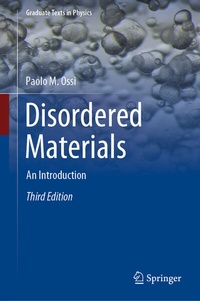
Disordered Materials
Description

This self-contained textbook takes readers on a comprehensive journey through the intricate realm of physics in structurally disordered condensed materials. Tailored for advanced undergraduate and graduate students, this book unfolds the complexities step by step.
In this updated and enlarged 3rd edition, fundamental building blocks serve as the foundation for constructing structural models of disordered solids, delving into their geometry and symmetry. The scope of the book encompasses the phenomenology and various models of the glass transition, elucidating the characteristics of bulk metallic glasses. Structural analysis techniques for amorphous solids, the role of atomic clusters in structure evolution, quasicrystals, nanometer-sized disordered solids, cluster-assembled materials, and the synthesis and assembly of nanoparticles are explored.
The text also navigates through the intricacies of transport and localization in heavily disordered materials, offering insights into controlled growth of thin films. Throughout, the narrative is enriched with references to recent and pertinent results, both experimental and theoretical, providing readers with a gateway to the latest and most dynamic research areas in the field.
Reviews / Votes
"This book provides a sequential introduction to the topics of order/disorder, issues of symmetry, and the complexity of materials, written in a style suitable for physics students who need to acquire the basics of the respective mathematical methods for theory and data interpretation." (Eugene Postnikov, zbMATH 1555.82003, 2025)
More details
Other editions
Additional editions
Previous edition
Person
Paolo M. Ossi is a full professor of Experimental Physics of Matter at the University of Messina and an adjunct professor at the Politecnico di Milano. He has authored or co-authored over 240 publications in scientific journals and thirteen invited book chapters. His notable books include "Disordered Materials - An Introduction" (Springer, Berlin, 2nd Ed., 2006; 3rd Ed., 2024) and "Plasmi per Superfici" (PoliPress, Milan, 2006, in Italian).
His research interests encompass the synthesis of nanoparticles in laser ablation-produced plasmas, the synthesis and optical properties of plasmonic surfaces and their applications in drug dosing in biological fluids and the sensing of chemical species, the interaction between UV radiation and snow (both natural and artificial), and innovative ski materials for alpine skiing.
He is also the author of the short novel "Ricreazione" (Robin Edizioni, 2017, in Italian). Additionally, he is a ski instructor specializing in alpine skiing, an athletics coach focused on speed, and a member of the Italian Alpine Club, Section Gressoney, and the Club of 4000.
