

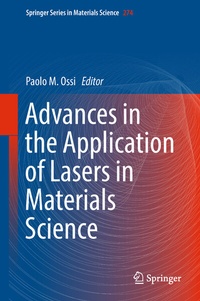
Advances in the Application of Lasers in Materials Science
Description

The book covers recent advances and progress in understanding both the fundamental science of lasers interactions in materials science, as well as a special emphasis on emerging applications enabled by the irradiation of materials by pulsed laser systems. The different chapters illustrate how, by careful control of the processing conditions, laser irradiation can result in efficient material synthesis, characterization, and fabrication at various length scales from atomically-thin 2D materials to microstructured periodic surface structures. This book serves as an excellent resource for all who employ lasers in materials science, spanning such different disciplines as photonics, photovoltaics, and sensing, to biomedical applications.
More details
Other editions
Additional editions
Person
Paolo M. Ossi is Associate Professor of Physics of Matter at the Politecnico di Milano. His main research interests include modeling the interaction between energetic beams (photons; particles) and solid surfaces, the controlled nanoparticle synthesis (oxides, transition and noble metals) by Pulsed Laser Deposition in dense gases and liquids, the growth and evolution under solar irradiation of snow nanocrystals (natural and artificial). He is author, or co-author of about 200 publications in International journals, numerous invited contributions to international volumes. He is co-editor of five books/proceedings. He authored the books Disordered Materials - An Introduction (Springer, Berlin, 2nd Ed., 2006) and Plasmi per Superfici (Polipress, Milano, 2006). He is holder of two patents and Co-Editor of the Springer Series Topics in Applied Physics.
Antonio Miotello is full professor of Experimental Physics at Trento University. His main research interests include microscopic processes involved in growth of thin films by using deposition techniques: Physical Vapor Deposition and Laser-Ablation, synthesis of nanoparticles of composite materials having catalytic properties for hydrolysis of chemical hydrides and development of related reactor chambers, synthesis of photocatalysts for water purification or splitting for hydrogen production with photolectrochemical cells, modeling the growth of nanostructures using Density Functional Theory and Monte Carlo simulation.
He is author, or co-author of more than 350 peer reviewed papers published in international journals and holder of two patents.
Maria Dinescu is Senior Scientist 1st degree, research group leader (Photonic Processing of Advanced Materials: ppam.inflpr.ro), National Institute for Lasers, Plasma and Radiation Physics (INFLPR), Bucharest, Romania. Her main research interests include Laser materials processing (Laser Induced forward transfer-LIFT, Matrix assisted pulsed laser evaporation (MAPLE), Pulsed laser deposition (PLD)), ferroelectrics, high k dielectrics, materials for energy. She is author or co-author of more than 250 peer reviewed papers published in international journals, 9 book chapters. She is co-editor of seven books/proceedings. She serves as Co-editor of Applied Surface Science.
David B. Geohegan is Distinguished Research Staff of Oak Ridge National Laboratory and Group Leader Functional Hybrid Materials at the Center for Nanophase Materials Sciences. He is a Fellow of the American Physical Society. His main research interests include understanding and controlling the synthesis of thin films and nanostructured materials through the development of time resolved laser spectroscopy and imaging diagnostic techniques; fundamental studies of growth mechanisms of single-walled carbon nanotubes and nanohorns, graphene and two-dimensional metal chalcogenide crystals, nanoparticles, inorganic and organic nanowires; laser interactions with materials for synthesis, characterization, and processing of nanoscale materials which exhibit new nanoscale properties; exploring the functionality of nanoscale materials for energy, including hydrogen storage, solid state lighting, and photovoltaics. He is author, or co-author, of more than 250 peer reviewed papers published in international journals and holder of seven patents.
