

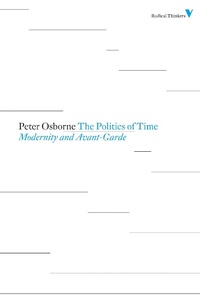
The Politics of Time
Modernity and Avant-Garde
Published on 5. May 2020
288 pages
978-1-78960-025-4 (ISBN)
Description

If Aristotle sought to understand time through change, might we not reverse the procedure and seek to understand change through time? Once we do this, argues Peter Osborne, it soon becomes clear that ideas such as avant-garde, modern, postmodern and tradition-which are usually only treated as markets for empirically discrete periods, movements or styles-are best understood as categories of historical totalization. More specifically, Osborne claims, such ideas involve distinct "temporalizations" of history, giving rise to conflicting politics of time.
His book begins with a consideration of the main aspects of modernity and develops though a series of critical engagements with the major twentieth-century positions in the philosophy of history. He concludes with a fascinating history of the avant-garde intervention into the temporality of everyday life in surrealism, the situationists and the work of Henri Lefebvre.
His book begins with a consideration of the main aspects of modernity and develops though a series of critical engagements with the major twentieth-century positions in the philosophy of history. He concludes with a fascinating history of the avant-garde intervention into the temporality of everyday life in surrealism, the situationists and the work of Henri Lefebvre.
More details
Series
Edition
Ebook UK & RoW
Language
English
Place of publication
London
United Kingdom
Target group
College/higher education
Professional and scholarly
US School Grade: College Freshman
Product notice
Reflowable
ISBN-13
978-1-78960-025-4 (9781789600254)
Copyright in bibliographic data and cover images is held by Nielsen Book Services Limited or by the publishers or by their respective licensors: all rights reserved.
Schweitzer Classification
Other editions
Additional editions
Book
01/2011
2nd Edition
Verso Books
€24.00
Shipment within 3-4 weeks
Person
Peter Osborne is Professor of Modern European Philosophy and Director of the Centre for Research in Modern European Philosophy (CRMEP), Kingston University London. He is a long-serving member of the editorial collective of Radical Philosophy. His books include The Politics of Time, Anywhere or Not At All, Philosophy in Cultural Theory, Conceptual Art and Marx.
Content
- Cover Page
- Title Page
- Copyright Page
- Contents
- Preface
- 1. Modernity: A Different Time
- Modernity as experience and misrecognition: Berman and Anderson
- From Neue Zeit to Neuzeit: Koselleck's historical semantics
- The quality of modernity: homogenization, differentiation and abstraction
- Modernity as project: Habermas, Foucault, Enlightenment
- Differential time and conjunctural analysis: Althusser and the Annales
- 2. One Time, One History?
- Conditions of possibility: the transcendental path
- Let history judge: the immanent road
- Difference against development
- Hegel's failure: end of history, end of time
- Time and Narrative: phenomenological ontology
- Present or instant? The time of the soul and the time of the world
- Historical time: ontology and narrative mediation
- Being-towards-death, being-towards-history
- Ordinary time or cosmological time? Nature and the social
- 3. Death and Recognition
- Being-there-with-others: the dialectic of recognition
- Trial by death
- From recognition to identification: Hegel and Lacan
- 'Afterwardsness' and the death drive
- Primary identification: Kristeva's imaginary father
- In the beginning was the bond: Jessica Benjamin or Jean Laplanche?
- Timelessness, death, and the unconscious
- Psychoanalysis, temporality, history
- 4. Modernity, Eternity, Tradition
- Exteriority and transcendence: Levinas's eschatology
- Outside or end? Totality, infinity, others
- The eternity of the classical: Gadamer's hermeneutics
- Historiography and the shattering of tradition
- Historicism as bad modernity
- Quasi-messianic interruption: images of redemption
- Montage, mediation, apocalypse: towards a new narrativity
- 5. Avant-Garde and Everyday
- Conservative revolution: fascism as reactionary modernism
- Vision and decision: existence as repetition (against decisionism)
- Repetition or remembrance?
- From Marxism to Surrealism: 'the mystery in the everyday'
- The verso of modernity: from everydayness to historical life
- Epilogue
- Notes
- Select Bibliography
- Index
