

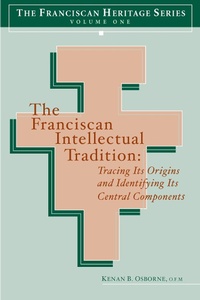
Franciscan Intellectual Tradition
Tracing Its Origins
Published on 15. June 2003
88 pages
978-1-57659-288-5 (ISBN)
Description

The purpose of this book is to present some general and major themes of the theological formulation of the Franciscan Intellectual Tradition as these themes intersect with contemporary perspectives. It provides a fine starting point for further reflection and a solid foundation for future expositions in this series. It is meant to help readers plumb the spiritual depths of our Franciscan inheritance and challenges readers to express these theological themes in preaching, in pastoral practice, in the works of evangelization and in the formative experiences of friars, sisters and the laity.
More details
Other editions
Additional editions

Kenan B. Osborne
The Franciscan Intellectual Tradition
Tracing Its Origins and Identifying Its Central Components
Book
02/2005
Franciscan Institute
€24.63
Article exhausted; check different version
Content
- Cover
- Title Page
- Copyright Page
- TABLE OF CONTENTS
- General Editor's Introduction
- The Franciscan Intellectual Tradition Project
- Making Connections
- Part One: Author's Introductory Remarks
- Part Two: Historical Overview-30 C.E. to 1300 C.E.
- The First Period: 30 C.E. to 70 C.E.
- The Second Period: 70 C.E. to 100 C.E.
- The Third Period: 100 C.E. to 325 C.E.
- The Fourth Period: The Councils of the Early Church-325 C.E. to 681 C.E.
- The Fifth Period: The Development of Scholastic Theology-1000 C.E. to 1300 C.E.
- Part Three: The Philosophical World of Aristotle
- I. The Predicamental Categories of Aristotelian Philosophy
- II. The Four Types of Causality in Aristotle's Philosophy
- III. The Comprehensive Structure of Aristotelian Philosophy
- IV. Two Major Changes Made by Thirteenth century Catholic Theologians in Their Acceptance of Aristotelian Philosophy
- A. GOD AS SUPREME BEING, ESSE IPSUM
- B. THE ETERNITY OF THE FINITE UNIVERSE
- Part Four: The Gradual Development of the Franciscan Intellectual Tradition
- I. The Franciscan Foundation: The Spirituality and Vision of St. Francis and St. Clare
- -The Humility of the Incarnation
- -The Love of the Passion
- II. The First Franciscan Theologians at the Universities of Paris and Oxford
- THE FRANCISCAN SCHOOL AT THE UNIVERSITY OF PARIS
- JOHN of LA ROCHELLE
- ODO RIGALDUS
- WILLIAM of MELITONA
- BONAVENTURE of BAGNOREGIO
- THE FRANCISCAN SCHOOL AT THE UNIVERSITY OF OXFORD
- ROBERT GROSSETESTE
- ADAM MARSH
- THOMAS of YORK
- RICHARD RUFUS of CORNWALL
- JOHN PECHAM
- ROGER BACON
- WILLIAM of WARE
- ROGER MARSTON
- JOHN DUNS SCOTUS
- PETER AUREOLI
- FRANCIS of MEYRONNES
- WILLIAM of OCKHAM
- III. Franciscans in the Twelfth and Thirteenth Centuries Whose Careers Were Not Generally Associated with the Universities of Paris and Oxford
- ANTHONY of PADUA
- PETER JOHN OLIVI
- RAYMOND LULL
- Part Five: Distinctive Features of the Franciscan Intellectual Tradition
- I. The Triune God: a Relational God, Who is Both Primitas and Fecunditas
- A. The Triune God in the Vision and Spirituality of St. Francis
- B. The Triune God as Developed in the Franciscan Intellectual Tradition
- 1. Bonaventure on the Triune God
- 2. John Duns Scotus on the Triune God
- 3. Creation and the Triune God: The Doctrine of Emanation
- 4. Incarnation: The Place of Jesus in Creation
- 5. The Absolute Freedom of God
- 6. The Humility of the Incarnation
- II. The Sacred Book of Creation
- A. The Book of Creation in the Vision and Spirituality of St. Francis
- B. The Book of Creation as developed in the Franciscan Intellectual Tradition
- 1. Creation as Gift of God's Freedom and Love
- 2. Haecceitas: The Doctrine of "Thisness"
- 3. Contingency and Grace
- Conclusion
- ISSUES FOR DISCUSSION
- Endnotes
