

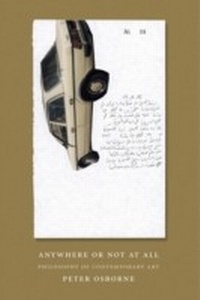
Anywhere or Not at All
Philosophy of Contemporary Art
Published on 4. June 2013
256 pages
978-1-78168-478-8 (ISBN)
Description

Winner of the 2014 Annual Book Prize of the Association for the Study of the Arts of the Present (USA).
Contemporary art is the object of inflated and widely divergent claims. But what kind of discourse can open it up effectively to critical analysis? Anywhere or Not at All is a major philosophical intervention in art theory that challenges the terms of established positions through a new approach at once philosophical, historical, social and art-critical. Developing the position that "contemporary art is postconceptual art," the book progresses through a dual series of conceptual constructions and interpretations of particular works to assess the art from a number of perspectives: contemporaneity and its global context; art against aesthetic; the Romantic pre-history of conceptual art; the multiplicity of modernisms; transcategoriality; conceptual abstraction; photographic ontology; digitalization; and the institutional and existential complexities of art-space and art-time. Anywhere or Not at All maps out the conceptual space for an art that is both critical and contemporary in the era of global capitalism.
Contemporary art is the object of inflated and widely divergent claims. But what kind of discourse can open it up effectively to critical analysis? Anywhere or Not at All is a major philosophical intervention in art theory that challenges the terms of established positions through a new approach at once philosophical, historical, social and art-critical. Developing the position that "contemporary art is postconceptual art," the book progresses through a dual series of conceptual constructions and interpretations of particular works to assess the art from a number of perspectives: contemporaneity and its global context; art against aesthetic; the Romantic pre-history of conceptual art; the multiplicity of modernisms; transcategoriality; conceptual abstraction; photographic ontology; digitalization; and the institutional and existential complexities of art-space and art-time. Anywhere or Not at All maps out the conceptual space for an art that is both critical and contemporary in the era of global capitalism.
All prices
More details
Edition
Ebook UK & RoW
Language
English
Place of publication
London
United Kingdom
Product notice
Reflowable
ISBN-13
978-1-78168-478-8 (9781781684788)
Copyright in bibliographic data and cover images is held by Nielsen Book Services Limited or by the publishers or by their respective licensors: all rights reserved.
Schweitzer Classification
Other editions
Additional editions
Book
06/2013
Verso Books
€33.00
Shipment within 3-4 weeks
Person
Peter Osborne is Professor of Modern European Philosophy and Director of the Centre for Research in Modern European Philosophy (CRMEP), Kingston University London. He is a long-serving member of the editorial collective of Radical Philosophy. His books include The Politics of Time, Anywhere or Not At All, Philosophy in Cultural Theory, Conceptual Art and Marx.
Content
- Cover
- Title
- Dedication
- Contents
- Introduction
- 1 The fiction of the contemporary
- Together in time?
- Three periodizations of contemporary art
- Idea, problem, fiction, task
- The global transnational, or, the contemporary today
- Joseph Bitar
- Fictionalization of artistic authority/collectivization of artistic fictions: A First Transnational
- 2 Art beyond aesthetics
- Art Versus Aesthetics (Jena Romanticism contra Kant)
- Periodization and Historical Ontology: Postconceptual Art
- A Speculative Proposition
- An Image of Romanticism (Benjamin, Schlegel, LeWitt)
- Fragment and Sentence
- Information and Series
- Process and Project
- 3 Modernisms and mediations
- The double heritage of the modern in art
- Artistic modernisms: aesthetic, specific, generic
- Mediations after mediums: nominalism and genre, isms and series
- Everything, everywhere? Polke and Richter
- 4 Transcategoriality: postconceptual art
- Smithson and medium (or, against 'sculpture')
- The 'interminable avalanche of categories'
- Ontology of materializations: non-site
- Conceptual abstraction and 'pure perception'
- 5 Photographic ontology, infinite exchange
- Distributive unity
- The photograph: metonymic model of an imagined unity
- Digitalization, art and the real (or, anxiety about abstraction)
- The visible, the invisible and the multiplication of visualizations
- 6 Art space
- Non-places and the textualization of art
- Architecturalization: three questions
- Construction and expression
- Art as displaced urbanism: capitalist constructivism of the exhibition-form
- Transnationalization: art industry
- Project space
- 7 Art time
- Attention and distraction: boredom as possibility
- Distracted reception (duration and rhythm)
- Memory or history?
- Testimonies: Three works
- Expectation as a historical category (critique of Koselleck)
- Expecting the unexpected: puncturing the horizon
- Acknowledgements
- Notes
- Bibliography
- Image credits
- Index
- Copyright
