

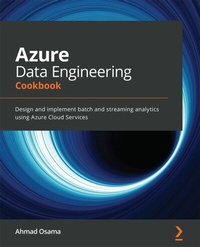
Azure Data Engineering Cookbook
Design and implement batch and streaming analytics using Azure Cloud Services
Published on 23. September 2024
454 pages
978-1-80020-154-5 (ISBN)
Description

Over 90 recipes to help you orchestrate modern ETL/ELT workflows and perform analytics using Azure services more easily
Key Features
Build highly efficient ETL pipelines using the Microsoft Azure Data services
Create and execute real-time processing solutions using Azure Databricks, Azure Stream Analytics, and Azure Data Explorer
Design and execute batch processing solutions using Azure Data Factory
Book DescriptionData engineering is one of the faster growing job areas as Data Engineers are the ones who ensure that the data is extracted, provisioned and the data is of the highest quality for data analysis. This book uses various Azure services to implement and maintain infrastructure to extract data from multiple sources, and then transform and load it for data analysis. It takes you through different techniques for performing big data engineering using Microsoft Azure Data services. It begins by showing you how Azure Blob storage can be used for storing large amounts of unstructured data and how to use it for orchestrating a data workflow. You'll then work with different Cosmos DB APIs and Azure SQL Database. Moving on, you'll discover how to provision an Azure Synapse database and find out how to ingest and analyze data in Azure Synapse. As you advance, you'll cover the design and implementation of batch processing solutions using Azure Data Factory, and understand how to manage, maintain, and secure Azure Data Factory pipelines. You'll also design and implement batch processing solutions using Azure Databricks and then manage and secure Azure Databricks clusters and jobs. In the concluding chapters, you'll learn how to process streaming data using Azure Stream Analytics and Data Explorer. By the end of this Azure book, you'll have gained the knowledge you need to be able to orchestrate batch and real-time ETL workflows in Microsoft Azure.What you will learn
Use Azure Blob storage for storing large amounts of unstructured data
Perform CRUD operations on the Cosmos Table API
Implement elastic pools and business continuity with Azure SQL Database
Ingest and analyze data using Azure Synapse Analytics
Develop Data Factory data flows to extract data from multiple sources
Manage, maintain, and secure Azure Data Factory pipelines
Process streaming data using Azure Stream Analytics and Data Explorer
Who this book is forThis book is for Data Engineers, Database administrators, Database developers, and extract, load, transform (ETL) developers looking to build expertise in Azure Data engineering using a recipe-based approach. Technical architects and database architects with experience in designing data or ETL applications either on-premise or on any other cloud vendor who wants to learn Azure Data engineering concepts will also find this book useful. Prior knowledge of Azure fundamentals and data engineering concepts is needed.
Key Features
Build highly efficient ETL pipelines using the Microsoft Azure Data services
Create and execute real-time processing solutions using Azure Databricks, Azure Stream Analytics, and Azure Data Explorer
Design and execute batch processing solutions using Azure Data Factory
Book DescriptionData engineering is one of the faster growing job areas as Data Engineers are the ones who ensure that the data is extracted, provisioned and the data is of the highest quality for data analysis. This book uses various Azure services to implement and maintain infrastructure to extract data from multiple sources, and then transform and load it for data analysis. It takes you through different techniques for performing big data engineering using Microsoft Azure Data services. It begins by showing you how Azure Blob storage can be used for storing large amounts of unstructured data and how to use it for orchestrating a data workflow. You'll then work with different Cosmos DB APIs and Azure SQL Database. Moving on, you'll discover how to provision an Azure Synapse database and find out how to ingest and analyze data in Azure Synapse. As you advance, you'll cover the design and implementation of batch processing solutions using Azure Data Factory, and understand how to manage, maintain, and secure Azure Data Factory pipelines. You'll also design and implement batch processing solutions using Azure Databricks and then manage and secure Azure Databricks clusters and jobs. In the concluding chapters, you'll learn how to process streaming data using Azure Stream Analytics and Data Explorer. By the end of this Azure book, you'll have gained the knowledge you need to be able to orchestrate batch and real-time ETL workflows in Microsoft Azure.What you will learn
Use Azure Blob storage for storing large amounts of unstructured data
Perform CRUD operations on the Cosmos Table API
Implement elastic pools and business continuity with Azure SQL Database
Ingest and analyze data using Azure Synapse Analytics
Develop Data Factory data flows to extract data from multiple sources
Manage, maintain, and secure Azure Data Factory pipelines
Process streaming data using Azure Stream Analytics and Data Explorer
Who this book is forThis book is for Data Engineers, Database administrators, Database developers, and extract, load, transform (ETL) developers looking to build expertise in Azure Data engineering using a recipe-based approach. Technical architects and database architects with experience in designing data or ETL applications either on-premise or on any other cloud vendor who wants to learn Azure Data engineering concepts will also find this book useful. Prior knowledge of Azure fundamentals and data engineering concepts is needed.
All prices
More details
Edition
Digital original
Language
English
Place of publication
Birmingham
United Kingdom
Target group
Professional and scholarly
US School Grade: College Graduate Student
Edition type
Digital original
Product notice
Reflowable
File size
22,65 MB
ISBN-13
978-1-80020-154-5 (9781800201545)
Copyright in bibliographic data and cover images is held by Nielsen Book Services Limited or by the publishers or by their respective licensors: all rights reserved.
Schweitzer Classification
Other editions
New editions
Luca Zanna | Nagaraj Venkatesan | Ahmad Osama
Azure Data Engineering Cookbook
Get well versed in various data engineering techniques in Azure using this recipe-based guide
E-Book
09/2024
2nd Edition
Packt Publishing
from
€37.19
Available for download
Additional editions
Ahmad Osama | Nagaraj Venkatesan
Azure Data Engineering Cookbook
Design and implement batch and streaming analytics using Azure Cloud Services
Book
04/2021
Packt Publishing
€47.50
Shipment within 3-4 weeks
Persons
Osama Ahmad :
Ahmad Osama works for Pitney Bowes Pvt. Ltd. as a technical architect and is a former Microsoft Data Platform MVP. In his day job, he works on developing and maintaining high performant, on-premises and cloud SQL Server OLTP environments as well as deployment and automating tasks using PowerShell. When not working, Ahmad blogs at DataPlatformLabs and can be found glued to his Xbox.Venkatesan Nagaraj :
Nagaraj Venkatesan works as a cloud solution architect at Microsoft. At Microsoft, he works with some of the largest companies in the world, solving their complex data engineering problems and helping them build effective solutions using cutting-edge technologies based on Azure. Nagaraj, based out of Singapore, is a popular member of the data and AI community and is a regular speaker at several international data and AI conferences. He is a two-time Microsoft Most Valuable Professional (MVP) award winner, in 2016 and 2017. Nagaraj shares his technical expertise through his blog and on his YouTube channel called DataChannel. He also holds a master's degree in computing from the National University of Singapore.
Ahmad Osama works for Pitney Bowes Pvt. Ltd. as a technical architect and is a former Microsoft Data Platform MVP. In his day job, he works on developing and maintaining high performant, on-premises and cloud SQL Server OLTP environments as well as deployment and automating tasks using PowerShell. When not working, Ahmad blogs at DataPlatformLabs and can be found glued to his Xbox.Venkatesan Nagaraj :
Nagaraj Venkatesan works as a cloud solution architect at Microsoft. At Microsoft, he works with some of the largest companies in the world, solving their complex data engineering problems and helping them build effective solutions using cutting-edge technologies based on Azure. Nagaraj, based out of Singapore, is a popular member of the data and AI community and is a regular speaker at several international data and AI conferences. He is a two-time Microsoft Most Valuable Professional (MVP) award winner, in 2016 and 2017. Nagaraj shares his technical expertise through his blog and on his YouTube channel called DataChannel. He also holds a master's degree in computing from the National University of Singapore.
Content
Table of Contents
Working with Azure Blob Storage
Working with Relational Database in Azure
Analyzing Data with Azure Synapse Analytics
Control Flow Activities in Azure Data Factory
Control Flow Transformation and Copy Data Activity in Azure Data Factory
Data Flow in Azure Data Factory
Azure Data Factory Integration Runtime
Deploying Azure Data Factory Pipelines
Batch and Streaming Data Processing with Azure Databricks
Working with Azure Blob Storage
Working with Relational Database in Azure
Analyzing Data with Azure Synapse Analytics
Control Flow Activities in Azure Data Factory
Control Flow Transformation and Copy Data Activity in Azure Data Factory
Data Flow in Azure Data Factory
Azure Data Factory Integration Runtime
Deploying Azure Data Factory Pipelines
Batch and Streaming Data Processing with Azure Databricks
