

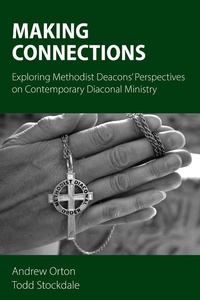
Making Connections
Exploring Methodist Deacons' Perspectives on Contemporary Diaconal Ministry
Published on 1. May 2014
180 pages
978-1-908381-69-9 (ISBN)
Description

Churches are increasingly exploring the potential of diaconal ministry to help them serve wider society in the contemporary context. Those involved in this ministry seek to forge improved connections between churches and the wider communities in which they are located. However, the role of those ordained to be deacons is diverse, challenging and often controversial, both within and outside the Church.This book explores how deacons within the Methodist Church in Britain have understood their own ministry and sought to address these challenges. It draws on innovative research undertaken with the Methodist Diaconal Order over two years. Key questions and implications for practice are provided to help those wishing to reflect further on this ministry.This book makes a significant contribution to the ecumenical debate on diaconal ministry. It offers much that will be of interest to all those seeking to reflect on, understand, engage in or work with those involved in this ministry in their own contexts.
More details
Language
English
Place of publication
Durham
United Kingdom
Target group
Professional and scholarly
File size
0,40 MB
ISBN-13
978-1-908381-69-9 (9781908381699)
Copyright in bibliographic data and cover images is held by Nielsen Book Services Limited or by the publishers or by their respective licensors: all rights reserved.
Schweitzer Classification
Other editions
Additional editions
Andrew Orton | Todd Stockdale
Making Connections
Exploring Methodist Deacons' Perspectives on Contemporary Diaconal Ministry
Book
05/2014
Sacristy Press
€32.10
Shipment within 3-4 weeks
Content
- Intro
- Foreword
- Acknowledgements
- 1. Introduction
- 1.1. Why Does Diaconal Ministry Matter in the Contemporary Global Context?
- 1.2. The Contribution of this Book
- 2. Exploring Contemporary Perspectives: An Introduction
- 2.1. Diversity and Flexibility: Responding to Need and Context
- Key Questions
- 2.2. Dimensions of Good Practice
- 3. Processes of Good Practice in Diaconal Ministry
- 3.1. Introduction to Chapter 3
- 3.2. Processes of Good Practice
- Key Questions
- 3.3. Chapter 3 Conclusion
- 4. Making Connections: A Key Purpose of a Deacon's Ministry
- 4.1. Introduction to Chapter 4
- 4.2. Bridging Between Churches and Wider Communities
- 4.3. Forming Connections within Churches
- 4.4. Forming Connections within Wider Communities
- Key Questions
- 4.5. Chapter 4 Conclusion
- 5. The Role of Deacons in Modelling Diaconal Ministry
- 5.1. Introduction to Chapter 5
- 5.2. A Deacon's Identity in Forming Connections
- Key Questions
- 6. Exploring the Relationship between Deacons and Other Ministries: Making Further Connections
- 6.1. Introduction to Chapter 6
- 6.2. Relationships between Deacons & Others, Especially Lay People
- Key Questions for all churches
- Key Questions for the Methodist Church in Britain
- 6.3. Presbyter/Deacon Relationships
- Box A: Deacons and Eucharistic Presidency
- Key Questions
- 6.4. Chapter 6 Conclusion
- 7. Enabling Effective Growth in Deacons' Ministries: Formation, Training, Support & Continuing Learning
- 7.1. Introduction to Chapter 7
- 7.2. Being a Deacon: The Personal Motivations, Joys and Challenges
- Key Questions
- 7.3. Belonging to the Order: Identity, Support, and Formation
- Key Questions
- 7.4. Chapter 7 Conclusion
- 8. Conclusion
- Key implications for practice
- Key implications for practice
- Key implications for practice
- Appendix A. Developing Collective Learning and Reflection: A Dialogical Research Methodology
- Appendix B. Summary of Clusters in Data Analysis
- Appendix C. Other Contributions Arising from this Research Project
- Appendix D. The Rule of Life of the Methodist Diaconal Order
- Appendix E. Recommendations to the Methodist Church in Britain
- References
