

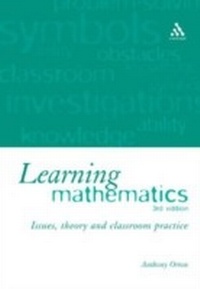
Learning Mathematics
Issues, Theory and Classroom Practice
3rd Edition
Published on 1. October 2004
242 pages
978-1-4411-4001-2 (ISBN)
Description

* Why do some students achieve more than others?
* Do we have to wait until pupils are "ready"?
* Can children discover math for themselves?
* Does language interfere with the learning of math?
This classic text, written from the viewpoint of the math teacher, provides answers to these and many more questions. Each chapter explores a particular issue that illustrates the interaction between theory and practice. New chapters have been included on cognition, pattern, and ICT.
* Do we have to wait until pupils are "ready"?
* Can children discover math for themselves?
* Does language interfere with the learning of math?
This classic text, written from the viewpoint of the math teacher, provides answers to these and many more questions. Each chapter explores a particular issue that illustrates the interaction between theory and practice. New chapters have been included on cognition, pattern, and ICT.
Reviews / Votes
'I greatly enjoyed reading it and found much to think about and reflect upon. It is a worthy successor to the original edition and can be recommended as a source of useful material on many key issues in mathematical education.' Mathematical GazetteMore details
Edition
3rd edition
Language
English
Place of publication
New York
United States
Target group
College/higher education
Professional and scholarly
ISBN-13
978-1-4411-4001-2 (9781441140012)
Copyright in bibliographic data and cover images is held by Nielsen Book Services Limited or by the publishers or by their respective licensors: all rights reserved.
Schweitzer Classification
Other editions
Additional editions
Book
10/2004
3rd Edition
Continuum International Publishing Group Ltd.
€44.00
Shipment within 15-20 days
Book
10/2004
3rd Edition
Continuum International Publishing Group Ltd.
€190.50
Shipment within 15-20 days
Person
Anthony Orton is a freelance writer. For many years he was Senior Lecturer in Mathematical Education at the University of Leeds, UK.
Content
- Intro
- Contents
- Preface to the Third Edition
- Chapter 1 Do Teachers of Mathematics Need Theories?
- The importance of theories
- The origins of theories
- Chapter 2 What Cognitive Demands Are Made in Learning Mathematics?
- The problem of classification
- Retention and recall
- Using algorithms
- Learning concepts
- Problem-solving
- Chapter 3 Could We Enhance Learning Through Optimum Sequencing?
- Behaviourism
- Objectives
- Programmed learning
- Learning hierarchies
- Chapter 4 Must We Wait Until Pupils Are Ready?
- Alternative views
- Piaget and readiness
- Accelerating learning
- Curriculum implementation
- Critical evaluation
- Cross-cultural issues
- Chapter 5 Can Pupils Discover Mathematics for Themselves?
- Learning by discovery
- Gestalt psychology
- Structural apparatus
- Problems and investigations
- Obstacles and difficulties in problem-solving
- Logo
- Chapter 6 Is an Appreciation of Pattern Important in Learning Mathematics?
- Pattern in mathematics
- Early concepts of pattern
- Number patterns
- The approach to algebra
- Pattern and proof
- Pattern in relation to shape
- Chapter 7 Does What We Learn Depend on Where We Are?
- Applying mathematics
- Everyday mathematics
- Work mathematics
- Transfer of learning and situated cognition
- Ethnomathematics
- The significance of the situation
- Chapter 8 Why Do Some Pupils Achieve More Than Others?
- Individual differences
- Convergent and divergent thinking
- Mathematical ability
- Spatial ability
- Gender-related differences
- Preferences and attitudes
- Chapter 9 Does Language Interfere with Learning Mathematics?
- Issues of language
- The mathematics register
- Reading mathematics
- Mathematical symbols
- Communicating meaning
- Language, culture and mathematics
- Word problems
- Chapter 10 Is There a Theory of Mathematics Learning?
- Mathematics and theories of learning
- The Dienes theory of mathematics-learning
- The van Hiele theory of learning geometry
- Ausubel's theory of meaningful learning
- Meaningful learning
- Superordinate and subordinate learning
- Conflicts and failures in learning
- A brief note on information processing
- Chapter 11 Can Pupils Construct Mathematical Knowledge for Themselves?
- Constructivism
- Versions of constructivism
- Some constructivist teaching experiments
- Constructivism in our classrooms
- Cognitive obstacles
- References
- Author index
- A
- B
- C
- D
- E
- F
- G
- H
- J
- K
- L
- M
- N
- O
- P
- R
- S
- T
- U
- V
- W
- Y
- Z
- Subject index
- A
- B
- C
- D
- E
- F
- G
- I
- K
- L
- M
- N
- O
- P
- R
- S
- T
- V
- W
- Z
