

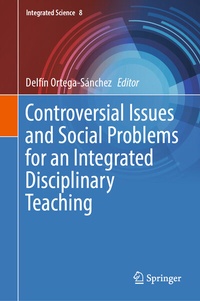
Controversial Issues and Social Problems for an Integrated Disciplinary Teaching
1st Edition
Published on 30. September 2022
VIII, 199 pages
978-3-031-08697-7 (ISBN)
Description

The scientific literature has been showing that the teaching of controversial topics constitutes one of the most powerful tools for the promotion of active citizenship, the development and acquisition of critical-reflective thinking skills (Misco, 2013), and education for democratic citizenship (Pollak, Segal, Lefstein, and Meshulam, 2017; Misco and Lee, 2014). It has also highlighted, however, the complexities, risks and interference of emotional reactions in learning about sensitive, controversial or controversial historical, geographical or social issues (Jerome and Elwick, 2019; Reiss, 2019; Ho and Seow, 2015; Washington and Humphries, 2011; Swalwell and Schweber, 2016).
Recent studies have advanced in the analysis of strategies employed by teacher educators in teaching controversial issues (Nganga, Roberts, Kambutu, and James, 2019; Pace, 2019), and in the curricular decisions of teachers about this teaching (Hung, 2019; King, 2009). These developments confirm the appropriateness of discussing or developing deliberative skills and conversational learning as the most appropriate strategy for the didactic treatment of controversial issues (Claire and Holden, 2007; Hand, 2008; Hess, 2002; Oulton, Day, Dillon and Grace, 2004; Oulton, Dillon and Grace, 2004; Myhill, 2007; Hand and Levinson, 2012; Ezzedeen, 2008). The promotion of discussion on specific social justice issues has also been approached from the use of controversial or documentary images in teacher education contexts, in order to question what is happening or has happened in present and past societies (Hawley, Crowe, and Mooney, 2016; Marcus and Stoddard, 2009).
In this context, the aim of this contributed volume is, on one hand, to understand the discourses and decision-making of teachers on controversial issues in interdisciplinary educational contexts and their association with the development of deliberation skills. On the other hand, it seeks to offer studies focused on the analysis of the levels of coherence between their attitudes, positions and teaching practices for the teaching and learning of social problems and controversial issues from an integrated disciplinary perspective.
Recent studies have advanced in the analysis of strategies employed by teacher educators in teaching controversial issues (Nganga, Roberts, Kambutu, and James, 2019; Pace, 2019), and in the curricular decisions of teachers about this teaching (Hung, 2019; King, 2009). These developments confirm the appropriateness of discussing or developing deliberative skills and conversational learning as the most appropriate strategy for the didactic treatment of controversial issues (Claire and Holden, 2007; Hand, 2008; Hess, 2002; Oulton, Day, Dillon and Grace, 2004; Oulton, Dillon and Grace, 2004; Myhill, 2007; Hand and Levinson, 2012; Ezzedeen, 2008). The promotion of discussion on specific social justice issues has also been approached from the use of controversial or documentary images in teacher education contexts, in order to question what is happening or has happened in present and past societies (Hawley, Crowe, and Mooney, 2016; Marcus and Stoddard, 2009).
In this context, the aim of this contributed volume is, on one hand, to understand the discourses and decision-making of teachers on controversial issues in interdisciplinary educational contexts and their association with the development of deliberation skills. On the other hand, it seeks to offer studies focused on the analysis of the levels of coherence between their attitudes, positions and teaching practices for the teaching and learning of social problems and controversial issues from an integrated disciplinary perspective.
More details
Series
Language
English
Place of publication
Cham
Switzerland
Publishing group
Springer International Publishing
Target group
Primary & secondary/elementary & high school
Product notice
Reflowable
Illustrations
VIII, 199 p. 48 illus., 41 illus. in color.
File size
4,55 MB
ISBN-13
978-3-031-08697-7 (9783031086977)
DOI
10.1007/978-3-031-08697-7
Schweitzer Classification
Other editions
Additional editions
Delfín Ortega-Sánchez
Controversial Issues and Social Problems for an Integrated Disciplinary Teaching
Book
10/2022
Springer
€106.99
Shipment within 15-20 days
Person
Professor Delfín Ortega-Sánchez holds a PhD in Didactics of Social Sciences from the Autonomous University of Barcelona, a PhD in Educational Sciences from the University of Burgos, and a PhD in History from the University of Extremadura. His research interests focus on the construction of identities in the History and Geography teaching, gender mainstreaming in initial education and training for teachers, the didactic treatment of relevant social problems and controversial issues in the teaching of the social and human sciences, and the application of educational technology in the specific field of social sciences. He is currently a Social Sciences teacher and researcher at University of Burgos (Spain).
Content
1. On integrating mathematics education and sustainability in teacher training: why, to what end and how?.- 2. Social sciences education based on social problems: traditions and integrative tendencies.- 3. Controversial heritage, ecosocial education and citizenship. Connections for the development of heritage education in formal education.- 4. Education for a New Era: Transdisciplinarity, Key Competences and an Eclectic Approach to Evaluation.-5. Historical thinking and controversial issues in social studies education.-6. Education and controversial topics in post-conflict societies: The Coexistence and Memory project in contemporary teacher training in the Basque Country.- 7. History education and democratic memory. An analysis of the opinions of social sciences teachers in initial training.- 8. The use of controversial issues in Higher Education for citizenship learning.- 9. Perceptions of STEAM+CLIL integration: results of a co-teaching proposal during initial teacher training.-10. The contribution of interdisciplinary education to the development of students competences with intellectua1l disabilities. An analysis from the social and rights model.- 11. COPACUL: An innovative didactic project on Heritage conservation for high school students.- 12.Disciplinary boundaries in STEM education from an identity perspective.
