

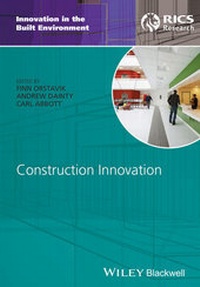
Construction Innovation
Description

More details
Other editions
Additional editions
Persons
Content
About the Authors ix
Foreword by Wim Bakens, CIB xv
Preface xvii
Chapter 1 Introduction 1
Construction Innovation: Concepts and Controversies 3
Perspectives on Construction Innovation 4
Instead of Conclusions 10
References 11
Chapter 2 Incentives for Innovation in Construction 13
Introduction 13
A Schumpeterian Definition of Construction Innovation 17
Innovation in Construction 18
Construction Innovation and Complexity 20
Construction Innovation and Asymmetric Information 20
Construction Innovation and Multi-Parametric Optimization 22
Conclusion 25
Acknowledgements 26
References 26
Chapter 3 Built-in Innovation and the Ambiguity of Designing Accessibility 29
Introduction: Making Innovation Accessible 29
Methodology 32
The Case: The World's Most Accessible Office Building 33
Discussion: In Search of the Innovation 38
Conclusions 42
Acknowledgements 44
References 45
Chapter 4 Stakeholder Integration Champions and Innovation in the Built Environment 47
Introduction 47
Stakeholder Integration Champions, Collaboration and Participation 50
Method 51
Creating the Conditions for Innovation in the Built Environment 52
Integration for Innovation 57
Conclusion 58
Acknowledgements 60
References 60
Chapter 5 Grassroots Innovation in the Construction Industry 65
Introduction 65
Grassroots Innovation 66
The Elements of Grassroots Innovation 68
Grassroots Innovation in Practice 69
Assessing the Potential of Grassroots Innovation in Construction 73
Conclusion 75
References 76
Chapter 6 Regulation and Innovation in New Build Housing: Insights into the Adoption and Diffusion of Micro-Generation Technologies 79
Introduction 79
Regulation and Innovation for Sustainable Building 81
Case Study Example 84
Conclusions 86
Acknowledgement 87
References 87
Chapter 7 An Industrial Network Perspective on Innovation in Construction 89
Introduction 89
Innovation in the Construction Industry 90
An Industrial Network Perspective on Innovation 91
Understanding Innovation as Resource Interaction Processes 93
Empirical Examples 95
Conclusions 98
References 99
Chapter 8 Innovation Diffusion Across Firms 103
Introduction 103
Antecedents 103
Central Themes 104
Points of Departure 105
How to Approach the Problem 105
Mapping Networks of Innovation Diffusion 107
The Innovation Diffusion Network 109
The Network of Firms Engaged in the Innovation Diffusion Process 110
Sense-Making Framework 113
Conclusion 114
References 115
Chapter 9 Clients Shaping Construction Innovation 119
Introduction 119
Empirical Grounding 122
Findings 127
Conclusions 131
References 132
Chapter 10 Innovation in Road Building: Removing Obstacles for Diffusion of Novel Building Products 135
Introduction 135
Methods 138
Findings and Discussion 141
Pre-Project Product Certification Process 142
Conclusion 145
References 147
Chapter 11 Innovating for Integration: Clients as Drivers of Industry Improvement 149
Introduction 149
Theory of Integration 151
Drivers and Strategies for Innovation Diffusion 153
Framework for Analysis 154
Integrated Project Delivery 155
Building Information Modelling 157
Supply Chain Integration 160
Conclusions 161
References 163
Chapter 12 Project Delivery Systems and Innovation: The Case of US Road Building 165
Introduction 165
Design-Build 166
Public-Private Partnerships 170
Construction-Manager-as-General-Contractor 175
Conclusion 179
References 180
Chapter 13 The Leitmotif of Building-Products Innovation in Finland: From Commercial Technology Exploitation to Sustainable Development 181
Introduction 181
The Evolving Context of Building Products Innovation in Finland 184
The Evolution of Industry Strategies 186
Innovation Strategies in the Finnish Building Products Industry 188
Conclusion 197
Acknowledgements 198
References 198
Index 203
About the Authors
Carl Abbott
Carl Abbott is Professor of Construction Innovation & Enterprise in the School of the Built Environment at the University of Salford and Director of the Salford Centre for Research & Innovation (SCRI) in the built and human environment. Carl's research interests include innovation in university-city regions and the sustainable delivery of housing. Significant research projects in which Carl has been involved include the EU funded 'INNOPOLIS', the Economic and Social Research Council Distributed Innovation Project 'The impact of environmental regulation on innovation in the housing sector', the Engineering and Physical Sciences Research Council/Électricité de France funded 'People Energy & Buildings' project on the uptake of micro-generation technologies in housing.
Catherine Barlow
Catherine Barlow is a Research Fellow at the University of Salford and was previously a researcher for a regional housing association. Catherine's research has primarily focussed on innovation and regulation in the context of UK housing. Catherine's PhD was on the impact of the Code for Sustainable Homes on UK housing. Since gaining her PhD, Catherine has developed her research interests working as a Research Fellow on projects concerned with low energy housing including the Greater Manchester Local Interaction Programme, Milesecure 2050 and the Innovative Retrofit of Housing.
Frédéric Bougrain
Frédéric Bougrain works as a researcher for the Economics and Human Sciences Department at the Scientific and Technical Centre for Building, University Paris Est in France. His research is concentrated on innovations in the building and construction industry, public-private partnerships, asset management in the social housing sector and energy-saving performance contracts. He previously lectured at the University of Orléans (France) where he defended his PhD thesis on innovation, small- and medium-size enterprises and the consequences for regional technology policy.
Mario Bourgault
Mario Bourgault has conducted more than a decade of research in the field of innovation and project management. He has held the Canada Research Chair in Technology Project Management since 2004. He is also head of Polytechnique Montreal's graduate program in project management. His work has been published in a number of journals, including Project Management Journal, International Journal of Project Management, R&D Management and International Journal of Managing Projects in Business. In addition to his academic credentials, he spent several years in the field working as a professional engineer, and he maintains close ties with the industry as a researcher and expert consultant.
Lena E. Bygballe
Lena E. Bygballe is Associate Professor at the Department of Strategy and Logistics at BI Norwegian Business School, Oslo, Norway. She is also chair of the Centre for the construction industry in the same department. Her research interests are in the area of interorganisational relationships with particular focus on organisation, learning and innovation.
Andrew Dainty
Andrew Dainty is Professor of Construction Sociology at Loughborough University's School of Civil and Building Engineering. For the past 20 years, his research has focused on social action within construction and other project-based sectors, particularly the social rules and processes that affect people working as members of project teams. He has a particular interest in practice-based perspectives on innovation in construction and in the relationship between innovation strategy and the performance of project-based firms. Andrew is co-editor of the leading research journal Construction Management and Economics, a past chair of the Association of Researchers in Construction Management (ARCOM) and former joint coordinator of CIB Task Group 76 on Recognising Innovation in Construction.
Nathalie Drouin
Nathalie Drouin, PhD (University of Cambridge), MBA (HEC-Montréal), is the Associate Dean of Research and former Director of Graduate programs in Project Management, School of Management at Université du Québec à Montreal (ESG UQAM) and a professor, Department of Management and Technology, ESG UQAM. She teaches initiation and strategic management of projects in the Graduate Project Management Programs. Her research has been funded by the Social Sciences and Humanities Research Council of Canada, the Canadian Institute of Health Research, the Quebec Research Council, and the Project Management Institute. She is a Member of the Scientific Committee of the Project Management Research Chair, ESG UQAM.
Marianne Forman
Marianne Forman is Senior Researcher at the Danish Building Research Institute, Aalborg University, Denmark. Her research area encompasses innovation, user-driven innovation, sustainable transition, environmental management in companies and product chains, project management and change processes, working environment and cooperation inside companies and among companies.
She graduated from the Danish Technical University (1991), where she also defended her PhD thesis on Processes of Change and Participation Forms in Preventive Environmental Work (1998).
Martha E. Gross
Currently based in Arup's New York office, Martha Gross is a Senior Infrastructure Consultant with a focus on delivering transportation megaprojects. From her past and present roles as contractor, owner's engineer, and lender's advisor on highway and bridge projects up to $3 billion in construction cost, she has gained extensive first-hand experience with design-build and public-private partnership contracting. Among other recognitions she holds an MBA and PhD in civil engineering from Virginia Polytechnic Institute and State University, where her research focussed on infrastructure finance and delivery via PPP contracts.
Håkan Håkansson
Håkan Håkansson is Professor in International Management at the Department of Innovation and Economic Organisation at BI Norwegian Business School, Oslo, Norway. His research interests are in the area of interorganisational business relationships and business networks with particular focus on innovation and economic development.
Kim Haugbølle
Kim Haugbølle has been working closely with construction clients for almost twenty years, and he was instrumental in the establishment of the Danish Construction Clients Association in 1999. He is coordinating the CIB Working Commission on Clients and Users in Construction with Professor David Boyd. Kim has published extensively on innovation and technology assessment in the construction industry with special emphasis on procurement, sustainable design and life cycle economics. The academic insights have been turned into the development of a life cycle costing tool for the Danish version of the German Sustainable Building Council sustainability certification scheme.
J. L. (John) Heintz
Dr. John L. Heintz is Head of Section and Associate Professor in the Design and Construction Management Section of the Faculty of Architecture at the Delft University of Technology. Before pursuing his PhD in architecture at the Technical University of Delft, he earned his professional degree in architecture from the University of Calgary, graduating with the AIA Gold Medal. His research interests include the strategic management of architectural firms, new forms of architectural practise, design collaboration, design quality and knowledge sharing in design projects. He is co-author of De Architect in de Praktijk (in Dutch).
Malena Ingemansson
Malena Ingemansson is post doc at the Centre for Science and Technology Studies at Uppsala University. Her research interests are in the area of technology development and innovation involving settings such as industrial production and academia.
Kristian Kreiner
Kristian Kreiner is professor at Copenhagen Business School, Department of Organization. He was the founder and director of the Centre for Management Studies of the Building Process (www.CLIBYG.org). In his research, he aims to understand how things are organized under conditions of complexity, uncertainty and ambiguity. These interests have occasioned detailed empirical studies in many sectors and industries, not the least in construction. Current studies include research on the ways in which we manage to make difficult or impossible choices, for example in connection with architectural competitions.
Heli Koukkari
Heli Koukkari is Principal Scientist at the VTT Technical Research Centre of Finland, which she joined in 1982. Her R&D topics have covered overall performance and sustainability of buildings; concrete, steel, composite and timber structures and most recently innovation processes. She has been vice-chair of the COST Action C25, Sustainability of Constructions - Integrated Approach to Life-Time Structural Engineering, and member of the RTD Committee of the European Network of Building Research Institutes ENBRI; of the TC14 Sustainable and Eco-Efficient Steel Construction of the European Convention for Constructional Steelwork ECCS; and of Work Group3, Construction & Infrastructure of the European Steel Technology Platform ESTEP.
Graeme D....
