

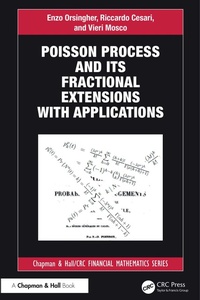
Poisson Process and its Fractional Extensions with Applications
Will be published approx. on 23. June 2026
283 pages
978-1-040-49262-8 (ISBN)
Description

This book accompanies the reader from the simple, standard Poisson process to its more complex transformations, using a unified framework, showing proofs of basic theorems and references to more difficult results.
The reader will also benefit from the empirical applications of the various models to real data in finance and insurance (e.g., stock market crashes and fire accidents), physics and geology (e.g., earthquakes), biology and demography (e.g., births, deaths, and pandemics), and more. Many of the applications relate to financial mathematics, and a professional can glean a lot from an understanding of how to apply this important mathematical tool.
Some examples are worked out in open-source R showing the reader how to implement the models. Strengths of Poisson Process and its Fractional Extensions with Applications are:
A focus on a very fundamental class of stochastic processes
An introductory approach assuming no previous experience with the topics
A wide range of generalizations considered, including recent advances to which one of the authors has made seminal contributions
Attention not only to theory, but also to practical applications with real-data examples from a wide range of fields
The authors pay special attention not only to the theoretical foundations of the Poisson process and the various generalizations that have been proposed in the literature in the last decades, but also to the practical applications in many different fields of the Poisson models for a better understanding of the stochastic structure of the real world.
Note that for the sake of the reader, the probability generating functions are summarized in Appendix A; subordinators in Appendix B; fractional derivatives in Appendix C; gamma and Mittag-Leffler functions in Appendix D; and tools for data analysis in Appendix E. Appendix F contains the R code.
The reader will also benefit from the empirical applications of the various models to real data in finance and insurance (e.g., stock market crashes and fire accidents), physics and geology (e.g., earthquakes), biology and demography (e.g., births, deaths, and pandemics), and more. Many of the applications relate to financial mathematics, and a professional can glean a lot from an understanding of how to apply this important mathematical tool.
Some examples are worked out in open-source R showing the reader how to implement the models. Strengths of Poisson Process and its Fractional Extensions with Applications are:
A focus on a very fundamental class of stochastic processes
An introductory approach assuming no previous experience with the topics
A wide range of generalizations considered, including recent advances to which one of the authors has made seminal contributions
Attention not only to theory, but also to practical applications with real-data examples from a wide range of fields
The authors pay special attention not only to the theoretical foundations of the Poisson process and the various generalizations that have been proposed in the literature in the last decades, but also to the practical applications in many different fields of the Poisson models for a better understanding of the stochastic structure of the real world.
Note that for the sake of the reader, the probability generating functions are summarized in Appendix A; subordinators in Appendix B; fractional derivatives in Appendix C; gamma and Mittag-Leffler functions in Appendix D; and tools for data analysis in Appendix E. Appendix F contains the R code.
More details
Series
Language
English
Place of publication
London
United Kingdom
Publishing group
Taylor & Francis Ltd
Target group
College/higher education
Professional and scholarly
Illustrations
11 Tables, black and white; 34 Line drawings, black and white; 34 Illustrations, black and white
File size
9,22 MB
ISBN-13
978-1-040-49262-8 (9781040492628)
Copyright in bibliographic data and cover images is held by Nielsen Book Services Limited or by the publishers or by their respective licensors: all rights reserved.
Schweitzer Classification
Other editions
Additional editions
Enzo Orsingher | Riccardo Cesari | Vieri Mosco
Poisson Process and its Fractional Extensions with Applications
Book
approx. 06/2026
1st Edition
Chapman & Hall/CRC
€113.50
Not yet published
Persons
Enzo Orsingher is Emeritus Full Professor of Probability at the Sapienza University of Rome. He has written many seminal papers on Random motions, Random fields, Pseudo-processes governed by heat-type equations, Fractional calculus and fractional differential equations. Recent interests are in Diffusions with branching and Motions in non-euclidean spaces.
Riccardo Cesari is Full Professor of Mathematical Methods of Economics, Finance and Actuarial Sciences at the University of Bologna. He has a D.Phil from Oxford University. Between 2013 and 2025 he has been a member of the board of IVASS, the Italian Supervisory Authority for Insurance Companies. His academic interest and publications concern the term structure of interest rates, the valuation of structured securities, the analysis of unit trusts and pension funds, forecasting models of financial markets and strategic and tactical optimal financial allocation, implicit guarantees in insurance contracts and solvency problems in life and non-life insurance.
Vieri Mosco is an actuarial researcher at IVASS, the Italian Supervisory Authority for Insurance Companies. He has a Ph.D. from the Sapienza University of Rome, where he discussed a thesis on optimal management of insurance-segregated funds. His interest is in life and non-life insurance, quantitative actuarial models and empirical applications.
Riccardo Cesari is Full Professor of Mathematical Methods of Economics, Finance and Actuarial Sciences at the University of Bologna. He has a D.Phil from Oxford University. Between 2013 and 2025 he has been a member of the board of IVASS, the Italian Supervisory Authority for Insurance Companies. His academic interest and publications concern the term structure of interest rates, the valuation of structured securities, the analysis of unit trusts and pension funds, forecasting models of financial markets and strategic and tactical optimal financial allocation, implicit guarantees in insurance contracts and solvency problems in life and non-life insurance.
Vieri Mosco is an actuarial researcher at IVASS, the Italian Supervisory Authority for Insurance Companies. He has a Ph.D. from the Sapienza University of Rome, where he discussed a thesis on optimal management of insurance-segregated funds. His interest is in life and non-life insurance, quantitative actuarial models and empirical applications.
Content
Part 1: Poisson processes 1. Poisson processes Part 2: Birth-and-Death processes 2. Birth processes 3. Death processes 4. The birth-death process Part 3: Fractional Poisson processes 5. Fractional extensions of the Poisson and birth and death processes
