

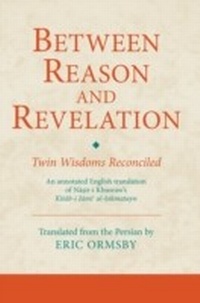
Between Reason and Revelation
Twin Wisdoms Reconciled
1st Edition
Published on 31. May 2012
304 pages
978-0-85772-254-6 (ISBN)
Description

I.B.Tauris in association with the Institute of Ismaili Studies
This is the first English translation of the final philosophical work of the great eleventh-century Ismaili thinker, poet, and Fatimid emissary, N?sir-i Khusraw. Appointed from Cairo by command of the Fatimid Imam-caliph al-Mustansir to serve first as a d?'?, and then as the hujjat, for the entire region of Khur?s?n, he maintained his allegiance both to his mission and his Imam-caliph for the rest of his life, even when threatened and driven into exile. Written
during his exile in Badakhsh?n in the year 1070, N?sir-i Khusraw here develops a powerful presentation of both Aristotelian philosophy and Ismaili exegesis, or ta'w?l, and strives to show that they are ultimately in harmony. The work is presented as a learned commentary on a long philosophical poem, written in the previous century and sent to N?sir by the am?r of Badakhsh?n, 'Al? b. al-Asad, who copied the poem out in his own hand from memory and asked the poet-philosopher to explicate it. In doing so, N?sir ranges over a huge span of topics from logic and language to the nature of the physical world, from the spheres of the highest heavens to the plants and animals of the earthly realm, and, most importantly, hidden spiritual realities: the esoteric (b?tin) as well as the exoteric (z?hir) realms. He thus discusses the nature of God, the creation of human beings, and the mysteries concealed in the physical world, itself a reflection of a higher, transcendent realm.
Between Reason and Revelation: Twin Wisdoms Reconciled is an annotated translation of the Persian text prepared by Henry Corbin and Mohammed Mu'?n based on the single surviving manuscript of the work, now in the Sueleymaniye Mosque Library in Istanbul. It is a work of great philosophical and spiritual insight, which is also a pioneering attempt to tackle difficult
intellectual problems in the Persian language; it is at once lucid and lyrical, precise and speculative. N?sir's influence has been immense as both a poet and a thinker, and the Kit?b-i J?mi' al-hikmatayn is his crowning work.
This is the first English translation of the final philosophical work of the great eleventh-century Ismaili thinker, poet, and Fatimid emissary, N?sir-i Khusraw. Appointed from Cairo by command of the Fatimid Imam-caliph al-Mustansir to serve first as a d?'?, and then as the hujjat, for the entire region of Khur?s?n, he maintained his allegiance both to his mission and his Imam-caliph for the rest of his life, even when threatened and driven into exile. Written
during his exile in Badakhsh?n in the year 1070, N?sir-i Khusraw here develops a powerful presentation of both Aristotelian philosophy and Ismaili exegesis, or ta'w?l, and strives to show that they are ultimately in harmony. The work is presented as a learned commentary on a long philosophical poem, written in the previous century and sent to N?sir by the am?r of Badakhsh?n, 'Al? b. al-Asad, who copied the poem out in his own hand from memory and asked the poet-philosopher to explicate it. In doing so, N?sir ranges over a huge span of topics from logic and language to the nature of the physical world, from the spheres of the highest heavens to the plants and animals of the earthly realm, and, most importantly, hidden spiritual realities: the esoteric (b?tin) as well as the exoteric (z?hir) realms. He thus discusses the nature of God, the creation of human beings, and the mysteries concealed in the physical world, itself a reflection of a higher, transcendent realm.
Between Reason and Revelation: Twin Wisdoms Reconciled is an annotated translation of the Persian text prepared by Henry Corbin and Mohammed Mu'?n based on the single surviving manuscript of the work, now in the Sueleymaniye Mosque Library in Istanbul. It is a work of great philosophical and spiritual insight, which is also a pioneering attempt to tackle difficult
intellectual problems in the Persian language; it is at once lucid and lyrical, precise and speculative. N?sir's influence has been immense as both a poet and a thinker, and the Kit?b-i J?mi' al-hikmatayn is his crowning work.
More details
Edition
1. Auflage
Language
English
Place of publication
London
United Kingdom
Publishing group
Bloomsbury Publishing PLC
Illustrations
4 line drawings
File size
1,29 MB
ISBN-13
978-0-85772-254-6 (9780857722546)
Copyright in bibliographic data and cover images is held by Nielsen Book Services Limited or by the publishers or by their respective licensors: all rights reserved.
Schweitzer Classification
Other editions
Additional editions
Book
05/2012
I.B. Tauris
€68.50
Shipment within 10-20 days
Persons
Eric Ormsby is Professor and Senior Research Associate at The Institute of Ismaili Studies, London. He was previously Director of Libraries at McGill University in Montreal, and Professor, and later Director, of McGill's Institute of Islamic Studies, from 1986 until 2005. He is the author of several books, most recently Ghazali: The Revival of Islam (Oxford, 2007), and many articles on Islamic philosophy, theology, and mysticism. From 1975 to 1983, he served as Curator of Islamic Manuscripts at Princeton University and co-authored (with Rudolf Mach) the Handlist of Arabic Manuscripts (New Series) in the Princeton University Library (Princeton, 1987). He is also a frequent contributor of essays and reviews on literature, history, and philosophy, as well as Islamic thought, to such publications as The New York Times Book Review, the Times Literary Supplement, and the New Criterion, among others.
Content
- Intro
- Contents
- Illustrations
- Abbreviations
- Introduction
- Translation of Kitab-i Jamil al-hikmatayn: The Book of Twin Wisdoms Reconciled
- Exordium
- 1. The Reason for the Composition of this Book
- its Title
- 2. The Qasida of Ahmad b. Hasan al-Jurjani
- 3. On the Proof of the Creator's Existence with a Discussion of His Oneness, in Several Discourses
- 4. Aristotle's Teaching on the Four Parts of Speech
- 5. On Form, Property, Definition, and Description
- 6. The Definition of 'I'
- 7. On the Body, on the Soul, on the Intelligence
- 8. On the Seven Lights
- 9. On Eternity, Truth, Pleasure, Life as it Passes, Perfection, and Occultation
- 10. On Universal Nature
- 11. On Angel, Pari, Demon
- 12. A Commentary on 'One'
- 13. Of Species and Genus
- 14. On Happiness and Unhappiness. And on Yesterday, Today, and Tomorrow
- 15. Properties of Minerals, Animals, and Places
- 16. On Language, Discourse, and Speech
- 17. On Pre-Eternity, Duration, Eternity, and Eternity without End
- 18. On the Moon's Properties
- 19. On the Necessity of Human Education
- 20. About ibda' (Origination)
- 21. On the Emergence of the Species from the Individual
- 22. On Intellect and Knowledge
- 23. On the Difference between the Perceiver and the Act of Perception
- 24. On the Creation of Heaven and Earth
- 25. On the Circle, the Chicken, and the Egg
- 26. On the Whole and the Part
- 27. On Saturn, Seed of Spring
- 28. On the Houses of the Sun and the Moon
- 29. On the Influence of Auspicious and Ominous Stars on the Soul and the Body
- 30. On Spiritual Father and Mother
- 31. On Questions without Answers about the Properties of the Elements
- 32. On the Poet's Resolve to Reply to his own Questions
- 33. That the Learned Man is Alive, the Ignorant Man Dead
- 34. Conclusion of the Book
- Bibliography
- Index
