

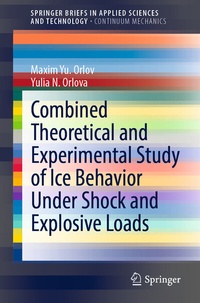
Combined Theoretical and Experimental Study of Ice Behavior Under Shock and Explosive Loads
Description

The book presents theoretical and experimental studies of ice fracturing process during impact and explosion load. It shows how to obtain ice in natural and artificial conditions. The book summarizes the results of full-scale experiments for 5 years on undermining ice sheets with emulsion explosives. It presents an algorithm that simulates the process of fracturing of thick ice subjected to blast load, showing that the behavior of ice under impact and explosive loads can be described by a model of continuum mechanics. Qualitative and quantitative assessments of the ballistic perfomance of an ice cube after deep penetration low-velocity projectiles are reported in this book. Some pilot problems are formulated for a deeper understanding of the mechanics of ice fracturing during impact and explosion.
More details
Other editions
Additional editions
Persons
Dr. Maxim Yu. Orlov is a senior researcher in the Strength Laboratory of Research Institute of Applied Mathematics and Mechanics, at Tomsk State University, Russia. He was scientific adviser on scientific projects supported by the Russian Foundation for Basic Research, Bortnik Foundation, Federal Target Program "Scientific and Scientific-Pedagogical personnel innovative Russia -2013", Grant of Research and Education Center "Physics and Chemistry of High-Energy" and Fund of Scientific Grants of the President of the Russia. He is member of the International Association on Protective Structure, Impact Engineering and Light Weight Armour Group (LWAG). His research interests include protective structures and impact resistance, numerical modelling and simulation, continuum mechanics and material design, ballistics performance, and impact resistance of advanced materials.
Dr. Yulia N. Orlova is an associate professor in the Department of Petroleum Engineering, School of Natural Resources Engineering, at Tomsk Polytechnic University. Russia. She successfully defended her PhD thesis in Deformable Solid Mechanics in 2015 at the Tomsk State University. Her dissertation is devoted to the study of the processes of ice failure under shock and explosive loads. She teaches several disciplines, including "Subsurface fluid mechanics", "Monitoring and regulation of oil recovery processes", "Fundamentals of oil and gas field development" and others. She was scientific adviser on scientific projects supported by the Russian Foundation for Basic Research and Federal Target Program "Scientific and Scientific-Pedagogical personnel innovative Russia - 2013". She trained at the Bauman Moscow State Technical University (Moscow), the Baltic State Technical University "Voenmekh named after D.F. Ustinov" (St. Petersburg) and the Lobachevsky Nizhny Novgorod State University (N. Novgorod). Her research interests include ice mechanics, numerical simulation, a full-scale and laboratory experiments, development of ice composite.
