

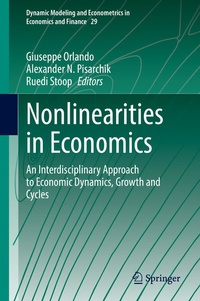
Nonlinearities in Economics
Description

This interdisciplinary book argues that the economy has an underlying non-linear structure and that business cycles are endogenous, which allows a greater explanatory power with respect to the traditional assumption that dynamics are stochastic and shocks are exogenous.
The first part of this work is formal-methodological and provides the mathematical background needed for the remainder, while the second part presents the view that signal processing involves construction and deconstruction of information and that the efficacy of this process can be measured. The third part focuses on economics and provides the related background and literature on economic dynamics and the fourth part is devoted to new perspectives in understanding nonlinearities in economic dynamics: growth and cycles.
By pursuing this approach, the book seeks to (1) determine whether, and if so where, common features exist, (2) discover some hidden features of economic dynamics, and (3)highlight specific indicators of structural changes in time series. Accordingly, it is a must read for everyone interested in a better understanding of economic dynamics, business cycles, econometrics and complex systems, as well as non-linear dynamics and chaos theory.
Reviews / Votes
"This highly-valuable book is a great entry-point for understanding the economy as a self-organizing non-linear dynamical system. This book not only introduces the reader to advanced techniques but also applies them to modern economic growth and business cycle models." ( Markus Brunnermeier , Edwards S. Sanford Professor of Economics, Director of the Bendheim Center for Finance, Princeton University, USA)More details
Other editions
Additional editions
Persons
Alexander N. Pisarchik is a Distinguished Researcher at the Center for Biomedical Technology, Technical University of Madrid (Spain). In 2013 he was appointed the Isaac-Peral Chair of Computational Systems Biology at the Center for Biomedical Technology, Technical University of Madrid in the framework of the BBVA-UPM BioTech Program. His scientific interests include nonlinear dynamics, chaos, synchronization, multistability, intermittency, and stochastic dynamics with applications to lasers, electronics, the brain, neurons and cryptography.
Ruedi Stoop is a Professor at the Institute for Neuroinformatics, University ofZurich (UZH); Swiss Federal Institute of Technology (ETH) in Zurich; the University of Bern and the Technical University Nordwestschweiz (Switzerland). A mathematician and theoretical physicist, his research focuses on biological computing, statistical physics and cochlear modelling.
