

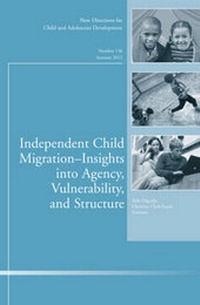
Independent Child Migrations
Insights into Agency, Vulnerability, and Structure: New Directions for Child and Adolescent Development, Number 136
Published on 4. June 2012
112 pages
978-1-118-43153-5 (ISBN)
Description

Explore the complexities of international independent child migration. This volume gives particular focus to agency and vulnerability as central concepts for understanding the diverse experiences of children who have migrated alone. Combining perspectives from academics and practitioners, the volume is filled with thought-provoking insights into the nature of current programmatic interventions for independent child migrants. It further invites critical reflection on the complex socio-economic, political, and cultural contexts in which migration decisions are taken.
Contributors recognize that independent child migrants, despite vulnerabilities, are active decision-makers in determining movement, responding to violent and discriminatory situations, resisting stereotypical assumptions, and figuring out integration and life choices as these are shaped by existing structural opportunities and constraints.
This is the 136th volume in this series. Its mission is to provide scientific and scholarly presentations on cutting edge issues and concepts in child and adolescent development. Each volume focuses on a specific new direction or research topic and is edited by experts on that topic.
More details
Other editions
Additional editions
Aida Orgocka | Christina Clark-Kazak
Independent Child Migrations: Insights into Agency, Vulnerability, and Structure
New Directions for Child and Adolescent Development, Number 136
Book
08/2012
Jossey-Bass
€47.22
Article exhausted; check different version
Content
1. Vulnerable Yet Agentic: Independent Child Migrants and Opportunity Structures 1
Aida Orgocka
This introductory piece discusses the fluidity of agency and vulnerability as central concepts that describe independent child migration and highlights the role of opportunity structure in qualifying this phenomenon.
2. Tactical Maneuvering and Calculated Risks: Independent Child Migrants and the Complex Terrain of Flight 13
Myriam Denov, Catherine Bryan
Using the conceptual framework of social navigation, this chapter highlights young people's strategies, tactical maneuvers, and calculated risks to assure their individual, and often collective, survival and wellbeing in the context of flight and resettlement.
3. Beyond Compartmentalization: A Relational Approach Towards Agency and Vulnerability of Young Migrants 29
Roy Huijsmans
Based on fieldwork material from Lao People's Democratic Republic, this chapter introduces the notions of fluid and institutionalized forms of migration as an analytical framework transcending compartmentalized approaches towards migration involving young people. This framework highlights the differing role of networks in becoming a young migrant.
4. When Children Seek Asylum from Their Parents: A Canadian Case Study 47
Michael Bossin, Laïla Demirdache
Using the case of a Mexican girl who was granted asylum in Canada on the basis of alleged abuse by her mother in Mexico, the authors show how family members may be the source of vulnerabilities for child migrants. Rapid family reunifi cation is not always in the best interests of independent child migrants.
5. Between Empowerment and Powerlessness: Separated Minors in Sweden 65
Kristina Gustafsson, Ingrid Fioretos, Eva Norström
The conceptual framework of the "liberated self" is employed to describe how the experiences of young migrants are shaped in the intersection between contexts and conditions of transnational migration and the Swedish reception system. The chapter reveals the paradox that migration serves simultaneously to empower and render children powerless.
6. Vulnerability and Agency: Beyond an Irreconcilable Dichotomy for Social Service Providers Working with Young Refugees in the UK 70
Aoife O'Higgins
Recognizing the significant barriers young refugees face in accessing comprehensive support, this chapter argues for a participatory approach that involves young migrants in processes that determine such access.
7. Conclusions, Refl ections, and Prospects for Future Research, Policy, and Programming 93
Christina Clark-Kazak
In drawing together some of the key themes from all of the contributions, this chapter highlights the importance of artificiality of categorization processes related to both migration and childhood that independent child migrants encounter, and argues for greater attention to the ways in which categories are constructed in theory and practice.
INDEX 9
