

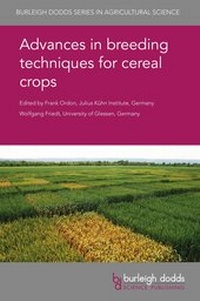
Advances in breeding techniques for cereal crops
Published on 28. June 2019
612 pages
978-1-78676-246-7 (ISBN)
Description

This book provides a comprehensive review of advances in breeding techniques for cereals such as wheat, barley maize and rye.
Part 1 discusses ways of better exploiting genetic diversity through techniques such as trait introgression. Parts 2-3 then summarise developments in the use of doubled haploids and hybrid breeding methods. Parts 4-5 review advances in high throughput phenotyping and its use in identifying markers for breeding using techniques such as genome-wide association studies and nested association mapping.
Part 1 discusses ways of better exploiting genetic diversity through techniques such as trait introgression. Parts 2-3 then summarise developments in the use of doubled haploids and hybrid breeding methods. Parts 4-5 review advances in high throughput phenotyping and its use in identifying markers for breeding using techniques such as genome-wide association studies and nested association mapping.
More details
Series
Language
English
Place of publication
Cambridge
United Kingdom
Publishing group
Burleigh Dodds
Target group
Academic researchers in cereal science; international and national agencies supporting cereal production; cereal breeding companies
Illustrations
Color tables, photos and figures
ISBN-13
978-1-78676-246-7 (9781786762467)
DOI
10.19103/AS.2019.0051
Schweitzer Classification
Other editions
Additional editions
Frank Ordon
Advances in Breeding Techniques for Cereal Crops
Book
06/2019
Burleigh Dodds Science Publishing Limited
€308.00
Shipment within 3-4 weeks
Persons
Editor
Julius Kühn-Institute (JKI), Federal Research Centre for Cultivated Plants (Germany)
Professor Frank Ordon is President of the Julius Kühn-Institute (JKI), the Federal Research Centre for Cultivated Plants in Germany. He is Honorary Professor for Molecular Resistance Breeding at the Martin-Luther University of Halle-Wittenberg, Editor-in-Chief of Plant Breeding, a member of the editorial board of several other journals and Chair of the Wheat Initiative Research Committee. He has published widely on molecular markers and improving resistance to biotic and abiotic stress especially in cereals.
Professor Frank Ordon is President of the Julius Kühn-Institute (JKI), the Federal Research Centre for Cultivated Plants in Germany. He is Honorary Professor for Molecular Resistance Breeding at the Martin-Luther University of Halle-Wittenberg, Editor-in-Chief of Plant Breeding, a member of the editorial board of several other journals and Chair of the Wheat Initiative Research Committee. He has published widely on molecular markers and improving resistance to biotic and abiotic stress especially in cereals.
Justus Liebig University of Giessen
Wolfgang Friedt is Professor Emeritus of Plant Breeding at the Justus Liebig-University of Giessen (Germany), where he has taught crop science, plant genetics and breeding. He has published widely on the genetic basis of important traits determining disease resistance, yield and quality of crop plants including cereals. Professor Friedt serves on the editorial board of two scientific journals. He is also chair or member of scientific boards for various professional organisations, including the Science Board of the Wheat Initiative.
Wolfgang Friedt is Professor Emeritus of Plant Breeding at the Justus Liebig-University of Giessen (Germany), where he has taught crop science, plant genetics and breeding. He has published widely on the genetic basis of important traits determining disease resistance, yield and quality of crop plants including cereals. Professor Friedt serves on the editorial board of two scientific journals. He is also chair or member of scientific boards for various professional organisations, including the Science Board of the Wheat Initiative.
Contributions
North Dakota State University
North Dakota State University
Leibniz Institute of Plant Genetics and Crop Plant Research (IPK)
Dr Matthew Haas holds a post-doc position at the University of Minnesota Department of Agronomy and Plant Genetics providing bioinformatics support for the wild rice (Zizania palustris) breeding and conservation project.
Dr Matthew Haas holds a post-doc position at the University of Minnesota Department of Agronomy and Plant Genetics providing bioinformatics support for the wild rice (Zizania palustris) breeding and conservation project.
Leibniz Institute of Plant Genetics and Crop Plant Research (IPK)
International Center for Agricultural Research in the Dry Areas (ICARDA)
The John Bingham Laboratory, NIAB (United Kingdom)
ICARDA
International Center for Agricultural Research in the Dry Areas (ICARDA)
International Center for Agricultural Research in the Dry Areas (ICARDA)
Justus Liebig University of Giessen
Saatzucht W. von Borries-Eckendorf (Germany)
Justus Liebig University of Giessen
Wolfgang Friedt is Professor Emeritus of Plant Breeding at the Justus Liebig-University of Giessen (Germany), where he has taught crop science, plant genetics and breeding. He has published widely on the genetic basis of important traits determining disease resistance, yield and quality of crop plants including cereals. Professor Friedt serves on the editorial board of two scientific journals. He is also chair or member of scientific boards for various professional organisations, including the Science Board of the Wheat Initiative.
Wolfgang Friedt is Professor Emeritus of Plant Breeding at the Justus Liebig-University of Giessen (Germany), where he has taught crop science, plant genetics and breeding. He has published widely on the genetic basis of important traits determining disease resistance, yield and quality of crop plants including cereals. Professor Friedt serves on the editorial board of two scientific journals. He is also chair or member of scientific boards for various professional organisations, including the Science Board of the Wheat Initiative.
Justus Liebig University Giessen (Germany)
University of Hohenheim
University of Hohenheim
University of Hohenheim
University of Hohenheim
University of Hohenheim
KWS Lochow GmbH (Germany)
ETH Zurich
ETH Zurich
ETH Zurich
KU Leuven (Belgium)
ETH Zurich
Dr Achim Walter is Professor of Crop Science and Head of the Crop Sciences Group in the Department of Environmental Systems Science in the Institute of Agricultural Sciences in ETH Zurich, Switzerland. Professor Walter is a member of the scientific advisory boards of several national and international agricultural research institutions. He is internationally-renowned for his research in image-based phenotyping of plant shoots and roots.
Dr Achim Walter is Professor of Crop Science and Head of the Crop Sciences Group in the Department of Environmental Systems Science in the Institute of Agricultural Sciences in ETH Zurich, Switzerland. Professor Walter is a member of the scientific advisory boards of several national and international agricultural research institutions. He is internationally-renowned for his research in image-based phenotyping of plant shoots and roots.
International Maize and Wheat Improvement Center (CIMMYT) (Mexico)
International Maize and Wheat Improvement Center (CIMMYT) (Mexico)
Flinders University (Australia)
Flinders University (Australia)
Flinders University (Australia)
S. Seifullin Kazakh AgroTechnical University (Kazakhstan)
S. Seifullin Kazakh AgroTechnical University (Kazakhstan)
King Abdullah University of Science and Technology
University of Bologna
Dr Roberto Tuberosa is Professor of Plant Biotechnology and Breeding in the Department of Agriculture and Food Science at the University of Bologna, Italy. Professor Tuberosa is internationally renowned for his genomic studies to dissect the genetic basis of drought resistance in cereals and how to leverage this knowledge toward the release of climate-resilient cultivars. He is on the editorial board of several leading journals, has been involved in many European and international research projects in cereal breeding, represents Europe in the International Crop Science Society (ICSS) and has published over 170 articles as well as edited a number of books. He has organised international congresses on genomics and breeding of cereals under drought conditions and is a member of the scientific board of the Wheat Initiative and of the PlantStress advisory board. Amongst other honours, Professor Tuberosa has been elected a Fellow of the Crop Society of America.
Dr Roberto Tuberosa is Professor of Plant Biotechnology and Breeding in the Department of Agriculture and Food Science at the University of Bologna, Italy. Professor Tuberosa is internationally renowned for his genomic studies to dissect the genetic basis of drought resistance in cereals and how to leverage this knowledge toward the release of climate-resilient cultivars. He is on the editorial board of several leading journals, has been involved in many European and international research projects in cereal breeding, represents Europe in the International Crop Science Society (ICSS) and has published over 170 articles as well as edited a number of books. He has organised international congresses on genomics and breeding of cereals under drought conditions and is a member of the scientific board of the Wheat Initiative and of the PlantStress advisory board. Amongst other honours, Professor Tuberosa has been elected a Fellow of the Crop Society of America.
University of Bologna
University of Bologna
University of Bonn
University of Oulu (Finland)
University of Bonn
Martin-Luther-University Halle-Wittenberg (Germany)
Martin-Luther-University Halle-Wittenberg (Germany)
International Maize and Wheat Improvement Center (CIMMYT) (Mexico)
Consejo Superior de Investigaciones Científicas (CSIC) (Spain)
Consejo Superior de Investigaciones Científicas (CSIC) (Spain)
Consejo Superior de Investigaciones Científicas (CSIC) (Spain)
University of Hohenheim
Leibniz Institute of Plant Genetics and Crop Plant Research (IPK)
Leibniz Institute of Plant Genetics and Crop Plant Research (IPK)
Leibniz Institute of Plant Genetics and Crop Plant Research (IPK)
Content
Part 1 Exploiting genetic diversity
1.Alien introgression and breeding of synthetic wheat: Wei Zhang and Xiwen Cai, North Dakota State University, USA;
2.Use of the secondary gene pool of barley in breeding improved varieties: Matthew Haas, Leibniz Institute of Plant Genetics and Crop Plant Research (IPK), Germany; and Martin Mascher, Leibniz Institute of Plant Genetics and Crop Plant Research (IPK) and German Center for Integrative Biodiversity Research, Germany;
3.Marker-assisted trait introgression for wheat breeding & research: Miguel Sanchez-Garcia, International Center for Agricultural Research in the Dry Areas (ICARDA), Morocco; and Alison Bentley, The John Bingham Laboratory, NIAB, UK;
Part 2 Doubled haploids
4.Doubled haploid production in wheat: W. Tadesse, M. Sanchez-Garcia, S. Tawkaz and M. Baum, International Center for Agricultural Research in the Dry Areas (ICARDA), Morocco;
5.Doubled haploid (DH) production for barley: Benjamin Wittkop, Justus Liebig University Giessen, Germany; László Csélènyi, Saatzucht W. von Borries-Eckendorf, Germany;
6.Production of doubled haploid lines for hybrid breeding in maize: Willem S. Molenaar and Albrecht E. Melchinger, University of Hohenheim, Germany;
Part 3 Hybrid breeding
7.Prerequisites, procedures and potential of hybrid breeding in wheat: Philipp H. G. Boeven and C. Friedrich H. Longin, University of Hohenheim, Germany;
8.Challenges and developments in hybrid breeding in barley: Timm Bernhard, Wolfgang Friedt and Benjamin Wittkop, Justus Liebig University Giessen, Germany;
9.Selection strategies in hybrid rye with special consideration of fungal disease resistances: Thomas Miedaner, University of Hohenheim, Germany; and Peer Wilde, KWS Lochow GmbH, Germany;
Part 4 High throughput phenotyping, genetic markers and QTL mapping
10.Non-invasive field phenotyping of cereal development: Andreas Hund, Lukas Kronenberg and Jonas Anderegg, ETH Zurich, Switzerland; Kang Yu, KU Leuven, Belgium; and Achim Walter, ETH Zurich, Switzerland;
11.Theory and application of phenotyping in wheat for different target environments: Matthew Reynolds and Francisco Pinto, International Maize and Wheat Improvement Centre (CIMMYT), Mexico;
12.Development of single nucleotide polymorphism (SNP) markers for cereal breeding and crop research: current methods and future prospects: Carly Schramm, Yuri Shavrukov and Peter Anderson, Flinders University, Australia; and Akhylbek Kurishbaev and Satyvaldy Jatayev, S. Seifullin Kazakh AgroTechnical University, Kazahkstan;
13.Mapping and isolation of major resistance genes in cereals: Jan Bettgenhauser and Simon G. Krattinger, King Abdullah University of Science and Technology, Saudi Arabia;
14.Leveraging the QTLome to enhance climate change resilience in cereals: Roberto Tuberosa, Marco Maccaferri and Silvio Salvi, University of Bologna, Italy;
15.Advances in statistical methods to handle large data sets for genome-wide association mapping in crop breeding: Boby Mathew, University of Bonn, Germany; Mikko J. Sillanpää, University of Oulu, Finland; and Jens Léon, University of Bonn, Germany;
16.Nested association mapping in barley to identify extractable trait genes: Andreas Maurer and Klaus Pillen, Martin-Luther-University Halle Wittenberg, Germany;
Part 5 Genome-wide association studies and genomic selection
17.Genome-wide association studies (GWAS) in wheat: Susanne Dreisigacker, International Maize and Wheat Improvement Center (CIMMYT), Mexico;
18.Genome-wide association studies (GWAS) in barley: Ernesto Igartua, Carlos P. Cantalapiedra and Ana M. Casas, Consejo Superior de Investigaciones Científicas (CSIC), Spain;
19.Genomic prediction in cereals: advantages and drawbacks: Patrick Thorwarth, University of Hohenheim, Germany;
20.Site-directed genome modification in barley and wheat: Jochen Kumlehn, Stefan Hiekel and Nagaveni Budhagatapalli, Leibniz Institute of Plant Genetics and Crop Plant Research (IPK), Germany;
1.Alien introgression and breeding of synthetic wheat: Wei Zhang and Xiwen Cai, North Dakota State University, USA;
2.Use of the secondary gene pool of barley in breeding improved varieties: Matthew Haas, Leibniz Institute of Plant Genetics and Crop Plant Research (IPK), Germany; and Martin Mascher, Leibniz Institute of Plant Genetics and Crop Plant Research (IPK) and German Center for Integrative Biodiversity Research, Germany;
3.Marker-assisted trait introgression for wheat breeding & research: Miguel Sanchez-Garcia, International Center for Agricultural Research in the Dry Areas (ICARDA), Morocco; and Alison Bentley, The John Bingham Laboratory, NIAB, UK;
Part 2 Doubled haploids
4.Doubled haploid production in wheat: W. Tadesse, M. Sanchez-Garcia, S. Tawkaz and M. Baum, International Center for Agricultural Research in the Dry Areas (ICARDA), Morocco;
5.Doubled haploid (DH) production for barley: Benjamin Wittkop, Justus Liebig University Giessen, Germany; László Csélènyi, Saatzucht W. von Borries-Eckendorf, Germany;
6.Production of doubled haploid lines for hybrid breeding in maize: Willem S. Molenaar and Albrecht E. Melchinger, University of Hohenheim, Germany;
Part 3 Hybrid breeding
7.Prerequisites, procedures and potential of hybrid breeding in wheat: Philipp H. G. Boeven and C. Friedrich H. Longin, University of Hohenheim, Germany;
8.Challenges and developments in hybrid breeding in barley: Timm Bernhard, Wolfgang Friedt and Benjamin Wittkop, Justus Liebig University Giessen, Germany;
9.Selection strategies in hybrid rye with special consideration of fungal disease resistances: Thomas Miedaner, University of Hohenheim, Germany; and Peer Wilde, KWS Lochow GmbH, Germany;
Part 4 High throughput phenotyping, genetic markers and QTL mapping
10.Non-invasive field phenotyping of cereal development: Andreas Hund, Lukas Kronenberg and Jonas Anderegg, ETH Zurich, Switzerland; Kang Yu, KU Leuven, Belgium; and Achim Walter, ETH Zurich, Switzerland;
11.Theory and application of phenotyping in wheat for different target environments: Matthew Reynolds and Francisco Pinto, International Maize and Wheat Improvement Centre (CIMMYT), Mexico;
12.Development of single nucleotide polymorphism (SNP) markers for cereal breeding and crop research: current methods and future prospects: Carly Schramm, Yuri Shavrukov and Peter Anderson, Flinders University, Australia; and Akhylbek Kurishbaev and Satyvaldy Jatayev, S. Seifullin Kazakh AgroTechnical University, Kazahkstan;
13.Mapping and isolation of major resistance genes in cereals: Jan Bettgenhauser and Simon G. Krattinger, King Abdullah University of Science and Technology, Saudi Arabia;
14.Leveraging the QTLome to enhance climate change resilience in cereals: Roberto Tuberosa, Marco Maccaferri and Silvio Salvi, University of Bologna, Italy;
15.Advances in statistical methods to handle large data sets for genome-wide association mapping in crop breeding: Boby Mathew, University of Bonn, Germany; Mikko J. Sillanpää, University of Oulu, Finland; and Jens Léon, University of Bonn, Germany;
16.Nested association mapping in barley to identify extractable trait genes: Andreas Maurer and Klaus Pillen, Martin-Luther-University Halle Wittenberg, Germany;
Part 5 Genome-wide association studies and genomic selection
17.Genome-wide association studies (GWAS) in wheat: Susanne Dreisigacker, International Maize and Wheat Improvement Center (CIMMYT), Mexico;
18.Genome-wide association studies (GWAS) in barley: Ernesto Igartua, Carlos P. Cantalapiedra and Ana M. Casas, Consejo Superior de Investigaciones Científicas (CSIC), Spain;
19.Genomic prediction in cereals: advantages and drawbacks: Patrick Thorwarth, University of Hohenheim, Germany;
20.Site-directed genome modification in barley and wheat: Jochen Kumlehn, Stefan Hiekel and Nagaveni Budhagatapalli, Leibniz Institute of Plant Genetics and Crop Plant Research (IPK), Germany;
