

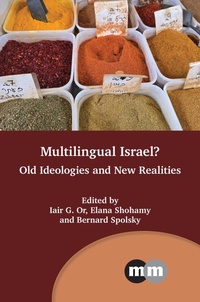
Multilingual Israel?
Old Ideologies and New Realities
Published on 2. April 2026
318 pages
978-1-78892-911-0 (ISBN)
Description

Engages directly with the delicate intersections between homogenizing state policies and the extraordinary linguistic diversity on the ground.
This book provides the most comprehensive overview to date of multilingualism in Israel, spanning Hebrew-only ideologies, immigrant and heritage languages, and grassroots community initiatives. The first section ('Ideologies') examines the persistence of monolingual Hebrew language ideologies and state efforts to regulate Yiddish, Arabic and other languages, and how such efforts have been contested in domains such as cinema, theatre, the printed press and digital media.
The second section ('Realities') explores the resilience of community languages, from Amharic and Russian to Chinese, Ladino and local sign languages, and demonstrates how community resilience and linguistic practices often prove stronger than official ideologies or state policy.
By situating multilingual practices within current political tensions, migration debates and language ideologies, the book offers essential insights for scholars, students and those interested in sociolinguistics, language policy and the complexities of Israeli society.
This book provides the most comprehensive overview to date of multilingualism in Israel, spanning Hebrew-only ideologies, immigrant and heritage languages, and grassroots community initiatives. The first section ('Ideologies') examines the persistence of monolingual Hebrew language ideologies and state efforts to regulate Yiddish, Arabic and other languages, and how such efforts have been contested in domains such as cinema, theatre, the printed press and digital media.
The second section ('Realities') explores the resilience of community languages, from Amharic and Russian to Chinese, Ladino and local sign languages, and demonstrates how community resilience and linguistic practices often prove stronger than official ideologies or state policy.
By situating multilingual practices within current political tensions, migration debates and language ideologies, the book offers essential insights for scholars, students and those interested in sociolinguistics, language policy and the complexities of Israeli society.
Reviews / Votes
An incisive tribute to Bernard Spolsky's unparalleled legacy, Multilingual Israel is a brilliant contribution to the different aspects of multilingualism research he spent a lifetime studying and shaping. Bold, timely, and deeply insightful, this volume advances the critical conversations Spolsky championed. An essential reading for anyone interested in multilingualism, identity, and politics. * Tommaso M. Milani, Penn State, USA * More than 25 years after Spolsky and Shohamy's book on multilingualism in Israel, this volume is far more than an update. It challenges the pursuit by some of uniformity, monolingualism, monoculturalism, nationalism, or extremism. The wide range of contributions and the multiple foci provide a compelling illustration of how, in Israel and beyond, multilingual policy and practice are shaped by the dynamics of globalization and mobility. This book implicitly and explicitly advocates a multilingual, multicultural, democratic, and internationally oriented society. * Piet Van Avermaet, University of Ghent, Belgium *More details
Series
Language
English
Place of publication
Bristol
United Kingdom
Target group
College/higher education
Product notice
Reflowable
File size
5,40 MB
ISBN-13
978-1-78892-911-0 (9781788929110)
Copyright in bibliographic data and cover images is held by Nielsen Book Services Limited or by the publishers or by their respective licensors: all rights reserved.
Schweitzer Classification
Other editions
Additional editions
Book
approx. 06/2026
Multilingual Matters
€173.50
Shipment within 3-4 weeks
Persons
Iair G. Or is a Lecturer at Kibbutzim College of Education and Tel Aviv University, Israel. His research interests include the instruction and language planning of Hebrew and Arabic in Israel, as well as minority language communities.
Elana Shohamy is Professor in Tel Aviv University School of Education and The Lowy International School, Israel. She is the author of many books, most recently Developing Multilingual Education Policies (co-authored with Michal Tannenbaum, Routledge, 2023).
Bernard Spolsky (1932-2022) was a Professor of English at Bar-Ilan University, Israel. His authored works include The Languages of Israel: Policy, Ideology and Practice (1999, with Elana Shohamy, Multilingual Matters) and Rethinking Language Policy (Edinburgh University Press, 2021).
Elana Shohamy is Professor in Tel Aviv University School of Education and The Lowy International School, Israel. She is the author of many books, most recently Developing Multilingual Education Policies (co-authored with Michal Tannenbaum, Routledge, 2023).
Bernard Spolsky (1932-2022) was a Professor of English at Bar-Ilan University, Israel. His authored works include The Languages of Israel: Policy, Ideology and Practice (1999, with Elana Shohamy, Multilingual Matters) and Rethinking Language Policy (Edinburgh University Press, 2021).
Content
Chapter 1. Iair G. Or, Elana Shohamy and Bernard Spolsky: Israel: A Multilingual Space Shaped by People, Media Technology, Policies, Ideologies and Needs
PART 1: IDEOLOGIES
Chapter 2. Dafna Yitzhaki: 'This Clause Does Not Harm the Status Given to the Arabic Language...' - The Nation State Law and the Status of the Arabic Language - A Language Ideology Perspective
Chapter 3. Yuval Rubovitch: The War of Languages and German-Speaking Jewry
Chapter 4. Rachel Rojanski: Was Yiddish Really Persecuted in Early Israel? The Case of the Yiddish Press
Chapter 5. Abed al-Rahman Mar'i: Ideological Dilemmas in the Use of Arabizi by Young Arab Citizens in Israel
Chapter 6. Oren Livio: Ideological Dilemmas in the Use of Arabizi by Young Arab Citizens in Israel
Chapter 7. Sarit Cofman-Simhon: Jewish Languages and Inclusivity-Exclusivity Dialectics in Israeli Theatre
Chapter 8. Sigal Yona: The Presence of Arabic in Israeli Cinema
PART 2: REALITIES
Chapter 9. Dolly Eliyahu-Levi: Abugida: Keeping the Tigrinya Language and Culture Alive
Chapter 10. Yael Gaulan and Yuli Hatzofe: Hebrew at the Margins: Language Instruction for Asylum Seekers in Israel
Chapter 11. Adam Ahmed and Lisa Richlen: Language Reclamation: A Response to the Oppressive Sudanese State and a Coping Strategy for Darfurian Asylum Seekers in Israel
Chapter 12. Belaynesh Mekonen, Monica Broido and Michal Tannenbaum: Keepers of the Flame: Mitigating Language Shift in the Ethiopian Jewish Community in Israel
Chapter 13. Wendy Sandler: The Sign Language Mosaic in Israel
Chapter 14. Marina Niznik: The Russian Israeli Community: A Language-Based Phenomenon
Chapter 15 Ivonne Lerner and Rosalie Sitman: Spanish and the Spanish-Speaking Community in Israel Today
Chapter 16 Ora (Rodrigue) Schwarzwald: Judeo-Spanish (Ladino) in Israel in a Multilingual Society
Chapter 17. Tamar Cohen-Kehat: Patterns of Maintenance: Uses and Teaching of Chinese as a Heritage Language in Chinese Communities in Israel
Chapter 18. Haitam Shehadeh: The Presence of Hebrew in the Arabic Discourse of Staff Meetings in an Arab School
Epilogue: Iair G. Or and Elana Shohamy: Multilingualism in Israel's Shifting Realities
PART 1: IDEOLOGIES
Chapter 2. Dafna Yitzhaki: 'This Clause Does Not Harm the Status Given to the Arabic Language...' - The Nation State Law and the Status of the Arabic Language - A Language Ideology Perspective
Chapter 3. Yuval Rubovitch: The War of Languages and German-Speaking Jewry
Chapter 4. Rachel Rojanski: Was Yiddish Really Persecuted in Early Israel? The Case of the Yiddish Press
Chapter 5. Abed al-Rahman Mar'i: Ideological Dilemmas in the Use of Arabizi by Young Arab Citizens in Israel
Chapter 6. Oren Livio: Ideological Dilemmas in the Use of Arabizi by Young Arab Citizens in Israel
Chapter 7. Sarit Cofman-Simhon: Jewish Languages and Inclusivity-Exclusivity Dialectics in Israeli Theatre
Chapter 8. Sigal Yona: The Presence of Arabic in Israeli Cinema
PART 2: REALITIES
Chapter 9. Dolly Eliyahu-Levi: Abugida: Keeping the Tigrinya Language and Culture Alive
Chapter 10. Yael Gaulan and Yuli Hatzofe: Hebrew at the Margins: Language Instruction for Asylum Seekers in Israel
Chapter 11. Adam Ahmed and Lisa Richlen: Language Reclamation: A Response to the Oppressive Sudanese State and a Coping Strategy for Darfurian Asylum Seekers in Israel
Chapter 12. Belaynesh Mekonen, Monica Broido and Michal Tannenbaum: Keepers of the Flame: Mitigating Language Shift in the Ethiopian Jewish Community in Israel
Chapter 13. Wendy Sandler: The Sign Language Mosaic in Israel
Chapter 14. Marina Niznik: The Russian Israeli Community: A Language-Based Phenomenon
Chapter 15 Ivonne Lerner and Rosalie Sitman: Spanish and the Spanish-Speaking Community in Israel Today
Chapter 16 Ora (Rodrigue) Schwarzwald: Judeo-Spanish (Ladino) in Israel in a Multilingual Society
Chapter 17. Tamar Cohen-Kehat: Patterns of Maintenance: Uses and Teaching of Chinese as a Heritage Language in Chinese Communities in Israel
Chapter 18. Haitam Shehadeh: The Presence of Hebrew in the Arabic Discourse of Staff Meetings in an Arab School
Epilogue: Iair G. Or and Elana Shohamy: Multilingualism in Israel's Shifting Realities
