
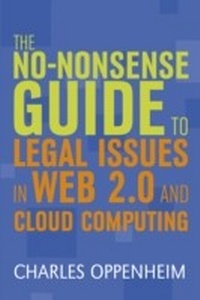
The No-nonsense Guide to Legal Issues in Web 2.0 and Cloud Computing
Description
Alles über E-Books | Antworten auf Fragen rund um E-Books, Kopierschutz und Dateiformate finden Sie in unserem Info- & Hilfebereich.
Expert hands-on advice on getting the most out of Web 2.0 and cloud computing. Applications like YouTube, Facebook, Flickr and Slideshare all raise legal problems for the information professional. Whether you're working with, managing or using Web 2.0 or cloud computing applications you will need to be able to assess and manage risk effectively. This no-nonsense practical working tool will make the relevant legal principles simple to understand for those with little or no experience and make common problems quick to solve when you're struggling with daily deadlines. Each chapter starts with an accessible introduction to the key areas of relevant law and the implications for Web 2.0 and cloud computing. Cross-sectoral case studies illustrate real world problems and exercises with easy-to-follow, pragmatic solutions allow you to quickly develop good practice. The relevant practice is discussed in relation to these key topics:
- the major legal issues raised by Web 2.0
- an overview of copyright
- other intellectual property rights and related rights
- data protection including UK and EU law
- freedom of information
- defamation and global differences in defamation law
- cloud computing issues
- liability issues.
Readership: This is an essential toolkit for all information professionals working in public, academic or special libraries, archives or museums, who are working with, using or managing Web 2.0 or cloud computing applications. It also provides a practical introduction to the law on these topics for LIS students and academics.
All prices
More details
Other editions
Additional editions
Person
Professor Charles Oppenheim is an internationally renowned expert, speaker, author and consultant on legal issues in LIS, particularly in copyright, data protection, freedom of information and cloud computing. He is an Honorary Fellow of CILIP, a member of the Legal Advisory Board of the European Commission, and of the Libraries and Archives Copyright Alliance.

Content
System requirements
File format: PDF
Copy-Protection: Adobe-DRM (Digital Rights Management)
System requirements:
- Computer (Windows; MacOS X; Linux): Install the free reader Adobe Digital Editions prior to download (see eBook Help).
- Tablet/smartphone (Android; iOS): Install the free app Adobe Digital Editions or the app PocketBook before downloading (see eBook Help).
- E-reader: Bookeen, Kobo, Pocketbook, Sony, Tolino and many more (only limited: Kindle).
The file format PDF always displays a book page identically on any hardware. This makes PDF suitable for complex layouts such as those used in textbooks and reference books (images, tables, columns, footnotes). Unfortunately, on the small screens of e-readers or smartphones, PDFs are rather annoying, requiring too much scrolling.
This eBook uses Adobe-DRM, a „hard” copy protection. If the necessary requirements are not met, unfortunately you will not be able to open the eBook. You will therefore need to prepare your reading hardware before downloading.
Please note: We strongly recommend that you authorise using your personal Adobe ID after installation of any reading software.
For more information, see our eBook Help page.
File format: PDF
Copy protection: without DRM (Digital Rights Management)
System requirements:
- Computer (Windows; MacOS X; Linux): Use the free software Adobe Reader, Adobe Digital Editions, or any other PDF viewer of your choice (see eBook Help).
- Tablet/Smartphone (Android; iOS): Install the free app Adobe Digital Editions or another reading app for eBooks, e.g., PocketBook (see eBook Help).
- E-reader: Bookeen, Kobo, Pocketbook, Sony, Tolino and many more (only limited: Kindle).
The file format PDF always displays a book page identically on any hardware. This makes PDF suitable for complex layouts such as those used in textbooks and reference books (images, tables, columns, footnotes). Unfortunately, on the small screens of e-readers or smartphones, PDFs are rather annoying, requiring too much scrolling.
This eBook does not use copy protection or Digital Rights Management.
For more information, see our eBook Help page.