

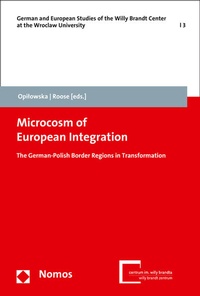
Microcosm of European Integration
The German-Polish Border Regions in Transformation
1st Edition
Published on 26. June 2015
216 pages
978-3-8452-6251-2 (ISBN)
Description

Border regions were regarded as the constellation of European integration in a nutshell. Problems and opportunities which can be found on the European level are often mirrored in local constellations in border regions. This regards the need and the opportunities of administrative and political cooperation as well as personal contact across borders. However, as the local constellation is less complex with only two or in rare incidences three countries involved, cooperation should be easier.
The aim of this volume is to take a close look at this very special PolishGerman border, particularly from the Polish side. To describe and understand the multiple patterns and shapes of cross-border links ? and especially the lack of such links ? we brought together contributions which take very different perspectives. We intend to present the scene of Polish border researchers to a wider community, to enhance exchange and provide information on this specific and particularly interesting border region to the international audience.
With contributions by:
Elzbieta Opilowska, Jochen Roose, Katarzyna Stoklosa, Maria Zielinska, Anna Bachmann, Robert Knippschild, Anja Schmotz, Kamila Dolinska, Natalia Niedzwiedzka-Iwanczak, Beata Trzop, Dorota Szaban, Krzysztof Lisowski, Tomasz Jask?w, Agnieszka Kormann
More details
Other editions
Additional editions
Elzbieta Opilowska | Jochen Roose
Microcosm of European Integration
The German-Polish Border Regions in Transformation
Book
07/2015
1st Edition
Nomos
€42.00
Shipment within 5-7 days
Persons
Content
- Cover
- Microcosm of European integration. The German-Polish border regions in transformation. Introduction
- European integration and the promises of border regions
- Polish western border in focus
- A microcosm in close-up
- References
- Border Regions as Laboratories of European Integration
- Borders on the move
- Myth-making
- Geopolitics, border regimes and identity construction
- Conclusions
- References
- The development of cross-border cooperation in Europe. The case of Germa ny and Poland
- Introduction
- The development of regional policy and cross-border cooperation in Europe
- Early cross-border cooperation in Western Europe
- The trans-border relations in the Central and Eastern European Countries. The case of Poland and Germany
- Borders and identities
- Conclusions
- References
- Toward openness and trust? Polish-German relations after Polish accession to the European Union
- Introduction
- Polish-German borderland in the process of cultural change
- A few remarks on the specifics of the Polish-German borderland
- Openness to other cultures and trust in others as theoretical and empirical constructs
- Toward openness and trust - changes in Polish-German relations
- Conclusion
- References
- Polish-German cross-border cooperation from the neofunctional perspective.
- Introduction
- Theoretical part
- Neofunctionalism and border regimes
- Variables and their operationalisation
- Regional integration and cross-border cooperation in cross-border regions
- Cross-border cooperation
- Cross-border regions
- Poland - Germany: neighbourhood
- Central level: framework for cooperation
- Regional level - a different form of cooperation
- Euroregions
- European Territorial Cooperation
- Cross-border small-scale trading (CBST) and other forms of economic interactions
- Partnerships and other forms of social interactions
- Conclusions
- References
- Seizing the opportunities of European integration? Qua?li?ty of li?fe and cross border interrelations in the German-Polish border region
- European integration in the German-Polish border region - Opportunity or threat?
- The process of European integration in the German-Polish border region between 1991 and 2014
- European spatial development policy
- Border regions = periphery?
- Quality of life and cross-border interrelations - Assumptions, research questions and research design
- Assumptions: Better quality of life through stronger cross-border interrelations
- Objectives and research questions
- Research design
- Quality of life and cross-border interrelations - Selected findings and remaining gaps
- Quality of life - perception of the border location in the Saxon-Lower Silesian borderland
- Cross-border interrelations - selected findings
- Demography - Polish citizens in Saxony
- Labour market - who's afraid of Polish workers?
- Regional economy, retail and services - (almost) no data, no cry?
- Education - where have all the students gone?
- Tourism - exceptionally stronger flows from Saxony to Lower Silesia
- Conclusions and policy options
- Lack of data on cross-border interrelations
- Mainly positive perception of the border
- Generally weak cross-border interrelations
- European integration and cross-border interrelations: differentiated trends
- Policy options: joint strategy development
- References
- Data sources
- Zgorzelec and Gubin - between Polish peripheries and a cross-border centre
- Borderland in different theoretical approaches
- Methodological background
- The residents about life in Gubin and Zgorzelec
- Conclusions
- References
- So close and yet so far... Lubuskie inhabitants on the relations with their German neighbours
- Description of Lubuskie
- Explanatory theoretical concepts
- The borderland framework
- Theories of cultural contact as a frame for explaining effects of cultural change
- Methodology
- Analysis
- Contact with Germans - an overview
- Taking advantage of the cultural and entertainment opportunities in Germany
- Economic behaviour: shopping
- Taking advantage of leisure and tourism opportunities in Germany
- References
- Open borders - closed minds. Lubusz youth on their relations with Germans
- Defining the proximity of the border
- Together or separately? Relationships with Germans
- Mutual perception - I soak it up like a sponge or I'm the pendulum?
- Conclusions
- References
- The significance of educational projects in the process of social integration in the region of Saxony and Lower Silesia
- Introduction
- The legal basis for the Polish-German trans-border cooperation
- Cross-border cooperation of Saxony with Polish partners in the field of education
- Conclusions
- References
- Saxon bilateral cooperative strategy in education policy regarding regional, historical and intercultural challenges in the Polish-German cross-border region
- Introduction
- Cross-border cooperative strategies in the field of education
- Cross-border history education
- (Inter)cultural education
- Cross-border teacher training
- Conclusions
- References
- Notes on Contributors
- The Editors
- The Authors
- Summaries and Keywords
- Katarzyna Stoklosa: Border Regions as Laboratories of European Integration
- Elzbieta Opilowska: The development of cross-border cooperation in Europe. The case of Germany and Poland
- Maria Zielinska: Toward openness and trust? Polish-German relations after Polish accession to the European Union
- Anna Bachmann: Polish-German cross-border cooperation from the neo-functional perspective
- Robert Knippschild, Anja Schmotz: Seizing the opportunities of European integration? Quality of life and cross-border interrelations in the German-Polish border region
- Kamilla Dolinska, Natalia Niedzwiecka-Iwanczak: Zgorzelec and Gubin - between Polish peripheries and a cross-border centre
- Beata Trzop: So close and yet so far... Lubuskie inhabitants on the relations with their German neighbours
- Dorota Szaban, Krzysztof Lisowski: Open borders - closed minds. Lubusz youth on their relations with Germans
- Tomasz Jasków: The significance of educational projects in the process of social integration in the region of Saxony and Lower Silesia
- Agnieszka Korman: Saxon bilateral cooperative strategy in education policy regarding regional, historical and intercultural challenges in the Polish-German cross-border region
