

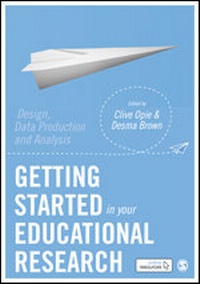
Getting Started in Your Educational Research
Design, Data Production and Analysis
1st Edition
Published on 8. April 2019
384 pages
978-1-5264-8049-1 (ISBN)
Description

A one-stop shop for anyone undertaking educational research for the first time, this text focuses on the development and application of key skills necessary for successful research.
Packed with useful exercises, checklists and case studies, this book will allow the reader to apply their skills across a range of essays, presentations and reports. Using digestible language to explain complex terminology and processes simply, the authors explore working with and presenting data and the software options available to students, including NVivo, SPSS and Excel. The text will help students to:
Understand the language of educational research
Frame their research questions and design their research
Judge the quality of educational research
Explore and justify research approaches and procedures (methods)
Analyse and present their data
Packed with useful exercises, checklists and case studies, this book will allow the reader to apply their skills across a range of essays, presentations and reports. Using digestible language to explain complex terminology and processes simply, the authors explore working with and presenting data and the software options available to students, including NVivo, SPSS and Excel. The text will help students to:
Understand the language of educational research
Frame their research questions and design their research
Judge the quality of educational research
Explore and justify research approaches and procedures (methods)
Analyse and present their data
Reviews / Votes
An exceptional introduction to research for students in education and beyond. Written by authors with in-depth understandings of student needs and research realities, and accompanied by a great wealth of additional resources, this volume constitutes a major publishing achievement. -- Christos Varvantakis This comprehensive guide to carrying out educational research will be invaluable for teachers, trainee teachers and Masters students. Each chapter guides you through the process of completing meaningful educational research, will support your own professional development and impact positively on the learners you work with. -- David Owen A book of its own kind with a few highly valuable chapters that are usually not a part of Research Books. These chapters are a great contribution as a guide and a saviour for researchers from making most common mistakes. -- Fizzi SabirMore details
Language
English
Place of publication
London
United Kingdom
Target group
College/higher education
Adult education
ISBN-13
978-1-5264-8049-1 (9781526480491)
Copyright in bibliographic data and cover images is held by Nielsen Book Services Limited or by the publishers or by their respective licensors: all rights reserved.
Schweitzer Classification
Other editions
Additional editions
Clive Opie | Desma Brown
Getting Started in Your Educational Research
Design, Data Production and Analysis
Book
04/2019
1st Edition
SAGE Publications Ltd
€142.50
Shipment within 15-20 days
Clive Opie | Desma Brown
Getting Started in Your Educational Research
Design, Data Production and Analysis
Book
04/2019
1st Edition
SAGE Publications Ltd
€77.40
Shipment within 15-20 days
Persons
In his 30-year career in higher education Clive has had a variety of extensive teaching and management roles in Sheffield University, Manchester Metropolitan University as Deputy Director of Education, and finally Bradford College as Dean of Education. Throughout his career he has maintained his teaching of research procedures and data analysis. His substantial teaching experience with undergraduates on Initial Teacher Education and Educational Studies courses, as well as practising teachers studying for their Masters, has provided him with extensive understanding of the needs of those starting their foray into educational research. In December 2013, whilst at Bradford College, he became the first person from a non-university environment to achieve the status of Principal Fellow of the Higher Education Academy. His semi-retirement has given him more opportunity to continue his attempt to try and improve his fiddle playing. Dr Desma Brown has extensive experience in the teaching of research methods at both undergraduate and postgraduate level. As Director of the MEd at Bradford College she played a key role in supervising numerous students from the initial stages of development of their research proposals through to successful completion of their dissertations. In her role as a visiting lecturer at Bishop Grosseteste University in Lincoln, she also taught research methods and worked with undergraduate Education Studies students in framing their research. Desma's current role is as the Head of Education for Kaplan Open Learning (University of Essex online). Desma's research interest is in sociolinguistics and she completed her EdD in 2016 (Open University), where she used a Discourse Analysis approach to examine how a successful group of final year trainee primary school teachers, used language to collaborate in framing their ideas and working together on an assessment task.
Content
About the Editors
About the Contributors
Acknowledgements
Preface
Online Resources
Chapter 1: Carrying Out Educational Research - The Start of Your Journey
Chapter 2: Research, Theory and Worldviews
Chapter 3: Framing the Research
Chapter 4: Literature Review
Chapter 5: Ethics
Chapter 6: Judging the Quality of Educational Research
Chapter 7: Write or Wrong? Conventions and Myths in Academic Literacy
Chapter 8: Research Approaches
Chapter 9: Research Procedures
Chapter 10: Analyzing and Presenting Your Research Data
Chapter 11: Understanding and Applying Qualitative Data Analysis
Chapter 12: Using NVivo in Your Research
Chapter 13: Understanding Quantitative Data Analysis
Chapter 14: Using Excel/SPSS in Your Research
References
About the Contributors
Acknowledgements
Preface
Online Resources
Chapter 1: Carrying Out Educational Research - The Start of Your Journey
Chapter 2: Research, Theory and Worldviews
Chapter 3: Framing the Research
Chapter 4: Literature Review
Chapter 5: Ethics
Chapter 6: Judging the Quality of Educational Research
Chapter 7: Write or Wrong? Conventions and Myths in Academic Literacy
Chapter 8: Research Approaches
Chapter 9: Research Procedures
Chapter 10: Analyzing and Presenting Your Research Data
Chapter 11: Understanding and Applying Qualitative Data Analysis
Chapter 12: Using NVivo in Your Research
Chapter 13: Understanding Quantitative Data Analysis
Chapter 14: Using Excel/SPSS in Your Research
References
