

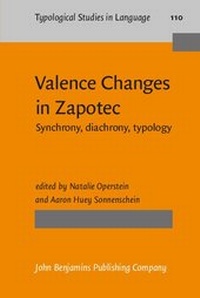
Valence Changes in Zapotec
Synchrony, diachrony, typology
1st Edition
Published on 16. December 2015
XIII, 385 pages
978-90-272-6778-8 (ISBN)
Description

Zapotec languages present a wide range of lexical, morphological, phonological, and syntactic means of indicating valence changes. Despite their significant theoretical interest, detailed descriptions of valence-changing phenomena in Zapotec are rare, comparative studies are practically non-existent, and Zapotec contributions to the general typology of valence-changing phenomena still remain largely untapped. The present volume addresses this imbalance by being the first to explore Zapotec valence-changing constructions in depth, and to highlight their broad comparative, typological, and theoretical significance. This book contains both write-ups of contributions to the Special Session on Valence-Changing Devices in Zapotecan (annual meeting of SSILA, 2012) and specially commissioned chapters. It will be of interest to Zapotecanists, Otomangueanists, Mesoamericanists, typologists, morphologists, syntacticians, semanticians, and general linguists with an interest in valence-changing phenomena, and may also be used as supplementary reading in field methods and typology courses.
More details
Other editions
Additional editions
Natalie Operstein | Aaron Huey Sonnenschein
Valence Changes in Zapotec
Synchrony, diachrony, typology
Book
12/2015
John Benjamins Publishing Co
€104.94
Shipment within 10-15 days
Persons
Content
- Intro
- Valence Changes in Zapotec
- Editorial page
- Title page
- LCC data
- Table of contents
- List of Contributors
- List of abbreviations and special symbols
- 1. Foreword
- References
- 2. Introduction
- 1. Preliminaries
- 2. Zapotec languages
- 3. The present volume
- 4. Chapter summaries
- 5. Prospects for future research
- References
- 3. Valence-altering operations in zapotec
- 1. Introduction
- 2. Structure and classification of the Zapotec verb
- 3. Overview of valence phenomena in Zapotec
- 4. Valence-increasing phenomena
- 4.1 Derivational causatives
- 4.1.1 *k-causative
- 4.1.2 *o-causative
- 4.1.3 *sse- ~ *se-causative
- 4.1.4 Redundant marking of valence increase
- 4.2 Incorporation
- 4.2.1 Preliminaries
- 4.2.2 Incorporation of the instrumental-comitative marker
- 4.2.3 Incorporation of the comparative marker
- 4.2.4 Adjective and verb incorporation
- 4.3 Periphrastic causatives
- 5. Valence-decreasing operations
- 5.1 Valence-decreasing prefixation
- 5.2 Argument incorporation
- 6. Non-directional (equipollent) valence-related alternations
- 6.1 Equipollent derivation
- 6.2 Equipollent inflection
- 7. Suppletion
- 8. Ambitransitive (labile) verbs
- 9. Prosodic changes in the vowel(s) of the verb stem
- 10. Conclusion and outlook
- References
- 4. Valence alternations in the Tlacolula Valley Zapotec lexicon
- 1. Introduction
- 2. TVZ verbs that do not change to reflect valence differences
- 2.1 Ambitransitive verbs
- 2.2 Passive/active or non-causative/causative verb pairs without no change in form
- 2.3 Positional/causative verb pairs
- 3. Verbs that include an apparent causative morpheme
- 3.1 Gw-, cw-, g-, and w- as causative markers
- 3.2 S-, z-, sa-, and su- as causative markers
- 3.3 D- as a causative marker
- 3.4 Y- as an anti-causative marker
- 4. Valence changes shown by changes in the verb base
- 4.1 Vowel alternations
- 4.2 Lenis/fortis base-initial consonant alternations
- 4.3 Other base-initial consonant alternations
- 4.4 Base-initial consonant alternations elsewhere in TVZ morphology
- 5. TVZ valence alternations and productivity
- 5.1 Irregular vowel alternations
- 5.2 Verbs with added phonological elements
- 5.3 Irregular morphosyntactic relationships
- 5.4 Causative or passive?
- 5.5 Two verbs corresponding to one
- 6. Historical comparisons
- 6.1 These relationships aren't productive
- 6.2 Relating synchronic TVZ data to Proto-Zapotec
- 6.2.1 TVZ and Proto-Zapotec *k and *o
- 6.2.2 TVZ and Proto-Zapotec *sse-/*se-
- 6.2.3 TVZ lenis/fortis alternations
- 6.2.4 Other TVZ consonant alternations
- 6.2.5 Connections with other proto-patterns
- 7. Conclusion
- References
- 5. Valence-changing morphology in San Dionisio Ocotepec Zapotec
- 1. Introduction
- 1.1 The language and its valence system
- 1.2 The relationship of San Dionisio Ocotepec Zapotec to San Pablo Güilá Zapotec
- 2. Valence alternations between v1 and v2
- 3. Morphological relationships between the v1 and v2
- 4. Equipollent relationships
- 4.1 The fortis/lenis distinction
- 4.2 Valence pairs with fortis/lenis alternations
- 4.3 Is the fortis/lenis alternation equipollent?
- 5. Valence-decreasing morphology
- 5.1 D-replacive
- 5.2 Y-replacive
- 5.3 Bi- replacive
- 6. Valence-increasing morphology
- 6.1 gu- prefix
- 6.2 /u-/ prefix or infix
- 6.3 /s-/ or /sa-/ prefix
- 7. Applicative morphology
- 7.1 Basic facts
- 7.2 Extraposition possibilities in sentences with comitatives
- 8. Conclusion
- References
- 6. Morphological valence-changing processes in juchitán zapotec
- 1. Introduction
- 2. The language
- 3. Typology and verbal morphology
- 4. Morphological valence-changing operations in vowel-initial roots
- 4.1 Group V1: More and less active verb triads
- 4.2 Group V2: Triads of less active to causative verbs
- 4.3 Group V3: Vowel-initial basic/causative pairs
- 4.4 Summary of valence paradigms for vowel-initial verbs
- 5. Morphological valence-changing operations in consonant-initial roots
- 5.1 Group C1: Causatives formed by prefixation of &-g-&
- 5.2 Group C2: Causatives formed by prefixation of &-u-&
- 5.3 Group C3: Causatives formed by prefixation of &-u-g-&
- 5.4 Group C4: Causatives formed by prefixation of &-u-zi-& and &-u-si-&
- 5.5 Summary
- 6. Equipollent verbs
- 7. Discussion and conclusion
- References
- 7. Valence-changing operations in Coatecas Altas Zapotec
- 1. Introduction
- 2. Coatecas Altas verbs
- 2.1 Intransitive and transitive verbs
- 2.2 "Experiencer" verbs
- 3. Valence-increasing devices
- 3.1 Derivational causatives
- 3.1.1 *k-causative
- 3.1.2 *sse~*se-causative
- 3.1.3 Other causative prefixation
- 3.2 Inflectional causatives
- 3.3 Lexical and paradigmatic suppletion
- 3.4 Syntactic causatives
- 3.5 Incorporation
- 3.5.1 Comitative incorporation
- 3.5.2 Dative marker incorporation
- 3.5.3 Adjective incorporation
- 4. Valence-decreasing devices
- 4.1 Experiencer/anticausative verbs
- 4.2 Stative
- 4.3 Object Incorporation
- 4.4 Reflexives and reciprocals
- 5. Conclusions and topics for further study
- References
- 8. Valency-changing devices in two Southern Zapotec languages
- 1. Introduction
- 2. Valency-increasing devices
- 2.1 Derivational causatives
- 2.1.1 The *k- causative
- 2.1.2 The (historical) *o causative
- 2.2 Inflectional causatives
- 2.2.1 The (historical) *o causative
- 2.2.2 Transitivity patterns marked by verb class
- 2.3 Causative auxiliary
- 2.4 Lexical(ized) causatives and paradigmatic suppletion
- 2.5 Incorporation
- 2.5.1 Incorporation of the comitative marker
- 2.5.2 Adjective incorporation
- 3. Valency-decreasing devices
- 3.1 Replacives
- 3.2 Intransitive (anticausative) y
- 3.2.1 Intransitive y paired with replacives
- 3.2.2 Intransitive y as palatalization
- 3.2.3 Intransitive y with V-stems
- 3.3 Noun incorporation
- 4. Derivations of ambiguous directionality
- 4.1 Feature loss
- 4.2 Tonl changes in Coatec
- 5. Conclusion
- References
- 9. Valence-changing operations in Zaniza Zapotec
- 1. Introduction
- 2. Directional valence-altering operations
- 2.1 Morphological valence-increasing operations
- 2.1.1 Derivational causatives
- 2.1.2 Inflectional causatives
- 2.2 Analytical valence-increasing operations
- 2.2.1 Incorporation of nu ~ du 'be with'
- 2.2.2 Analytical causatives
- 2.3 Morphological valence-decreasing operation: Anticausative
- 2.4 Analytical valence-decreasing operation: Object incorporation
- 3. Non-directional valence-altering operations
- 3.1 Lexical means
- 3.2 Morphological means
- 3.3 Analytical means
- 3.3.1 Ambitransitive verbs
- 3.3.2 Adjective incorporation
- 4. Summary and outlook
- References
- 10. Agency and verb valence in Lachixío Zapotec
- 1. Introduction
- 2. Inflectional classes of the Zapotec verb
- 3. Valence-increasing devices
- 3.1 *k-causative
- 3.2 *o-causative
- 3.3 Active pronominal marking: The /=né/ enclitic
- 3.3.1 /=né/ throughout the paradigm
- 3.3.2 /=né/ only with the potential mood
- 3.3.4 /=né/ in statives
- 3.3.5 /=né/ in negation
- 3.3.6 /=né/ in a conversational context
- 3.4 Glottalization of a root vowel
- 3.5 Syntactic causatives
- 3.6 Multiple marking of causation
- 4. Lexical suppletion
- 5. Valence-decreasing devices
- 5.1 Anticausative d-
- 5.2 Anticausative y-
- 6. Summary and some directions for future research
- References
- 11. Changes in valence in san andrés yaá zapotec
- 1. Overview of variation in verb valence in San Andrés Yaá Zapotec (SAYZ)
- 2. Background on SAYZ
- 3. Variation in verb base
- 3.1 Syntactico-semantic correlations
- 3.2 Verb-base alternation patterns
- 3.2.1 Patterns involving the Proto-Zapotec causative marker *k-
- 3.2.2 Patterns involving the Proto-Zapotec causative marker *o-
- 3.2.3 Patterns involving the Proto-Zapotec causative marker *s(s)e-
- 3.2.4 Change in phonation and additional initial segment
- 3.2.5 Equipollent pairs
- 4. Elements inserted post-verbally that increase valence
- 4.1 Suffixation of -l corresponding to proto-Zapotec *nV[-hi]
- 4.2 Incorporation of comitative -neen
- 4.3 Cliticization of comparative =x/=zh/=ch/=dzh
- 5. Reflexives and reciprocals: Potential instances of incorporation that decrease valence
- 6. Summary/goals for future
- References
- 12. Causative morphology in Macuiltianguis Zapotec
- 1. Introduction
- 2. Language background
- 2.1 Word order
- 2.2 Verbal aspectual morphology and causatives
- 2.2.1 Aspectual inflection
- 2.2.2 Morphological and syntactic causatives
- 3. The *s(s)e- causative: di-
- 3.1 Restrictions on the use of di-
- 4. The *o- causative: [u]
- 4.1 Underlying Meaning of Verb Forms
- 4.2 Is u- a distinct causative morpheme in MacZ?
- 4.2.1 Intraparadigmatic forms
- 4.2.2 Interaction with restorative and repetitive prefixes
- 4.3 The semantics of the be-/ru-/gu- inflectional class
- 4.4 Summary: *o-
- 5. The *k- prefix
- 6. Morpheme co-occurrences
- 7. Concluding remarks
- References
- 13. Indirect object 'lowering' in san bartolomé zoogocho zapotec
- 1. Introduction
- 2. Background information
- 3. IO lowering in SBZZ
- 3.1 Attributive possession in SBZZ
- 3.2 Double object constructions
- 3.3 IO lowering in SBZZ
- 3.4 The basic expression of beneficiaries
- 3.5 Beneficiaries or recipients?
- 3.6 What is whose?
- 4. The covert subject construction
- 4.1 Introduction
- 4.2 Binding conditions
- 5. IO lowering in Mayan languages and External Possession
- 6. Conclusions
- References
- 14. Zapotec reciprocals
- 1. Introduction
- 2. Reciprocals in Tlacolula Valley Zapotec
- 2.1 Free reciprocal constructions
- 2.2 Free reciprocal prepositional objects
- 2.3 Free reciprocal possessors
- 2.4 What is sa'ah?
- 2.5 Bound reciprocal constructions
- 2.6 Reciprocal constructions in other Zapotec languages
- 3. Other languages with free reciprocals
- 3.1 Coatec Zapotec
- 3.2 Coatecas Altas Zapotec
- 4. Other languages with bound reciprocals
- 4.1 Quiegolani Zapotec
- 4.2 Laxichío Zapotec
- 4.3 Santo Domingo Albarradas Zapotec (Dihidx Bilyáhab)
- 4.4 Isthmus Zapotec
- 5. Other languages with both types of reciprocal constructions
- 5.1 Zaniza Zapotec
- 5.2 San Andrés Yaá Zapotec
- 5.3 San Juan Yaee Zapotec
- 6. Covert subject reciprocal constructions
- 6.1 Covert subjects and reciprocals in Macuiltianguis Zapotec
- 6.2 Yalálag Zapotec
- 6.3 Zoogocho Zapotec
- 6.4 Analyzing the Covert Subject reciprocal construction
- 7. Reciprocal sentences in Colonial Valley Zapotec
- 8. Conclusions
- References
- Index
