

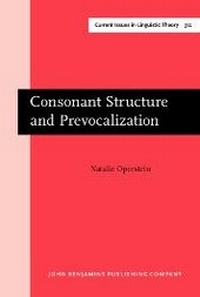
Consonant Structure and Prevocalization
1st Edition
Published on 19. May 2010
X, 234 pages
978-90-272-9090-8 (ISBN)
Description

This monograph proposes a new interpretation of the intrasegmental structure of consonants and provides the first systematic intra- and cross-linguistic study of consonant prevocalization. The proposed model represents consonants as inherently bigestural and makes strong predictions that are automatically relevant to phonological theory at both the diachronic and synchronic levels, and also to the phonetics of articulatory evolution. It also clearly demonstrates that a wide generalization of the notion of consonant prevocalization provides a uniform account for many well-known processes generally considered independent - from asynchronous palatalization in Polish to intrusive [r] in nonrhotic English, to vowel epentheses in Avestan, and to pre-/s/ vowel prothesis in Welsh. Consonant prevocalization has not played a significant role in the development of modern phonological theory to date, and this work is the first to highlight its broad theoretical significance. It develops important theoretical insights, with a wealth of supporting data and a rich bibliography. No doubt, this book will be of great interest to phonologists, phoneticians, typologists, and historical linguists.
More details
Other editions
Additional editions
Natalie Operstein
Consonant Structure and Prevocalization
Book
05/2010
John Benjamins Publishing Co
€111.30
Shipment within 10-15 days
Person
Content
- Consonant Structure and Prevocalization
- Editorial page
- Title page
- LCC page
- Table of contents
- Preface & acknowledgments
- Part 1. The theory
- Chapter 1. Consonant prevocalization
- 1.1 Goals and organization of the study
- 1.2 Data and definitions
- 1.3 Conditioning factors
- 1.4 CP and vowel diphthongization
- 1.5 Toward a theory of CP
- 1.6 Theoretical approaches
- 1.6.1 Vocalization of primary stricture
- 1.6.2 Vowel diphthongization
- 1.7 Summary and conclusion
- Chapter 2. Intrasegmental consonant structure
- 2.1 Preliminaries
- 2.2 The analytical framework
- 2.3 CP and the bigestural structure of consonants
- 2.3.1 Intrasegmental gestures
- 2.3.2 CP of secondarily modified consonants
- 2.3.3 CP of plain consonants
- 2.4 Summary and outlook
- Chapter 3. Related processes
- 3.1 Introduction
- 3.2 Consonant postvocalization
- 3.3 Syllabic consonants
- 3.4 Alternatives to CP
- 3.4.1 Vowel intrusion
- 3.4.2 (Compensatory) vowel lengthening
- 3.5 Summary and outlook
- Part 2. The data
- Chapter 4. Front prevowels
- 4.1 Introduction
- 4.2 Palatalized consonants
- 4.2.1 Preliminary considerations
- 4.2.2 Contrastively palatalized consonants
- 4.2.3 Contextually palatalized consonants
- 4.2.4 Palatal umlaut
- 4.3 Palatals
- 4.3.1 Preliminary considerations
- 4.3.2 Catalan, French, Portuguese
- 4.3.3 English
- 4.3.4 Other languages
- 4.3.5 Palatals in loanwords
- 4.4 Alveolars
- 4.4.1 Liquids
- 4.4.2 /s/
- 4.4.3 /n/
- 4.4.4 Word-final weakening
- 4.5 Summary and conclusion
- Chapter 5. Other prevowels
- 5.1 Introduction
- 5.2 Prevelarization and prelabialization
- 5.2.1 Dentals
- 5.2.2 Dark [l]
- 5.2.3 Velar nasal
- 5.2.4 Broad consonants in Gaelic
- 5.2.5 Back umlaut and breaking
- 5.2.6 Labial and labialized consonants
- 5.3 Postvelar consonants
- 5.4 Retroflex consonants
- 5.5 Summary and conclusion
- Chapter 6. Conclusions and outlook
- References
- Appendix 1. Rosapelly's vocaloid
- Appendix 2. Languages in the survey
- Index of languages
- Index of subjects and terms
