

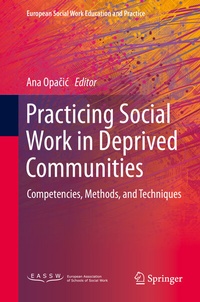
Practicing Social Work in Deprived Communities
Competencies, Methods, and Techniques
1st Edition
Published on 12. April 2021
XIV, 265 pages
978-3-030-65987-5 (ISBN)
Description

This contributed volume offers a holistic understanding of social work practice in deprived communities through its thematization of understanding deprived communities globally, the development of competencies for social work practice in and with deprived communities, social work education as a community development tool, and the empowerment of social workers in deprived communities. Inequality as a globally recognized challenge is extensively elaborated within the UN Sustainable Development Goals (SDGs) and the Global Agenda program for social work, making this a timely and important contribution to the literature.
Deprived communities, used in this book to mean slums, ghettos, favelas, and low-income, remote, underserved, vulnerable, impoverished, underdeveloped, disadvantaged, or less-favoured communities, exist worldwide and are conceptualized under different terms and concepts. For that reason, social work, specifically in deprived areas, is notsufficiently recognized as a specific field of practice within community work. As a result, this volume features contributions that:
Deprived communities, used in this book to mean slums, ghettos, favelas, and low-income, remote, underserved, vulnerable, impoverished, underdeveloped, disadvantaged, or less-favoured communities, exist worldwide and are conceptualized under different terms and concepts. For that reason, social work, specifically in deprived areas, is notsufficiently recognized as a specific field of practice within community work. As a result, this volume features contributions that:
- provide a conceptual clarification of many different terms that are used for describing deprived communities and offer a systematic literature review on community processes and effects on well-being in underdeveloped communities;
- map different fields of social work involvement in deprived communities with concrete practice examples; and,
- stress why social work as a profession needs support and how it can be empowered to improve its capacities in deprived communities.
Reviews / Votes
"Among the aims of social work is implementing measures which lead to improving people's living conditions. The reviewed book, part of the European Social Work Education and Practice series and edited by Ana Opacic, is contributing to this aim by exploring and proposing solutions for community social work in the context of deprived communities. . it can be considered a revival of social work in community development for the benefit of deprived communities." (Anca Mihai, European Journal of Social Work, Vol. 26 (2), 2023)
More details
Series
Language
English
Place of publication
Cham
Switzerland
Publishing group
Springer International Publishing
Target group
Professional and scholarly
Product notice
Reflowable
Illustrations
XIV, 265 p. 3 illus., 1 illus. in color.
File size
4,46 MB
ISBN-13
978-3-030-65987-5 (9783030659875)
DOI
10.1007/978-3-030-65987-5
Schweitzer Classification
Other editions
Additional editions
Book
04/2021
Springer
€69.54
Shipment within 7-9 days
Person
Ana Opa
cic, PhD,
is an assistant professor at the Department of Social Work within the Faculty of Law, University of Zagreb in Croatia. Her field of interest includes community social work, international social work and theory of social work. As a researcher and practitioner, she is involved in local vulnerable communities in Croatia. Ana Opacic did her PhD thesis on the conceptualization of developmentally sensitive communities in Croatia, and has published numerous articles on this topic in distinguished peer-reviewed journals. Some of the subtopics include typology of underdeveloped communities, environmental justice, social capital and post-war reconstruction.
Ana Opacic was active not solely as a researcher in deprived communities in Croatia, but was also engaged in developing service-learning programs, social services, strategic planning and evaluation of development projects. Her professional as well as personal experience is deeply connected with challenges of living in deprived communities alongside all other issues that build this experience, such as war, post-socialist transition or social inequalities.
Ana Opacic was active not solely as a researcher in deprived communities in Croatia, but was also engaged in developing service-learning programs, social services, strategic planning and evaluation of development projects. Her professional as well as personal experience is deeply connected with challenges of living in deprived communities alongside all other issues that build this experience, such as war, post-socialist transition or social inequalities.
Content
Chapter 1. Understanding Deprived Communities at the Global Level: Semantic, Operative and Theoretical Dimensions of the Phenomenon.- Chapter 2. Effects of Living in Disadvantaged Neighbourhoods on Personal Wellbeing.- Chapter 3. Principles of Community Development and Challenges Facing Deprived Communities.- Chapter 4. Listening to the Least: Engaging Communities in Development Programs in India.- Chapter 5. Searching for Local Answers to Societal Challenges: The Contribution of Civil Society Organizations and Social Innovations to Community Development.- Chapter 6. Developing Social Work Competencies to Empower Challenging Communities: From an Empty Foyer to a Shared Social Space.- Chapter 7. Accompaniment and Emergence: Social Work Community Practice with Resettled Refugees.- Chapter 8. Enhancing Poverty Reduction Through Community Work in Low Resourced Areas in Africa.- Chapter 9. Developing Smart Social Services for Mending the Gap in Development Inequalities.- Chapter 10. SocialWork Higher Education Institutions - Allies of Most Vulnerable Communities.- Chapter 11. Culture and Resource Scarcity: Social Work Practice in Canada's Remote Communities.- Chapter 12. Development of Deprived Communities Through Multidisciplinary, Interdisciplinary and Transdisciplinary Approaches.- Chapter 13. Conclusion: Full Profile of Social Work in Deprived Communities.
