

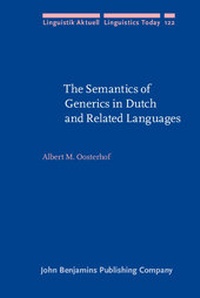
The Semantics of Generics in Dutch and Related Languages
1st Edition
Published on 25. April 2008
XVIII, 286 pages
978-90-272-9073-1 (ISBN)
Description

This monograph is a comprehensive study of the various ways in which genericity can be expressed in Dutch, dialects of Dutch, and languages related to Dutch. On the basis of empirical (corpus- and questionnaire-based) data, a wide range of topics are discussed which have been addressed in the literature on the semantics and pragmatics of generics. The empirical data presented in this book shed new light on issues crucial to the study of genericity. A number of widely accepted ideas are shown to be problematic. For example, arguments are presented against the well-known claim that progressive forms typically exclude characterizing interpretations. Furthermore, the author shows that speakers do not agree in their judgements of the acceptability of bare plurals (as well as other noun phrase types) in generic contexts. Such data are a problem for the influential thesis that bare plurals refer to kinds unambiguously.
More details
Other editions
Additional editions
Albert Oosterhof
The Semantics of Generics in Dutch and Related Languages
Book
04/2008
John Benjamins Publishing Co
€121.90
Shipment within 10-15 days
Person
Content
- The Semantics of Generics in Dutch and Related Languages
- Editorial page
- Title page
- LCC data
- Dedication
- Table of contents
- Preface and acknowledgements
- List of abbreviations
- 1. Introduction
- 1.1 Kinds and generalizations
- 1.2 Variation among speakers
- 1.3 Outline of this book
- Part I. Theoretical perspectives
- 2. Generalization
- 2.1 Introduction
- 2.2 Generalization over objects
- 2.2.1 Overt and implicit adverbial elements
- 2.2.2 Syntactic aspects
- 2.2.3 Semantic aspects
- 2.3 Habitual sentences
- 2.3.1 Arguments against a uniform analysis of characterizing and habitual sentences
- 2.3.1.1 Sentences with two frequency adverbs
- 2.3.1.2 The relation between habitual characterizing readings and aspectual information
- 2.3.1.3 Indefinite singular direct objects
- 2.3.2 Habituality and indefinite objects
- 2.3.2.1 Quantifier Raising
- 2.3.2.2 Semantic representations
- 2.3.2.3 Bare direct objects
- 2.3.2.4 Characterizing interpretations and indefinite direct objects
- 2.3.3 Concluding remarks
- 2.4 Indefinite singulars and rules and regulations readings
- 2.4.1 Cohen 2001
- 2.4.1.1 Observations
- 2.4.1.2 Representations
- 2.4.2 Drawbacks of Cohen s proposal
- 2.4.3 An alternative account Greenberg 2002
- 2.4.3.1 Some general comments
- 2.4.3.2 An account of the data in terms of accessibility relations
- 2.4.3.3 Applying Greenberg s account to Lawler s 1973 observations
- 2.4.4 The ambiguity of indefinite singulars
- 2.5 Summary
- 3. Kind reference
- 3.1 Introduction
- 3.2 Kind predicate interpretation
- 3.2.1 Observations
- 3.2.2 Semantics and representations
- 3.3 Representative object interpretation
- 3.3.1 Observations
- 3.3.2 Representations
- 3.4 Characterizing property interpretation
- 3.4.1 Definite singulars
- 3.4.1.1 Observations
- 3.4.1.2 Representations
- 3.4.2 Bare plurals
- 3.5 Taxonomic kind referring noun phrases
- 3.5.1 Observations
- 3.5.2 Representations
- 3. 6 Summary
- Part II. Empirical perspectives
- 4. The empirical base of semantic research
- 4.1 Introduction
- 4.2 Intuition based approaches
- 4.2.1 Introduction
- 4.2.2 Types of intuitions
- 4.2.2.1 Acceptability judgements about sentences under certain interpretations
- 4.2.2.2 Gradient well formedness
- 4.2.3 Justification of the use of the researcher s intuitions
- 4.2.4 A limitation of intuition based approaches conflicting intuitions
- 4.2.4.1 Bare plurals in the subject position of kind predicates
- 4.2.4.2 Definite plurals in characterizing sentences
- 4.2.5 Intuition based research in this book
- 4.2.5.1 Investigations of the judgements of groups of speakers
- 4.2.5.2 Questionnaire based research
- 4.3 Corpus based approaches
- 4.3.1 Introduction
- 4.3.2 Advantages of corpus based results
- 4.3.2.1 Bare plurals in the subject position of kind predicates
- 4.3.2.2 Definite plurals in characterizing sentences
- 4.3.3 Limitations and drawbacks of corpus based approaches
- 4.3.3.1 Subjective aspects of corpus research
- 4.3.3.2 The absence of sentence types
- 4.3.4 Corpus based approaches in this book
- 4.4 Summary and conclusions
- 5. Corpus and questionnaire based studies
- 5.1 Introduction
- 5.2 Corpus study 1 Taxonomic hierarchies
- 5.2.1 Introduction
- 5.2.2 Corpu and election of entence
- 5.2.3 Re ult
- 5.2.4 Summary and ome di cu ion of the finding
- 5.3 Corpus study 2 Nationality and animal names in Flemish and Dutch material
- 5.3.1 Introduction
- 5.3.2 Corpu and election of entence
- 5.3.3 Re ult
- 5.3.4 Summary and ome di cu ion of the finding
- 5.4 Corpus study 3 mens man and vrouw
- 5.4.1 Introduction
- 5.4.2 Corpu and election of entence
- 5.4.3 Re ult
- 5.4.4 Summary of the finding
- 5.5 Questionnaire study Genericity in local or regional varieties of Dutch and Frisian
- 5.5.1 Introduction
- 5.5.2 Methodology and election of entence
- 5.5.3 Result
- 5.5.3.1 Characterizing sentences with count noun phrases sentences I XIV
- 5.5.3.3 Kind predicate sentences sentences XIX XXIV
- 5.5.4 Summary and ome di cu ion of the re ult
- 5.6 Concluding remarks
- Appendix to chapter 5
- Part III. Issues in the syntax-semantics interface
- 6. The semantics of bare arguments
- 6.1 Introduction
- 6.2 Bare plurals
- 6.2.1 Introduction
- 6.2.2 Inter speaker variation
- 6.2.3 Bare plurals in non subject positions
- 6.2.3.1 Direct object position
- 6.2.3.2 Complement position in a postnominal PP
- 6.2.4 Common nouns that cannot be used to refer to kinds
- 6.2.4.1 Non well established kinds
- 6.2.4.1.3 Mens human man man and vrouw woman . There is one further interesting consequence of the hypothesis in 32 . In section 5.4 the results of a corpus study were presented that investigated the differences between the nouns mens human man man man and vrouw woman . The distinction between natural and nominal kind terms can be applied to these nouns. The Dutch common nouns man and vrouw are quite similar to stallion. For example man and vrouw correspond to analytic definitions containing a s
- 6.2.4.2 Common nouns that are located relatively high in a taxonomic hierarchy
- 6.2.4.2.2 Kinds and basic level categories. There is a potential discrepancy between our proposal and the psychological literature. According to the psychological literature it should be possible that categories are too low in a taxonomic hierarchy as well. In the relevant literature categories that are easiest to consider as distinguishable from others are called basic level categories. For biological categories Rosch 1978 32 claims that the basic level is the level of the genus. So it is actua
- 6.2.4.3 Modified common nouns
- 6.2.5 Representative object interpretation
- 6.2.6 Conclusion
- 6.3 Bare mass arguments
- 6.3.1 Introduction
- 6.3.2 Inter speaker variation
- 6.3.3 Bare mass nouns in non subject positions
- 6.3.4 Mass nouns that cannot be used to refer to kinds
- 6.3.5 Representative object interpretation
- 6.3.6 Conclusion
- 6.4 Summary and conclusions
- 7. Formal accounts of genericity reference and the syntax semantics interface
- 7.1 Introduction
- 7.1.1 The DP hypothe i
- 7.1.2 Aim and cope of thi chapter
- 7.2 Longobardi 1994
- 7.2.1 Introduction
- 7.2.2 Arguing in favour of Rai ing from N to D and the DP hypothe i
- 7.2.3 Semantic and yntactic re triction on empty determiner
- 7.2.4 The ituation in Engli h
- 7.2.5 The ill formedne of bare count ingular
- 7.2.6 Denotational and referential interpretation
- 7.2.7 The parametric propo al
- 7.2.8 Generic and the concept of expletive article
- 7.2.9 The referentiality feature
- 7.2.10 Summary
- 7.3 Problems for Longobardi s 1994 approach
- 7.3.1 Rai ing at LF
- 7.3.2 Ambiguou bare argument
- 7.3.3 The ill formedne of bare ingular count
- 7.3.4 Lexical government
- 7.3.5 The licen ing of expletive article
- 7.3.6 Final remark
- 7.4 Longobardi 2001
- 7.5 Chierchia 1998
- 7.5.1 Nominal Mapping Parameter
- 7.5.2 Blocking Principle
- 7.5.3 Avoid Structure
- 7.6 Problems for Chierchia s 1998 approach
- 7.6.1 Bare argument in the direct object po ition of kind predicate
- 7.6.2 Re triction on definite article in kind referential context
- 7.6.3 Problem related to lexical di tinction
- 7.6.3.1 Lexical semantic clases of nouns
- 7.6.3.2 Well established kinds in relation to kind predicates
- 7.6.3.3 Kind predicates
- 7.7 Final remarks
- 8. An alternative description of the syntax and semantics of articles
- 8.1 Introduction
- 8.2 Basic asumptions
- 8.2.1 Noun phra e are DP
- 8.2.2 The feature Referential and three type of determiner
- 8.3 Selectional properties of empty determiners
- 8.4 Distributional properties of empty determiners
- 8.4.1 Distributional propertie of
- 8.4.1.1 Describing distributional restrictions
- 8.4.1.2 Standard Dutch
- 8.4.1.3 Local varieties of Dutch
- 8.4.2 Distributional propertie
- 8.4.2.1 Standard Dutch
- 8.4.2.2 Local varieties of Dutch
- 8.4.3 Distributional propertie
- 8.4.3.1 Standard Dutch
- 8.4.3.2 Italian
- 8.4.4 Distributional propertie of
- 8.4.4.1 Groningen dialect
- 8.4.4.2 Standard Dutch
- 8.5 Distributional and selectional properties of definite articles
- 8.5.1 Distributional and electional properties
- 8.5.2 Distributional and electional properties
- 8.5.2.1 Standard Dutch
- 8.5.2.2 Local varieties of Dutch
- 8.5.2.2.1 Syntactic properties. In most of the local varieties investigated in chapter 5 definite singular DPs can receive kind readings cf. section 5.5.3.1.2 and section 5.5.3.3.2 table 5.19 for the presentation of the results . There is only one variety in which this is imposible the Groningen dialect of Uithuizen. In this variety sentences like 70 as well as sentences like 71 are unacceptable.
- 8.5.2.2.2 Semantic selectional properties. At the end of the previous section we pointed out that there are 13 varieties in which sentences such as 77 cf. 73 or some of the relevant sentences are acceptable.
- 8.5.3 Distributional and electional properties
- 8.5.3.1 Standard Dutch
- 8.5.3.2 German and English
- 8.5.3.3 Local varieties of Dutch
- 8.5.4 Distributional and electional properties
- 8.5.4.1 Standard Dutch
- 8.5.4.2 German and English
- 8.5.4.3 Local varieties of Dutch
- 8.6 Final remarks
- 9. Conclusions and issues for future research
- 9.1 Summary of the conclusions
- 9.1.1 Conclusions about the description of genericity in the literature
- 9.1.2 Conclusions of the corpus and questionnaire studies
- 9.1.3 Conclusions regarding issues in the syntax-semantics interface
- 9.2 Some issues for future research
- References
- Index
- The series Linguistik Aktuell/Linguistics Today
