

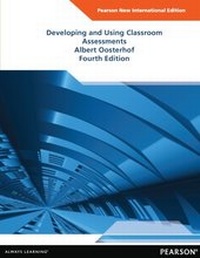
Developing and Using Classroom Assessments
Description

This brief, inexpensive text focuses on how to write, construct, and use assessments in the classroom. It continues to take a balanced approach to assessment, involving both traditional and innovative techniques. It includes the development and use of written tests, informal assessments, portfolios, and performance assessments. This balanced approach to assessment is what prospective teachers need when they get into the classroom.
All prices
More details
Other editions
Additional editions
Content
Chapter 1: Introduction
Significance of Measurement
Distinction Between Measurement, Assessment, and Evaluation
Settings Where Assessments Show Up
Distinction Between Formal and Informal Assessments
Roles of Assessment in the Classroom
Maximum Versus Typical Performance
Summary
Key terms
PART 1 - How to Establish a Framework for Assessing Your Students
Chapter 2: How Assessments Are Interpreted and Used
Frames of Reference for Interpreting Performance
Meaning of Criterion and Norm-Referenced Interpretations
Choosing the Appropriate Interpretation
Summary
Key Terms
Answers: Apply What You are Learning
Something to Try
Additional Reading
Chapter 3: Measurable Objectives and Goals
Categories of Learning Outcomes
Levels of Cognitive Complexity
Instructional Goals Versus Performance Objectives
Selecting Performances that Align with Standards
Summary
Key Terms
Answers: Apply What You are Learning
Something to Try
Additional Reading
Chapter 4: Gathering Evidence of Validity
Levels of Cognitive Complexity
Components of Performance Objectives
Instructional Goals Versus Performance Objectives
Selecting Performances that Align With Standards
Summary
Key Terms
Answers: Apply What You are Learning
Something to Try
Additional Reading
Chapter 5: Generalizing Performance
Why Observations Do Not Generalize
Methods for Detecting Inconsistencies
Techniques for Improving Generalizability
Relation of Generalizability to Validity
Summary
Key Terms
Answers: Apply What You are Learning
Something to Try
Additional Reading
PART 2 - How to Develop, Administer, and Score Written Tests
Chapter 6: Completion Items
What Completion Items Can Do
Qualities Completion Items Should Have
Practice With Applying These Desired Qualities to Completion Items
Summary
Key Terms
Answers: Apply What You Are Learning
Something to Try
Chapter 7: Essay Items
What Essay Items Can Do
Qualities Essay Items Should Have
Practice With Applying These Desired Qualities to Essay Items
Scoring Students' Responses to Essay Items
Summary
Key Terms
Answers: Apply What you are Learning
Something to Try
Additional Reading
Chapter 8: Multiple-Choice Items
What Multiple-Choice Items Can Do
Qualities Multiple-Choice Items Should Have
Practice With Applying These Desired Qualities To Multiple-Choice Items
Variations of Multiple-Choice Items
Optimal Number of Choices
Summary
Key Terms
Answers: Apply What You Are Learning
Something to Try
Additi
