

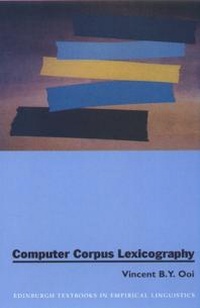
Computer Corpus Lexicography
1st Edition
Published on 6. August 2019
224 pages
978-1-4744-7145-9 (ISBN)
Description

This book introduces the reader to the changing notions of the lexicon and dictionary-making, using a convergence of perspectives from computational linguistics, corpus linguistics, and computational lexicography/lexicology. The main issues include: the relation between lexicon and corpus; corpus-based lexical modelling of language; the computational storage of the lexicon. From this, the book constructs and applies a framework for lexicon-building to a case study. It also stresses the importance of the Internet and World Wide Web for dictionary research and study.
More details
Other editions
Additional editions

Vincent B. Y. Ooi
Computer Corpus Lexicography
Book
02/1998
Edinburgh University Press
€42.50
Shipment within 15-20 days
Content
- Intro
- Contents
- Acknowledgements
- Abbreviations
- 1 What is Computer Corpus Lexicography?
- 1.0 Introduction
- 1.1 Developing Notions of the Lexicon
- 1.1.1 The trend towards lexicalism
- 1.1.2 The word vs the clause as the most basic unit inn linguistics
- 1.2 Lexical content
- 1.2.1 Characterisations of lexical content
- 1.2.2 Hudson's All-Inclusive Lexicon
- 1.2.3 The TEI Lexicon
- 1.3 Lexical form
- 1.4 Conclusion and organisation of this book
- 1.5 Study questions
- 1.6 Further reading
- Notes
- 2 The lexicon in Computational Linguistics (CL1), Computational Lexicography (CL2), and Corpus Linguistics (CL3)
- 2.0 Introduction
- 2.1 What is Computational Linguistics (CL1)?
- 2.1.1 The lexicon in CL1
- 2.2 What is Computational Lexicography (CL2)?
- 2.2.1 Human consumption vs machine-use
- 2.2.2 The lexicon in CL2
- 2.3 What is Corpus Linguistics (CL3)?
- 2.3.1 The lexicon in CL3
- 2.4 The Interdependence and Convergence of CL1, CL2, CL3
- 2.5 The TEI for the emergence of textual and lexical standards
- 2.6 The notions of the reusability of lexical resources
- 2.7 The core-reusable multifunctional lexicon
- 2.8 The polytheoretical lexicon
- 2.9 Conclusion
- 2.10 Study questions
- 2.11 Further reading
- Notes
- 3 Corpus evidence and lexicon-based language modelling
- 3.0 Introduction
- 3.1 Types of lexicographic and lexical evidence
- 3.2 The corpus as a lexical resource: the issue of representativeness
- 3.3 Corpus size and the 'Bank of English'
- 3.4 The search for units of meaning
- 3.5 Conclusion
- 3.6 Study Questions
- 3.7 Further reading
- Notes
- 4 Methods of lexical acquistion: 'Learning' a lexicon for real texts from real texts
- 4.0 Introduction
- 4.1 The relation between the lexicon and the corpus
- 4.2 Manual lexical acquisition
- 4.3 Automatic and semi-automatic lexical acquistion
- 4.4 The lexicographer/linguist's workbench for lexical acquistion
- 4.5 A framework for lexical analysis
- 4.6 Conclusion
- 4.7 Study questions
- 4.8 Further readings
- Notes
- 5. Computational storage of the lexicon
- 5.0 Introduction
- 5.1 The question of formalism
- 5.2 Lexical database vs lexical knowledge base?
- 5.3 The notion of inheritance
- 5.4 The DATR lexical knowledge representation language
- 5.5 The ACQUILEX lexical knowledge base
- 5.6 The PROLEX Prolog lexical database
- 5.7 The WORDNET Lexical database of English
- 5.8 The CELEX lexical database
- 5.8.1 THE CELEX English lexical database
- 5.8.2. The structure of the CELEX English database
- 5.8.3 Accessing the database
- 5.8.4 Selected lexemes using the CELEX linguistic codes
- 5.8.5 General comments on the CELEX database
- 5.9 Using the World Wide Web for lexical research
- 5.10 Conclusion
- 5.11 Study questions
- 5.12 Further reading
- Notes
- 6 A case study: Applying the LFA framework to two corpora of business English
- 6.0 Introduction
- 6.1 The notion of sublanguage, genre and register
- 6.2 The PROLEX corpus
- 6.2.1 The PROLEX lexicon
- 6.3 The PROCOMPARE corpus
- 6.3.1 The PROCOMPARE lexicon
- 6.4 Corpus tagging
- 6.5 Corpus syntactic parsing
- 6.6 Corpus word-extraction
- 6.7 Corpus collocation
- 6.8 Corpus semantic tagging and parsing
- 6.9 Corpus pragmatics
- 6.9.1 The COCOA format for referencing the PROLEX corpus
- 6.9.2 Extraction of typological frequency from the PROLEX corpus
- 6.10 Structuring lexical entries from the PROLEX and PROCOMPARE corpora
- 6.10.1 Morphology
- 6.10.2 Syntax
- 6.10.3 Semantics
- 6.10.4 Pragmatics
- 6.11 A discussion of the PROLEX and PROCOMPARE specimen lexical entries
- 6.11.1 Account (n)
- 6.11.2 Advise (v)
- 6.11.3 Appreciate (v)
- 6.11.4 Claim (v, n)
- 6.11.5 Full (adj)
- 6.11.6 Please (adv)
- 6.11.7 Regret (v)
- 6.11.8 Shipment (n)
- 6.11.9 The relatedness of information
- 6.11.10 Making the LFA lexicon more compact
- 6.12 Conclusion
- 6.13 Study questions
- 6.14 Further reading
- Notes
- 7 Conclusion: Towards a more adequate concept of the lexicon
- Appendix A: Specimen lexical entries
- Appendix B: Some World Wide Web sites for CL1, CL2, CL3
- Appendix C: Suggested solution to exercises
- Bibliography
- Index
