

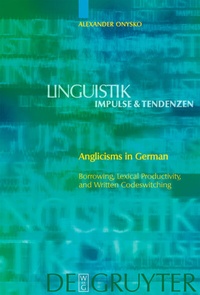
Anglicisms in German
Description

The book offers a detailed account of English influence on German based on a large scale corpus analysis of the newsmagazine 'Der Spiegel'. The study is structured into three parts covering fundamental questions and as of yet unsolved and disputed issues in the domain of anglicism research and language contact. Part 1 discusses the terminological uncertainty in the field, puts forward a model of the influence of English on German, and proposes a principled classification of the term anglicism. Part 2 portrays the numerical impact of anglicisms in an extensive corpus and draws general conclusions about the overall quantitative influence of English on German. Part 3 conclusively investigates the integration of anglicisms in German across the various lexical and syntactic paradigms. Particular focus is attributed to the salient morphological features of gender, plural, genitive case, and to verbal and adjectival inflection. Furthermore, word formational processes are substantively analyzed including compounding, derivation, and peripheral types of word formation. A functional classification of written codeswitching concludes part 3, and the book closes with a brief outlook on future challenges of anglicism research. In its breadth and detailed manner of analysis, the study sets the current standards of research in the field.
Reviews / Votes
"Alexander Onysko has definitely succeeded in reaching his research objectives. He has written a book on the use of anglicisms and codeswitching in an influential news medium showing both the numerical impact of anglicims and their functions. He has also struck a proper balance between underlying theoretical concepts and their practical application. For these reasons his results are reliable. It is to be hoped that the book reaches a large audience in order to rationalise emotional debates on the 'detrimental impact' of English on present-day German. I can recommend this work wholeheartedly to anybody seriously interested in Anglo-German language contact. The book is an important contribution to the field and can serve as a reference tool for years to come and also as a point of departure for future studies."Ulrich Busse in: Anglia 2/2008 "The book contains a wealth of observation, based not only on a solid investigation of overall quantitative patterns but also many careful and often highly insightful analyses of individual tokens in context. While in large parts it confirms findings about lexical borrowing made in earlier research, it provides a valuable contribution to a deepened understanding of the mechanisms and patterns involved on a theoretical level."Lukas Pietsch in: Journal of Language Contact 1/2008 "In this stimulating book on anglicisms in the German press, Onysko has made an important contribution to the understanding of lexical borrowings in a language contact situation. His ability to analyze the anglicisms in question and provide plausible implications of these anglicisms on the German language is a strength of this book. An additional strength is the accessibility of the German-language text, through translation or paraphrase, to a non-German speaker."Tyler K. Anderson in: http://linguistlist.org/issues/19/19-299.html "Mit seiner umfangreichen, detaillierten quantitativen und qualitativen Untersuchung von Anglizismen liefert Onysko einen wertvollen Beitrag zur Sprachkontakt- bzw. Anglizismenforschung. Durch die beispielhafte Analyse einzelner Anglizismen aus dem Korpus, die den theoretischen Rahmen überzeugend untermauert, ermöglicht die Arbeit vertiefte theoretische Erkenntnisse zum Verständnis der bei lexikalischer Entlehnung ablaufenden Prozesse."Sabine Kupper in: ZRS 3/2011More details
Other editions
Additional editions
Person
Content
- Intro
- Preface
- Contents
- Symbols and Abbreviations
- List of Figures
- List of Tables
- 1. English as a source of language influence in German
- PART I: Integrating Theories and Terminology: Borrowing, Codeswitching, Lexical Productivity, and Interference as Types of Anglicisms in German
- Overview - What is an anglicism?
- 2. Loan meaning and loan formation
- 3. Borrowing, codeswitching, and anglicism: different approaches to definition
- 4. Pseutlo anglicisms and hybrid anglicisms
- 5. Diachronic aspects of anglicisms in German: assimilation and etymology
- 6. Modelling transmission from SL to RL
- PART II: Corpus, Methods, and Frequency of Anglicisms
- Overview - Questions of research
- 7. Corpus and methods
- 8. The quantitative impact of anglicisms
- PART III: Types and Integration of Anglicisms: Structural Patterns, Word Formational Productivity, and Codeswitching
- Overview - Convergence and divergence of anglicisms
- 9. Salient morphological features of nominal anglicisms: gender, plural, and genitive case
- 10. Lexical productivity and inflectional integration of anglicisms
- 11. Codeswitching and phrasal anglicisms
- 12. Conclusion - The impact of anglicisms and its implications for the future of German
- 13. Appendices
- 14. References
- Subject index
- Anglicism Index
