

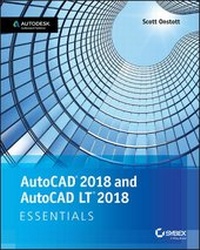
AutoCAD 2018 and AutoCAD LT 2018 Essentials
Description

More details
Other editions
Additional editions
Person
Content
- Intro
- AutoCAD® 2018 and AutoCAD LT® 2018: Essentials
- About the Author
- Acknowledgments
- Contents
- Introduction
- Chapter 1 Getting Started
- Sign In to Autodesk 360 on the Start Tab
- Exercise 1.1: Configure Autodesk 360
- Explore the AutoCAD 2018 for Windows User Interface
- Exercise 1.2: Explore the Graphical User Interface
- Exercise 1.3: Control the AutoCAD Ribbon
- Set Drawing Units
- Exercise 1.4: Set the AutoCAD Drawing Units
- Chapter 2 Gaining Basic Drawing Skills
- Navigate 2D Drawings
- Exercise 2.1: Navigate a Drawing
- Draw Lines and Rectangles
- Exercise 2.2: Draw Lines
- Exercise 2.3: Draw Rectangles
- Cancel, Erase, and Undo
- Exercise 2.4: Correct Mistakes
- Use Coordinate Systems
- Exercise 2.5: Use Absolute Coordinates
- Exercise 2.6: Use Relative Coordinates
- Exercise 2.7: Use Polar Coordinates
- Draw Circles, Arcs, and Polygons
- Exercise 2.8: Create Circles
- Exercise 2.9: Create Arcs
- Exercise 2.10: Draw Polygons
- Use Fillet and Chamfer
- Exercise 2.11: Join Nonparallel Lines
- Exercise 2.12: Join Crossed Lines with Fillet
- Chapter 3 Using Drawing Aids
- Use Grid and Snap
- Exercise 3.1: Draw with Grid and Snap
- Employ Ortho and Polar Tracking
- Exercise 3.2: Draw with Ortho and Polar Tracking
- Use PolarSnap
- Exercise 3.3: Draw with PolarSnap
- Select Running Object Snaps
- Exercise 3.4: Draw with Running Object Snaps
- Harness the From Snap
- Exercise 3.5: Use the From Snap
- Apply Object Snap Tracking
- Exercise 3.6: Use Object Snap Tracking
- Chapter 4 Editing Entities
- Create Selection Sets
- Exercise 4.1: Create a Selection Set at the Select Objects: Prompt
- Exercise 4.2: Create a Selection Set Before Deciding on a Command
- Use Move and Copy
- Exercise 4.3: Move and Copy
- Use Rotate and Scale
- Exercise 4.4: Rotate and Scale
- Work with Arrays
- Exercise 4.5: Create a Rectangular Array
- Exercise 4.6: Create a Polar Array
- Use Trim and Extend
- Exercise 4.7: Trim and Measure
- Use Lengthen and Stretch
- Exercise 4.8: Lengthen and Stretch
- Use Offset and Mirror
- Exercise 4.9: Offset and Mirror
- Edit with Grips
- Exercise 4.10: Edit with Grips
- Chapter 5 Shaping Curves
- Draw and Edit Curved Polylines
- Exercise 5.1: Draw and Edit Curved Polylines
- Draw Ellipses
- Exercise 5.2: Draw Ellipses
- Shape Splines
- Exercise 5.3: Work with Control Vertices
- Exercise 5.4: Work with Fit Points
- Blend Between Objects with Splines
- Exercise 5.5: Blend Splines
- Chapter 6 Controlling Object Visibility and Appearance
- Change Object Properties
- Exercise 6.1: Edit Object Properties
- Set the Current Layer
- Exercise 6.2: Choose the Current Layer
- Alter the Layer Assignments of Objects
- Exercise 6.3: Assign Layers
- Control Layer Visibility
- Exercise 6.4: Toggle Layer Status
- Exercise 6.5: Isolate Layers
- Exercise 6.6: Save Layer States
- Apply Linetype
- Exercise 6.7: Use Linetype
- Assign Properties by Object or by Layer
- Exercise 6.8: Assign Properties
- Manage Layer Properties
- Exercise 6.9: Control Layer Properties
- Isolate Objects
- Exercise 6.10: Isolate and Hide Individual Objects
- Chapter 7 Organizing Objects
- Define Blocks
- Exercise 7.1: Draw a Chair and Define It as a Block
- Exercise 7.2: Draw a Door and Define It as a Block
- Insert Blocks
- Exercise 7.3: Use Blocks
- Edit Blocks
- Exercise 7.4: Edit Block Definitions
- Exercise 7.5: Assign Floating Properties
- Exercise 7.6: Nest Blocks
- Exercise 7.7: Explode Blocks
- Redefine Blocks
- Exercise 7.8: Redefine Block Definitions
- Work with Groups
- Exercise 7.9: Create Groups
- Chapter 8 Hatching and Gradients
- Specify Hatch Areas
- Exercise 8.1: Pick Points to Determine Boundaries
- Exercise 8.2: Select Objects to Define Boundaries
- Associate Hatches with Boundaries
- Exercise 8.3: Associate Boundaries
- Hatch with Patterns
- Exercise 8.4: Specify Properties
- Exercise 8.5: Separate Hatch Areas
- Hatch with Gradients
- Exercise 8.6: Create Gradients
- Chapter 9 Working with Blocks and Xrefs
- Work with Global Blocks
- Exercise 9.1: Write a Local Block Definition to a File
- Exercise 9.2: Insert a Drawing as a Local Block
- Exercise 9.3: Redefine Local Blocks with Global Blocks
- Access Content Globally
- Exercise 9.4: Access Global Content
- Store Content on Tool Palettes
- Exercise 9.5: Add to the Tool Palettes
- Reference External Drawings and Images
- Exercise 9.6: Use Xrefs
- Chapter 10 Creating and Editing Text
- Style Text
- Exercise 10.1: Create Text Styles
- Write Lines of Text
- Exercise 10.2: Create Text to Fit
- Exercise 10.3: Justify Text
- Exercise 10.4: Transform and Create Text
- Write and Format Paragraphs Using MTEXT
- Exercise 10.5: Write and Format with MTEXT
- Edit Text
- Exercise 10.6: Edit Content and Properties
- Exercise 10.7: Work with Columns
- Recognize and Combine Text
- Exercise 10.8: Import, Recognize, and Combine Text from PDF
- Chapter 11 Dimensioning
- Style Dimensions
- Exercise 11.1: Create Dimension Styles
- Add Dimensions
- Exercise 11.2: Use Inquiry Commands
- Exercise 11.3: Add Dimension Objects
- Exercise 11.4: Add and Style Multileaders
- Edit Dimensions
- Exercise 11.5: Alter Dimension Objects
- Chapter 12 Keeping In Control with Constraints
- Work with Geometric Constraints
- Exercise 12.1: Use Geometric Constraints
- Apply Dimensional Constraints
- Exercise 12.2: Create Dimensional Constraints
- Constrain Objects Simultaneously with Geometry and Dimensions
- Exercise 12.3: Use Simultaneous Constraints
- Make Parametric Changes to Constrained Objects
- Exercise 12.4: Alter Constraint Parameters
- Chapter 13 Working with Layouts and Annotative Objects
- Create Annotative Styles and Objects
- Exercise 13.1: Work with Annotative Text
- Exercise 13.2: Work with Annotative Dimensions
- Create Layouts
- Exercise 13.3: Configure Layouts
- Adjust Floating Viewports
- Exercise 13.4: Work on Layout1
- Exercise 13.5: Work on Layout2
- Override Layer Properties in Layout Viewports
- Exercise 13.6: Override Layer Properties
- Draw on Layouts
- Exercise 13.7: Lay Out Geometry
- Chapter 14 Printing and Plot ting
- Configure Output Devices
- Exercise 14.1: Set Up a System Printer
- Exercise 14.2: Set Up an AutoCAD Plotter
- Create Plot Style Tables
- Exercise 14.3: Create a Named Plot Style Table
- Use Plot Style Tables
- Exercise 14.4: Configure New Drawings for Named Plot Style Tables
- Exercise 14.5: Assign Plot Styles by Layer or by Object
- Plot in Model Space
- Exercise 14.6: Plot from Model Space
- Plot Layouts in Paper Space
- Exercise 14.7: Plot from Paper Space
- Export to an Electronic Format
- Exercise 14.8: Export to DWF
- Exercise 14.9: Export to PDF
- Exercise 14.10: Share Design Views
- Chapter 15 Working with Data
- Geolocate Projects
- Exercise 15.1: Geolocate a Drawing
- Import SketchUp Models
- Exercise 15.2: Import a SketchUp Model
- Define Attributes and Blocks
- Exercise 15.3: Define Attributes and a Block
- Insert Attributed Blocks
- Exercise 15.4: Insert Block References with Attributes
- Edit Table Styles and Create Tables
- Exercise 15.5: Alter a Table Style and Make a Table
- Use Fields in Table Cells
- Exercise 15.6: Create Fields
- Edit Table Data
- Exercise 15.7: Alter Table Data
- Chapter 16 Navigating 3D Models
- Use Visual Styles
- Exercise 16.1: Explore Visual Styles
- Work with Tiled Viewports
- Exercise 16.2: Tile Viewports
- Navigate with the ViewCube
- Exercise 16.3: Use the ViewCube to Navigate
- Orbit in 3D
- Exercise 16.4: Orbit
- Use Cameras
- Exercise 16.5: Utilize Virtual Cameras
- Navigate with SteeringWheels
- Exercise 16.6: Use SteeringWheels to Navigate
- Save Views
- Exercise 16.7: Save Views
- Chapter 17 Modeling in 3D
- Create Surface Models
- Exercise 17.1: Make Planar Surfaces
- Exercise 17.2: Revolve a 2D Profile to Create a 3D Model
- Exercise 17.3: Sweep Out 3D Geometry
- Exercise 17.4: Extrude 2D Geometry into 3D
- Edit Surface Models
- Exercise 17.5: Trim Surfaces with Other Surfaces
- Exercise 17.6: Project Edges on Surfaces
- Exercise 17.7: Trim Surfaces with Edges
- Create Solid Models
- Exercise 17.8: Extrude Solid Objects
- Exercise 17.9: Loft Solid Objects
- Edit Solid Models
- Exercise 17.10: Perform Boolean Operations
- Exercise 17.11: Edit Solids
- Smooth Mesh Models
- Exercise 17.12: Create, Edit, and Smooth Mesh
- Live-Section Models
- Exercise 17.13: Create and Edit a Section Plane
- Chapter 18 Presenting and Documenting 3D Design
- Assign Materials
- Exercise 18.1: Apply Materials
- Place and Adjust Lights
- Exercise 18.2: Add Artificial Lights
- Exercise 18.3: Simulate Natural Light
- Create Renderings
- Exercise 18.4: Make Realistic Renderings in the Cloud
- Document Models with Drawings
- Exercise 18.5: Document Models
- Appendix A Making Isometric Drawings
- Appendix B AutodeskT AutoCADT 2018 Certification
- Index
- EULA
INTRODUCTION
The staying power of the AutoCAD® program is legendary in the ever-changing software industry, having been around for 36 years by the 2018 release. You can rest assured that spending your time learning AutoCAD will be a wise investment, and the skills you obtain in this book will be useful for years to come.
I welcome you in beginning the process of learning AutoCAD®. It will give you great satisfaction to learn such a complex program and use it to design and document whatever you dream up. In this book, you'll find step-by-step tutorials that reveal a wide variety of techniques built on many years of real-world experience.
The first 14 chapters apply to both AutoCAD® 2018 and AutoCAD LT® 2018. AutoCAD LT is Autodesk's lower-cost version of AutoCAD, and it has reduced capabilities. Chapters 15 through 18 are for full AutoCAD users only, because they cover advanced tools not available in AutoCAD LT, including attributes, 3D navigation, 3D modeling, and rendering.
Who Should Read This Book
This book is for students, hobbyists, professional architects, industrial designers, engineers, builders, landscape architects, or anyone who communicates through technical drawings as part of their work.
If you're interested in certification for AutoCAD 2018, this book can be a great resource to help you prepare. See www.autodesk.com/ training-and-certification/certification for more certification information and resources. This book also features appendices that can help you focus your studies on the skills you will need for the certification exams.
What You Will Learn
You'll gain a solid understanding of the features of AutoCAD in this book. Each chapter features multiple exercises that take you step by step through the many complex procedures of AutoCAD. The goal of performing these steps on your own is to develop skills that you can apply to many different real-world situations.
Although each project presents different obstacles and opportunities, I urge you to focus on the concepts and techniques presented rather than memorizing the specific steps used to achieve the desired result. The actual steps performed may vary in each geometric situation.
The best way to build skills is to perform the steps on your computer exactly as they are presented in the book during your first reading. After you achieve the desired result, start over and experiment using the same techniques on your own project (whether invented or real). After you have practiced, think about how you have achieved the desired result, and you will get the most out of this book.
Reader Requirements
You don't need any previous experience with AutoCAD to use this book. However, you'll need familiarity with either the Windows or Mac operating system and the basic skills necessary to use a graphical user interface successfully and to operate a computer confidently.
AutoCAD 2018 or AutoCAD LT 2018 System Requirements
This book was written for both AutoCAD 2018 and AutoCAD LT 2018. The following are system requirements for running either version on the different operating systems in which they are offered. See http://knowledge.autodesk .com/support/system-requirements for the most up-to-date requirements.
General System Requirements
AutoCAD 2018 runs on the following operating systems:
- Microsoft Windows 7 SP1 (32-bit & 64-bit)
- Microsoft Windows 8.1 with update KB2919355 (32-bit & 64-bit)
- Microsoft Windows 10 (64-bit only)
AutoCAD for Mac 2018 runs on the following 64-bit operating systems:
- macOS v10.12 (Sierra) or later
- OS X v10.11 (El Capitan)
- OS X v10.10 (Yosemite)
- OS X v10.9 (Mavericks)
FREE AUTODESK SOFTWARE FOR STUDENTS AND EDUCATORS
The Autodesk Education Community is an online resource with more than five million members that enables educators and students to download-for free (see website for terms and conditions)-the same software used by professionals worldwide. You can also access additional tools and materials to help you design, visualize, and simulate ideas. Connect with other learners to stay current with the latest industry trends and get the most out of your designs. Get started today at www.autodesk.com/education/free-software/featured.
What Is Covered in This Book
AutoCAD® 2018 and AutoCAD LT® 2018 Essentials is organized to provide you with the knowledge needed to master the basics of computer-aided design. The book's web page is located at www.sybex.com/go/autocad2018essentials, where you can download the sample files used in each chapter.
Chapter 1: Getting Started You'll take a tour of the user interface and learn to identify each of its parts by name. Chapter 1 is essential reading because you'll need to know the difference between workspaces, ribbon tabs, toolbars, panels, palettes, status toggles, and so on to understand the terminology used by your colleagues and in the rest of this book. In addition, you'll learn how to match your industry's standard units to the drawings you'll be creating.
Chapter 2: Gaining Basic Drawing Skills Learn how to navigate a 2D drawing with Zoom and Pan so that you can zero in on areas of interest. You'll learn how to draw lines, rectangles, circles, arcs, and polygons; how to cancel, erase, and undo; and how to fillet and chamfer lines. In addition, you'll use two coordinate systems to specify the exact sizes of objects you are drawing.
Chapter 3: Using Drawing Aids Drawing aids are something you'll want to learn how to use to create measured drawings with ease. The drawing aids covered with step-by-step exercises in this chapter include grid and snap, Ortho and Polar Tracking, PolarSnap, running object snaps, the From snap, and object snap tracking.
Chapter 4: Editing Entities This chapter teaches what you'll probably be doing most of the time in AutoCAD: editing the basic entities that you've drawn to make them conform with your design intent. Editing commands covered include Move, Copy, Rotate, Scale, Array, Trim, Extend, Lengthen, Stretch, Offset, and Mirror. In addition to these commands, you'll learn an alternative method for editing entities called grip editing.
Chapter 5: Shaping Curves The landscape exercise in this chapter teaches you how to create complex curves with NURBS-based splines, curved polylines, and ellipses. By the end, you'll be able to shape curves to create almost any curvilinear form imaginable.
Chapter 6: Controlling Object Visibility and Appearance You'll learn how to hide and reveal objects with properties and layers. Layers are essential to managing the complexity of design, and you'll use many different layer tools in this chapter's step-by-step exercises.
Chapter 7: Organizing Objects By combining entities such as lines, polylines, circles, arcs, and text into blocks and/or groups, you can more efficiently manipulate complex objects such as chairs, mechanical assemblies, trees, or any other organizational designation appropriate to your industry. You'll learn how to create and work with blocks and groups in this chapter.
Chapter 8: Hatching and Gradients In this chapter, you'll flood bounded areas with solid fill, hatch patterns, and/or gradients to indicate transitions between materials and to improve the readability of drawings in general.
Chapter 9: Working with Blocks and Xrefs You'll learn how to access content from other files in the current drawing in this chapter. You'll also understand the important distinction between inserting and externally referencing content. In addition, you'll store saved content on tool palettes for simplified reuse.
Chapter 10: Creating and Editing Text The written word is undeniably a part of every drawing. This chapter teaches you how to create both single- and multiline text, how to edit any text, and how to control its appearance through text styles and object properties.
Chapter 11: Dimensioning You'll learn how to annotate drawings with specific measurements known as dimensions in this chapter. In addition to learning how to control measurements' appearance with dimension styles, you'll create linear, aligned, angular, and radius dimension objects.
Chapter 12: Keeping In Control with Constraints This chapter teaches you how to add geometric and dimensional constraints to objects so that their ultimate form is controlled by mathematical formulas. The formulas in the examples are as simple as adding two dimensions or calculating the diameter of a circle from its radius.
Chapter 13: Working with Layouts and Annotative Objects AutoCAD has two environments, which you'll learn about in this chapter on layouts: model space and paper space. You'll create floating...
