

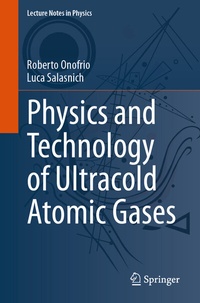
Physics and Technology of Ultracold Atomic Gases
Description

This book is based on lecture notes originally developed for introductory graduate courses offered by the authors at Dartmouth College and the University of Padova. The first two chapters analyze quantum degenerate gases and various cooling and trapping techniques for atoms. The remaining three chapters discuss ultracold atoms as weakly interacting, strongly interacting, and non-interacting coherent systems. The third chapter presents multiple pieces of evidence for quantum degeneracy in Bose and Fermi gases, followed by peculiar features such as superfluidity and the formation of topological defects. The fourth chapter addresses strongly correlated systems, discussing the BCS-BEC crossover in fermionic gases and quantum phase transitions, including their dependence on effective dimensionality. The fifth chapter offers a more specific discussion of quantum coherence in ultracold atoms and their potential as a platform for quantum metrology and quantum emulation. Four appendices provide more quantitative details of theoretical tools used in the last two chapters. Each chapter concludes with problems and a list of more specialized material. The main goal is to introduce interested students to ultracold atom physics research topics and expose scientists working in other areas of frontier physics to this novel and exciting research direction. This book is also intended to complement existing textbooks in standard courses on condensed matter physics, demonstrating how some general elements of the latter can be understood by continuously increasing the interactions between ultracold and quantum degenerate atoms under controlled external conditions.
More details
Other editions
Additional editions
Persons
Roberto Onofrio is a professor of Physics and Astronomy at the Department of Physics and Astronomy of Dartmouth College. His main research interests are in macroscopic quantum phenomena and their potential role in understanding the interplay between gravitation and the standard model of elementary particle physics. He has been a fellow of the American Physical Society since 2009.
Luca Salasnich is a professor in Theoretical Physics of Matter at the Department of Physics and Astronomy "Galileo Galilei" of the University of Padova. His fields of research are condensed matter theory and statistical physics. In particular, he studies nonlinear phenomena and macroscopic quantum effects in ultracold atomic gases and other many-body systems.
Content
Chapter 1. Quantum Degenerate Gases.-Chapter 2. Trapping and Cooling of Atoms.- Chapter 3. Ultracold Atoms as Weakly-Correlated Systems.- Chapter 4. Ultracold Atoms as Strongly-Correlated Systems.- Chapter 5. Quantum Coherence with Ultracold Atoms.
