

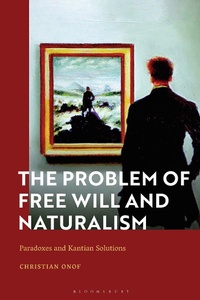
The Problem of Free Will and Naturalism
Paradoxes and Kantian Solutions
1st Edition
Published on 22. February 2024
256 pages
978-1-350-42537-8 (ISBN)
Description

The problem of free will is one of the oldest and most central philosophical conundrums. The contemporary debate around it has produced a range of sophisticated proposals, but shows no sign of leading to convergence. Christian Onof reviews these contemporary approaches and argues that their main shortcomings are ultimately due to paradoxical requirements on free will imposed by the naturalistic framework.
Onof singles out Kant's critical solution as one that stands out among historical approaches insofar as it is based upon a rejection of this framework. By using the same methodological tool that he applies to contemporary proposals, namely a distinction between a volitional account of how we control our actions, a psychological account of the reasons for it and a metaphysical account of our status as agent, Onof shows that Kant's solution constitutes a coherent picture of free will.
By exhibiting the structure running through several key publications of Kant's critical period and drawing upon unpublished notes, Onof addresses several debates which loom large in contemporary Kant literature. His exegetical work puts Kant's theory into conversation with contemporary analytic theories of free will and leads to defining a Kantian position that overcomes the issues plaguing existing approaches to the problem of free will.
Onof singles out Kant's critical solution as one that stands out among historical approaches insofar as it is based upon a rejection of this framework. By using the same methodological tool that he applies to contemporary proposals, namely a distinction between a volitional account of how we control our actions, a psychological account of the reasons for it and a metaphysical account of our status as agent, Onof shows that Kant's solution constitutes a coherent picture of free will.
By exhibiting the structure running through several key publications of Kant's critical period and drawing upon unpublished notes, Onof addresses several debates which loom large in contemporary Kant literature. His exegetical work puts Kant's theory into conversation with contemporary analytic theories of free will and leads to defining a Kantian position that overcomes the issues plaguing existing approaches to the problem of free will.
More details
Edition
1. Auflage
Language
English
Place of publication
London
United Kingdom
Publishing group
Bloomsbury Publishing PLC
Target group
Professional and scholarly
ISBN-13
978-1-350-42537-8 (9781350425378)
Copyright in bibliographic data and cover images is held by Nielsen Book Services Limited or by the publishers or by their respective licensors: all rights reserved.
Schweitzer Classification
Other editions
Additional editions
Book
08/2025
Bloomsbury Academic
€44.60
Shipment within 15-20 days
Person
Christian Onof is Honorary Research Fellow in the Department of Philosophy at Birkbeck College, UK and Reader at Imperial College London, UK.
Content
Introduction
1. Free Will and Compatibilism
2. Kant's Idealism and Compatibilism
3. Libertarian theories of free will
4. Kant's resolution of the Third Antinomy
5. Freedom in Kant's Practical Philosophy
6. The Temporal Dimension of Free Agency
7. The Kantian Solution and its Requirements
Bibliography
Index
1. Free Will and Compatibilism
2. Kant's Idealism and Compatibilism
3. Libertarian theories of free will
4. Kant's resolution of the Third Antinomy
5. Freedom in Kant's Practical Philosophy
6. The Temporal Dimension of Free Agency
7. The Kantian Solution and its Requirements
Bibliography
Index
