

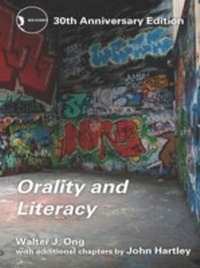
Orality and Literacy
30th Anniversary Edition
3rd Edition
Published on 7. May 2013
264 pages
978-1-136-24373-8 (ISBN)
Description

Walter J. Ong's classic work provides a fascinating insight into the social effects of oral, written, printed and electronic technologies, and their impact on philosophical, theological, scientific and literary thought.
This thirtieth anniversary edition - coinciding with Ong's centenary year - reproduces his best-known and most influential book in full and brings it up to date with two new exploratory essays by cultural writer and critic John Hartley.
Hartley provides:
A scene-setting chapter that situates Ong's work within the historical and disciplinary context of post-war Americanism and the rise of communication and media studies;
A closing chapter that follows up Ong's work on orality and literacy in relation to evolving media forms, with a discussion of recent criticisms of Ong's approach, and an assessment of his concept of the 'evolution of consciousness';
Extensive references to recent scholarship on orality, literacy and the study of knowledge technologies, tracing changes in how we know what we know.
These illuminating essays contextualize Ong within recent intellectual history, and display his work's continuing force in the ongoing study of the relationship between literature and the media, as well as that of psychology, education and sociological thought.
This thirtieth anniversary edition - coinciding with Ong's centenary year - reproduces his best-known and most influential book in full and brings it up to date with two new exploratory essays by cultural writer and critic John Hartley.
Hartley provides:
A scene-setting chapter that situates Ong's work within the historical and disciplinary context of post-war Americanism and the rise of communication and media studies;
A closing chapter that follows up Ong's work on orality and literacy in relation to evolving media forms, with a discussion of recent criticisms of Ong's approach, and an assessment of his concept of the 'evolution of consciousness';
Extensive references to recent scholarship on orality, literacy and the study of knowledge technologies, tracing changes in how we know what we know.
These illuminating essays contextualize Ong within recent intellectual history, and display his work's continuing force in the ongoing study of the relationship between literature and the media, as well as that of psychology, education and sociological thought.
More details
Series
Edition
3rd edition
Language
English
Place of publication
London
United Kingdom
Publishing group
Taylor & Francis Ltd
Target group
College/higher education
Illustrations
1 Halftones, black and white; 1 Illustrations, black and white
File size
1,52 MB
ISBN-13
978-1-136-24373-8 (9781136243738)
Copyright in bibliographic data and cover images is held by Nielsen Book Services Limited or by the publishers or by their respective licensors: all rights reserved.
Schweitzer Classification
Other editions
Additional editions
Book
09/2012
3rd Edition
Routledge
€230.65
Shipment within 15-20 days
Book
09/2012
3rd Edition
Routledge
€64.00
Shipment within 15-20 days
Persons
Walter J. Ong (30 November 1912 - 12 August 2003) was University Professor Emeritus at Saint Louis University, USA, where he was previously Professor of English and Professor of Humanities in Psychiatry. His many publications have been highly influential for studies in the evolution of consciousness.
John Hartley is an educator, author, researcher and commentator on the history and cultural impact of television, journalism, popular media and creative industries. He is Professor of Cultural Science and Director of the Centre for Culture & Technology at Curtin University, Western Australia.
John Hartley is an educator, author, researcher and commentator on the history and cultural impact of television, journalism, popular media and creative industries. He is Professor of Cultural Science and Director of the Centre for Culture & Technology at Curtin University, Western Australia.
Content
John Hartley: Before Ongism: "To become what we want to be, we have to decide what we were" Orality & Literacy: The Technologization Of The Word Introduction Part 1: The orality of language 1. The literate mind and the oral past 2. Did you say 'oral literature'? Part 2: The modern discovery of primary oral cultures 1. Early awareness of oral tradition 2. The Homeric question 3. Milman Parry's discovery 4. Consequent and related work Part 3: Some psychodynamics of orality 1. Sounded word as power and action 2. You know what you can recall: mnemonics and formulas 3. Further characteristics of orally based thought and expression 4. Additive rather than subordinative 5. Aggregative rather than analytic 6. Redundant or 'copious' 7. Conservative or traditionalist 8. Close to the human lifeworld 9. Agonistically toned 10. Empathetic and participatory rather than objectively distanced 11. Homeostatic 12. Situational rather than abstract 13. Oral memorization 14. Verbomotor lifestyle 15. The noetic role of heroic 'heavy' ?gures and of the bizarre 16. The interiority of sound 17. Orality, community and the sacral 18. Words are not signs Part 4: Writing restructures consciousness 1. The new world of autonomous discourse 2. Plato, writing and computers 3. Writing is a technology 4. What is 'writing' or 'script'? 5. Many scripts but only one alphabet 6. The onset of literacy 7. From memory to written records 8. Some dynamics of textuality 9. Distance, precision, grapholects and magnavocabularies 10. Interactions: rhetoric and the places 11. Interactions: learned languages 12. Tenaciousness of orality Part 5: Print, space and closure 1. Hearing-dominance yields to sight-dominance 2. Space and meaning 3. Indexes 4. Books, contents and labels 5. Meaningful surface 6. Typographic space 7. More diffuse effects 8. Print and closure: intertextuality 9. Post-typography: electronics Part 6: Oral memory, the story line and characterization 1. The primacy of the story line 2. Narrative and oral cultures 3. Oral memory and the story line 4. Closure of plot: travelogue to detective story 5. The 'round' character, writing and print Part 7: Some theorems 1. Literary history 2. New Criticism and Formalism 3. Structuralism 4. Textualists and deconstructionists 5. Speech-act and reader-response theory 6. Social sciences, philosophy, biblical studies 7. Orality, writing and being human 8. 'Media' versus human communication 9. The inward turn: consciousness and the text John Hartley: After Ongism: The Evolution of Networked Intelligence
